Artificial intelligence is rapidly evolving from passive response generation toward systems capable of planning, acting, coordinating tools, and operating autonomously across complex environments.
At the center of this transformation are agent systems.
Agent systems combine reasoning, memory, planning, tool usage, and orchestration into autonomous workflows that can pursue goals, execute tasks, and adapt dynamically to changing conditions.
Modern AI systems are increasingly expected not only to answer questions, but also to:
- perform actions,
- use external tools,
- retrieve information,
- execute workflows,
- coordinate with other agents,
- and operate semi-autonomously.
This hub explores the architectures, workflows, frameworks, and engineering concepts behind modern AI agent systems.
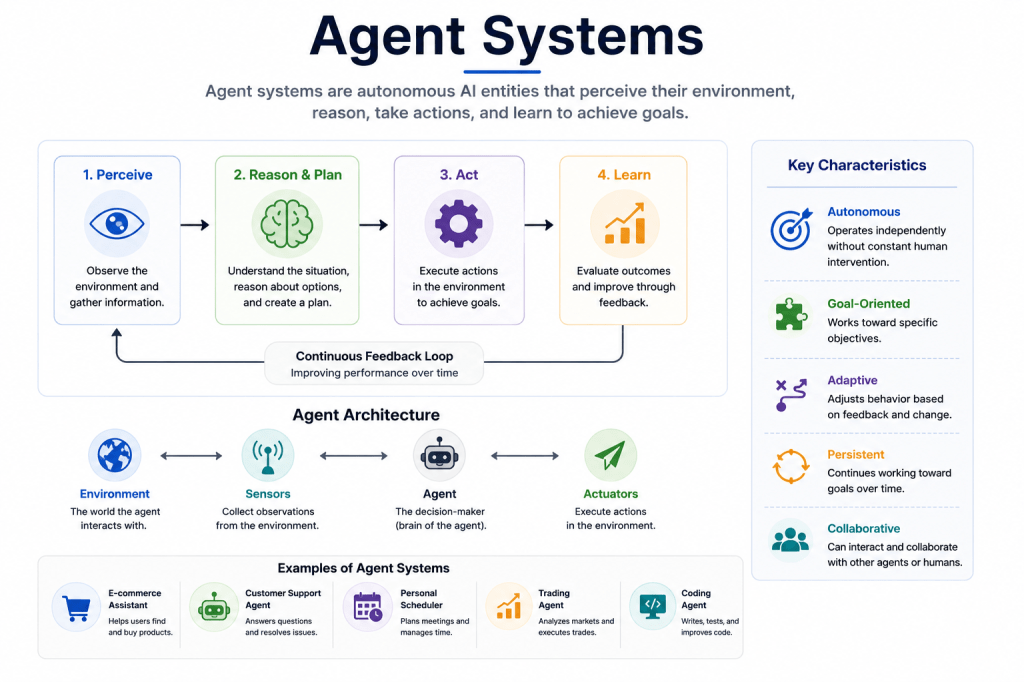
What Are Agent Systems?
An agent system is an AI architecture designed to:
- perceive information,
- reason about objectives,
- plan actions,
- use tools,
- maintain memory,
- and execute tasks autonomously.
Unlike traditional chat interfaces that generate isolated responses, agent systems are designed to pursue goals across multiple steps.
A modern AI agent may:
- search the web,
- write code,
- access APIs,
- retrieve documents,
- execute software actions,
- evaluate results,
- and revise its strategy.
Agent systems represent one of the most important transitions in modern artificial intelligence:
from static generation toward autonomous problem-solving systems.
Why Agent Systems Matter
Large language models alone are powerful, but they still have important limitations.
Traditional models often:
- lose context over long tasks,
- struggle with planning,
- hallucinate information,
- fail at execution,
- and cannot directly interact with external environments.
Agent systems attempt to overcome these limitations by combining:
- reasoning architectures,
- memory systems,
- external tools,
- orchestration layers,
- planning loops,
- and verification mechanisms.
This enables AI systems to move beyond:
“Generate an answer.”
Toward:
“Understand a goal, create a plan, execute actions, evaluate outcomes, and adapt dynamically.”
Core Components of Agent Systems
Modern AI agents typically combine several architectural components.
Planning Systems
Planning systems allow agents to:
- decompose tasks,
- prioritize actions,
- sequence operations,
- and adapt strategies.
Instead of responding immediately, planning agents may:
- analyze the objective,
- create subgoals,
- execute steps,
- monitor outcomes,
- and revise plans when necessary.
Planning architectures are foundational to:
- autonomous workflows,
- coding agents,
- research systems,
- and enterprise automation.
Related articles:
- What Are Planning Agents?
- Task Decomposition in AI Systems
- Goal-Oriented Agent Architectures
- Deliberative Planning Systems
Tool Use and Tool Calling
Modern agents increasingly rely on external tools.
An agent may interact with:
- APIs,
- databases,
- browsers,
- spreadsheets,
- vector databases,
- shell environments,
- or software applications.
Tool use transforms language models into actionable systems capable of interacting with real-world environments.
Tool-augmented agents can:
- retrieve live information,
- execute code,
- manipulate files,
- automate workflows,
- and validate results.
Related articles:
- Tool Calling Explained
- AI Agents and External APIs
- Retrieval-Augmented Agents
- Function Calling Architectures
Agent Memory Systems
Memory systems help agents maintain context across extended workflows.
Without memory, agents struggle with:
- long tasks,
- evolving objectives,
- persistent state,
- and multi-step coordination.
Agent memory may include:
- short-term conversational memory,
- long-term vector memory,
- episodic memory,
- semantic memory,
- and structured task history.
Memory architectures are becoming increasingly important for:
- personalized assistants,
- autonomous workflows,
- and persistent AI systems.
Related articles:
- Memory Architectures for AI Agents
- Vector Memory Systems
- Episodic Memory in Autonomous AI
- Long-Term Context Management
Multi-Agent Systems
Some AI systems distribute tasks across multiple specialized agents.
Instead of relying on a single monolithic model, multi-agent architectures may include:
- planner agents,
- researcher agents,
- coding agents,
- verifier agents,
- and orchestration agents.
Multi-agent systems can improve:
- scalability,
- specialization,
- fault tolerance,
- parallelism,
- and reasoning quality.
These systems are becoming increasingly important in:
- enterprise automation,
- software engineering,
- scientific workflows,
- and autonomous research systems.
Related articles:
- Multi-Agent Architectures Explained
- Agent Communication Protocols
- Cooperative AI Systems
- Distributed Reasoning Agents
Reflection and Self-Correction
Advanced agents increasingly incorporate reflection loops.
A reflective agent may:
- generate a plan,
- evaluate weaknesses,
- revise actions,
- and iterate toward stronger outcomes.
Reflection systems improve:
- reliability,
- reasoning quality,
- coding accuracy,
- and long-horizon task completion.
Reflection architectures are becoming central to autonomous agent design.
Related articles:
- Reflection Loops in AI Agents
- Self-Correcting Systems
- Iterative Agent Architectures
- Self-Critique Frameworks
Orchestration Systems
Orchestration systems coordinate workflows between:
- models,
- agents,
- tools,
- memory systems,
- and execution layers.
Modern orchestration frameworks help manage:
- task routing,
- agent communication,
- execution order,
- retries,
- verification,
- and workflow state.
As agent systems grow more complex, orchestration is becoming a major engineering discipline.
Related articles:
- AI Orchestration Explained
- Workflow Routing Systems
- Agent Coordination Frameworks
- Stateful Agent Pipelines
ReAct and Hybrid Agent Frameworks
Many modern agent systems combine:
- reasoning,
- action,
- observation,
- and iteration.
One influential example is the ReAct framework:
Reason → Act → Observe → Repeat.
This hybrid reasoning-action pattern allows agents to:
- think through problems,
- perform actions,
- evaluate results,
- and refine decisions dynamically.
Related articles:
- ReAct Framework Explained
- Hybrid Reasoning Systems
- Action-Oriented AI Architectures
- Observation-Driven Agents
Autonomous Workflows
One of the major goals of agent systems is workflow automation.
Autonomous AI workflows may:
- monitor systems,
- analyze data,
- generate reports,
- interact with APIs,
- update databases,
- and coordinate multi-step business operations.
This is becoming increasingly important in:
- enterprise operations,
- cybersecurity,
- software engineering,
- customer support,
- and research automation.
Related articles:
- Autonomous Workflow Systems
- AI Operations Pipelines
- AI Agents for Enterprise Automation
- Event-Driven AI Systems
Agent Evaluation and Reliability
As agents become more autonomous, evaluation becomes increasingly important.
Key challenges include:
- hallucinations,
- tool misuse,
- reasoning failures,
- unsafe execution,
- and unreliable planning.
Modern agent evaluation focuses on:
- task completion,
- reasoning consistency,
- action reliability,
- execution safety,
- and robustness.
Related articles:
- Evaluating AI Agents
- Agent Reliability Metrics
- Hallucination Detection in Autonomous Systems
- Safety and Verification for AI Agents
Emerging Trends in Agent Systems
The field of agent systems is evolving rapidly.
Major emerging trends include:
- autonomous coding agents,
- memory-augmented agents,
- persistent AI assistants,
- multi-agent orchestration,
- reasoning-aware planning,
- cognitive routing systems,
- and enterprise-scale AI workflows.
The industry is increasingly moving toward:
systems that can reason, plan, coordinate, and act autonomously.
Agent Systems and Reasoning Architectures
Reasoning architectures and agent systems are deeply connected.
Autonomous agents rely heavily on:
- planning,
- reflection,
- verification,
- memory,
- and structured reasoning.
Without robust reasoning mechanisms, autonomous agents become unreliable.
This is why modern AI development is increasingly converging around:
- reasoning systems,
- cognitive architectures,
- and autonomous agent engineering.
Practical Applications of Agent Systems
Agent systems are already being deployed across:
- software engineering,
- customer support,
- cybersecurity,
- enterprise automation,
- scientific research,
- robotics,
- finance,
- and operational workflows.
Examples include:
- coding copilots,
- autonomous research agents,
- AI workflow assistants,
- monitoring systems,
- and intelligent orchestration pipelines.
As reasoning capabilities improve, agent systems are likely to become one of the foundational layers of modern software systems.
Python and Practical Implementations
ReasoningSystems.org focuses not only on concepts, but also on implementation.
Throughout the Agent Systems hub, you will find:
- Python tutorials,
- orchestration workflows,
- tool-calling examples,
- planning agents,
- memory systems,
- multi-agent pipelines,
- and GitHub-linked projects.
The goal is to understand not only:
what agent systems are,
but also:
how they can be designed, built, tested, and deployed.
Explore the Agent Systems Hub
This hub serves as a central entry point for understanding how autonomous AI systems:
- reason,
- plan,
- coordinate,
- use tools,
- maintain memory,
- and execute complex workflows.
Whether you are:
- building AI agents,
- experimenting with orchestration systems,
- studying autonomous AI,
- or exploring the future of intelligent workflows,
agent systems are rapidly becoming one of the defining engineering disciplines in modern artificial intelligence.
Recommended Starting Articles
- What Are AI Agents?
- Planning Systems in Autonomous AI
- Tool Calling Explained
- Memory Architectures for AI Agents
- Multi-Agent Systems Explained
- Reflection Loops in AI Agents
- ReAct Framework Explained
- Autonomous Workflow Systems
- AI Orchestration Explained
- Evaluating AI Agents
 Reasoning Systems