Modern reasoning AI systems are not built from theory alone.
Behind autonomous agents, planning systems, reflection loops, orchestration frameworks, and reasoning pipelines lies practical engineering — and Python has become one of the most important languages driving this ecosystem.
The goal of this hub is simple:
Understand how reasoning systems are actually built.
This section focuses on:
- hands-on implementations,
- practical experimentation,
- reasoning workflows,
- orchestration patterns,
- and Python-based AI system engineering.
Whether you are building:
- autonomous agents,
- multi-step reasoning systems,
- reflection loops,
- tool-calling architectures,
- or evaluation pipelines,
Python has become one of the foundational tools powering modern reasoning AI development.
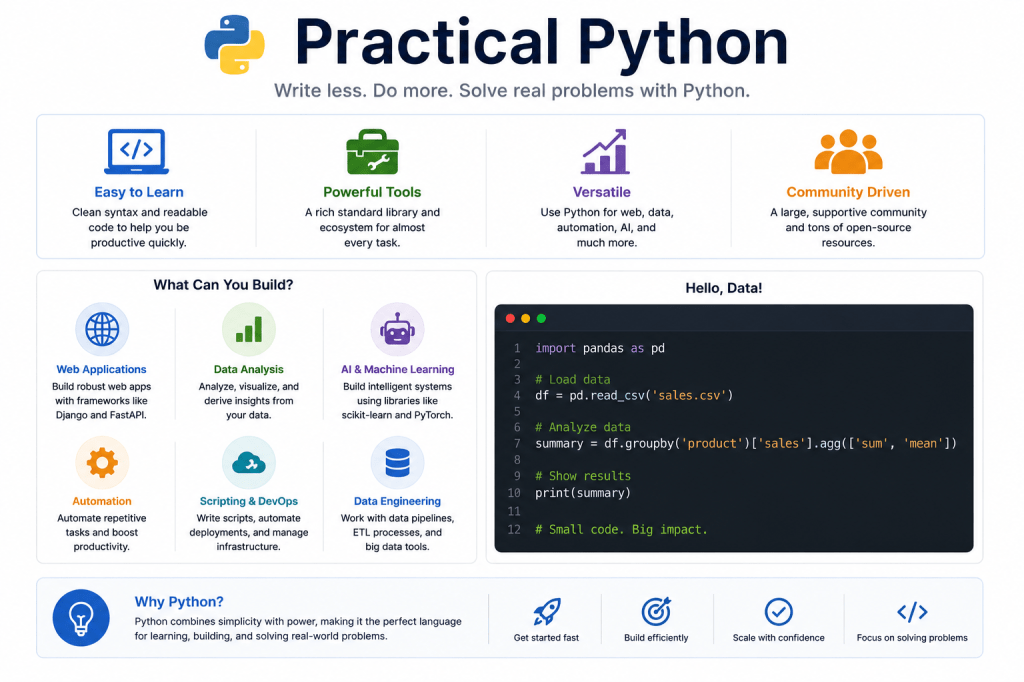
Why Python Dominates Reasoning AI
Python has emerged as the dominant language for AI engineering because it combines:
- readability,
- flexibility,
- ecosystem maturity,
- rapid experimentation,
- and integration capabilities.
Modern AI frameworks, orchestration systems, and reasoning pipelines are overwhelmingly built around Python ecosystems.
This includes:
- model inference,
- vector databases,
- agent frameworks,
- orchestration systems,
- evaluation pipelines,
- and autonomous workflows.
Python enables developers to move quickly from:
conceptual reasoning architectures
to:
functioning autonomous systems.
What This Hub Covers
The Practical Python hub focuses on implementation-oriented reasoning systems.
Topics include:
- reasoning loops,
- planning systems,
- memory architectures,
- agent orchestration,
- tool calling,
- evaluation workflows,
- and autonomous AI pipelines.
The emphasis is on:
- clarity,
- practical experimentation,
- modular architectures,
- and real-world workflows.
Core Areas of Practical AI Engineering
Building Reasoning Loops
One of the foundational patterns in reasoning AI is the reasoning loop.
Instead of generating a single response, reasoning systems may:
- analyze a problem,
- generate intermediate reasoning,
- evaluate outputs,
- revise conclusions,
- and iterate toward stronger solutions.
Python makes it possible to build these workflows explicitly.
Topics include:
- iterative reasoning,
- reflection loops,
- self-correction systems,
- and deliberative inference pipelines.
Related articles:
- Build a Reflection Loop in Python
- Simple Deliberative Inference Workflow
- Iterative Reasoning Systems Explained
- Self-Correcting AI Pipelines
Planning Agents
Planning systems allow AI agents to:
- decompose objectives,
- organize tasks,
- prioritize actions,
- and adapt dynamically.
Python-based planning systems often combine:
- reasoning models,
- workflow state,
- memory systems,
- and execution logic.
Planning agents are increasingly important for:
- coding assistants,
- research agents,
- enterprise workflows,
- and autonomous automation systems.
Related articles:
- Build a Planning Agent in Python
- Task Decomposition Systems
- Goal-Oriented Agent Architectures
- Autonomous Workflow Planning
Tool Calling and External APIs
Modern AI agents increasingly interact with external systems.
Python is commonly used to integrate:
- APIs,
- databases,
- search engines,
- browsers,
- spreadsheets,
- shell environments,
- and external applications.
Tool-augmented systems can:
- retrieve information,
- execute code,
- automate workflows,
- and manipulate real-world environments.
Related articles:
- Tool Calling With Python
- Function Calling Architectures
- Building API-Driven AI Agents
- External Tool Integration Patterns
Multi-Agent Systems
Many modern AI systems distribute reasoning across multiple specialized agents.
Python frameworks make it possible to create:
- planner agents,
- researcher agents,
- verifier agents,
- execution agents,
- and orchestration pipelines.
Multi-agent systems often improve:
- scalability,
- specialization,
- and reasoning quality.
Related articles:
- Build a Multi-Agent Workflow
- Agent Communication Systems
- Distributed Reasoning Architectures
- Multi-Agent Coordination Patterns
Memory Systems
Autonomous systems require memory.
Without memory, agents struggle with:
- long tasks,
- persistent objectives,
- workflow continuity,
- and contextual consistency.
Python-based memory systems often combine:
- vector databases,
- embeddings,
- retrieval pipelines,
- semantic memory,
- and state management.
Related articles:
- Build Agent Memory Systems
- Vector Databases Explained
- Long-Term Context Management
- Episodic Memory for AI Agents
Orchestration Frameworks
Modern reasoning systems often require orchestration layers.
Orchestration systems coordinate:
- models,
- agents,
- tools,
- workflows,
- execution state,
- and evaluation pipelines.
Python orchestration frameworks help manage:
- workflow routing,
- retries,
- state persistence,
- and execution control.
Related articles:
- AI Orchestration With Python
- Stateful Workflow Systems
- Agent Routing Architectures
- Building AI Pipelines
Evaluation and Testing
Reliable AI systems require testing infrastructure.
Python is heavily used for:
- benchmark evaluation,
- hallucination testing,
- reliability measurement,
- and automated scoring pipelines.
Evaluation workflows help developers:
- detect failures,
- compare systems,
- validate outputs,
- and monitor autonomous behavior.
Related articles:
- Build an AI Evaluation Pipeline
- Hallucination Detection With Python
- Benchmark Automation Systems
- Reliability Testing Frameworks
Retrieval-Augmented Systems
Retrieval systems allow AI models to:
- access external knowledge,
- search document collections,
- retrieve context dynamically,
- and ground reasoning in data.
Python is commonly used to build:
- vector search systems,
- embedding pipelines,
- semantic retrieval workflows,
- and RAG architectures.
Related articles:
- Build a RAG Pipeline in Python
- Semantic Search Systems
- Vector Retrieval Architectures
- Retrieval-Augmented Reasoning
Reasoning Frameworks and Libraries
The Python AI ecosystem is evolving rapidly.
Modern reasoning systems increasingly rely on frameworks for:
- orchestration,
- memory,
- tool calling,
- and agent coordination.
Popular ecosystems include:
- LangGraph,
- Pydantic AI,
- AutoGen,
- CrewAI,
- and workflow orchestration frameworks.
These libraries help developers:
- structure reasoning workflows,
- coordinate agents,
- manage execution state,
- and scale autonomous systems.
Related articles:
- Pydantic AI Explained
- LangGraph Tutorial
- AutoGen Framework Overview
- CrewAI Systems Explained
Building Autonomous Workflows
One of the most important trends in modern AI engineering is workflow automation.
Autonomous workflows may:
- monitor systems,
- process documents,
- generate reports,
- coordinate APIs,
- execute tasks,
- and adapt dynamically.
Python enables these workflows through:
- event-driven systems,
- orchestration frameworks,
- scheduling pipelines,
- and stateful execution architectures.
Related articles:
- Build an Autonomous Workflow System
- Event-Driven AI Architectures
- AI Automation Pipelines
- Workflow-Oriented Agent Systems
Why Practical Implementation Matters
Reasoning systems are often discussed conceptually, but implementation reveals many real-world challenges.
Building practical systems exposes issues involving:
- hallucinations,
- orchestration complexity,
- memory management,
- latency,
- state persistence,
- evaluation,
- and reliability.
Hands-on experimentation helps developers understand:
not just how reasoning systems appear to work,
but:
how they behave operationally in real environments.
Python and the Future of AI Systems Engineering
As reasoning systems become more autonomous, AI engineering is increasingly becoming:
- workflow engineering,
- orchestration engineering,
- reasoning systems design,
- and autonomous infrastructure development.
Python remains one of the central tools enabling this transformation.
Future AI systems will likely rely heavily on:
- agent pipelines,
- orchestration layers,
- evaluation systems,
- memory architectures,
- and dynamic reasoning workflows.
Understanding how to build these systems practically is becoming increasingly valuable.
GitHub and Open Experimentation
A major goal of this hub is to encourage:
- experimentation,
- modular learning,
- and open implementation workflows.
Many articles include:
- GitHub-linked projects,
- reusable examples,
- workflow diagrams,
- Python snippets,
- and practical engineering breakdowns.
The goal is to help readers move from:
understanding reasoning architectures,
to:
building functioning reasoning systems.
Explore the Practical Python Hub
This hub serves as a central entry point for hands-on reasoning AI engineering.
Whether you are:
- building AI agents,
- experimenting with orchestration systems,
- creating autonomous workflows,
- studying reasoning architectures,
- or developing AI infrastructure,
Python has become one of the foundational languages powering modern reasoning systems.
Recommended Starting Articles
- Build a Reflection Loop in Python
- Simple Planning Agent Tutorial
- Tool Calling With Python
- Build a Multi-Agent Workflow
- Agent Memory Systems Explained
- AI Orchestration With Python
- Build a RAG Pipeline
- Hallucination Detection With Python
- Pydantic AI Explained
- LangGraph Tutorial
- Teaching a Neural Network to Add Two Numbers with PyTorch (Full Working Example)
- Teaching a Neural Network to Add Numbers as Text with PyTorch
 Reasoning Systems