Artificial intelligence is rapidly evolving from simple text generation toward systems capable of planning, deliberation, verification, reflection, and autonomous decision-making. At the center of this transformation is a new class of AI design patterns known as reasoning architectures.
Reasoning architectures define how AI systems:
- break down problems,
- evaluate intermediate steps,
- choose actions,
- revise conclusions,
- coordinate tools,
- and navigate complex tasks.
Modern AI systems are no longer judged solely on their ability to generate fluent responses. Increasingly, the focus is shifting toward whether they can:
- reason reliably,
- solve multi-step problems,
- perform structured planning,
- and operate autonomously in dynamic environments.
This hub explores the architectures, frameworks, and mechanisms that enable modern AI reasoning systems.
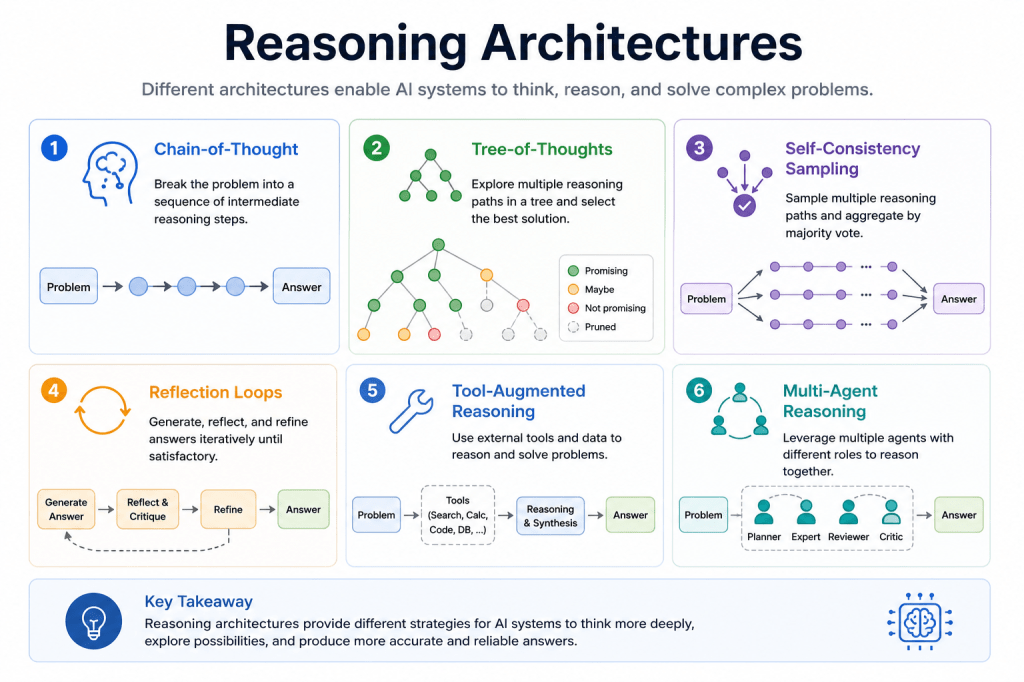
What Are Reasoning Architectures?
A reasoning architecture is the structural framework that governs how an AI system processes information and arrives at decisions.
Instead of generating a single immediate output, reasoning architectures often introduce:
- intermediate reasoning steps,
- planning loops,
- verification phases,
- memory systems,
- tool interaction,
- or multi-agent collaboration.
These systems aim to improve:
- accuracy,
- reliability,
- consistency,
- long-horizon problem solving,
- and autonomous behavior.
Reasoning architectures are becoming foundational to:
- autonomous AI agents,
- coding assistants,
- scientific AI systems,
- enterprise workflows,
- robotics,
- and advanced research systems.
Why Reasoning Architectures Matter
Traditional large language models often behave like highly sophisticated autocomplete systems. While powerful, they can still:
- hallucinate,
- lose track of goals,
- fail at long reasoning chains,
- or make inconsistent decisions.
Reasoning architectures attempt to address these limitations by introducing structured reasoning strategies.
These architectures help AI systems:
- think step-by-step,
- evaluate alternatives,
- reflect on mistakes,
- use external tools,
- and maintain coherent plans.
As AI systems become more autonomous, reasoning architectures are likely to become one of the most important engineering disciplines in artificial intelligence.
Core Areas of Reasoning Architectures
Chain-of-Thought Reasoning
Chain-of-thought reasoning encourages AI systems to generate intermediate reasoning steps before producing a final answer.
This approach improves:
- mathematical reasoning,
- logical analysis,
- coding tasks,
- and complex problem solving.
Key topics:
- step-by-step reasoning,
- prompting strategies,
- reasoning traces,
- hidden vs explicit reasoning.
Related articles:
- What Is Chain-of-Thought Reasoning?
- Chain-of-Thought vs Direct Answering
- Hidden Reasoning Tokens Explained
Tree-of-Thoughts
Tree-of-thoughts extends chain-of-thought by allowing AI systems to explore multiple reasoning paths simultaneously.
Instead of following a single linear chain, the system:
- branches into alternatives,
- evaluates competing solutions,
- backtracks when necessary,
- and selects stronger reasoning paths.
This architecture resembles:
- search algorithms,
- planning systems,
- and decision trees.
Related articles:
- Tree-of-Thoughts Explained
- Search-Based Reasoning in AI
- Branching Inference Systems
Reflection Systems
Reflection architectures allow AI systems to critique and revise their own outputs.
A reasoning system may:
- generate an answer,
- analyze weaknesses,
- revise the response,
- and repeat the cycle.
Reflection improves:
- reliability,
- coding accuracy,
- planning consistency,
- and error correction.
Related articles:
- Reflection Loops in AI
- Self-Critique Architectures
- Iterative Reasoning Systems
Self-Consistency Sampling
Self-consistency systems generate multiple reasoning paths and compare the results to identify the most reliable answer.
Instead of trusting a single reasoning chain, the system:
- samples multiple solutions,
- measures agreement,
- and selects consensus outputs.
This improves robustness on:
- math benchmarks,
- reasoning tasks,
- and complex inference problems.
Related articles:
- Self-Consistency Reasoning
- Consensus-Based Inference
- Sampling Strategies for AI Reasoning
Verifier Models
Verifier architectures introduce specialized models that evaluate whether generated reasoning steps are correct.
The generator creates solutions.
The verifier validates them.
This separation helps reduce:
- hallucinations,
- logical inconsistencies,
- and invalid reasoning chains.
Related articles:
- What Are Verifier Models?
- Process Supervision Explained
- AI Verification Architectures
Deliberative Reasoning Systems
Deliberative systems allocate additional compute and reasoning time to difficult problems.
Instead of immediately answering, these systems:
- plan,
- simulate alternatives,
- compare outcomes,
- and refine conclusions.
This trend is closely connected to:
- test-time compute,
- reasoning scaling,
- and autonomous planning.
Related articles:
- Deliberative Inference
- Test-Time Compute Explained
- Why Reasoning Models “Think Longer”
Tool-Augmented Reasoning
Modern reasoning systems increasingly rely on external tools.
These systems can:
- execute code,
- search databases,
- retrieve documents,
- browse APIs,
- and manipulate software systems.
Tool use transforms AI systems from passive responders into active problem-solving environments.
Related articles:
- Tool Calling Architectures
- Retrieval-Augmented Reasoning
- AI Systems That Use External Tools
Multi-Agent Reasoning
Some reasoning architectures distribute tasks across multiple specialized agents.
Examples:
- one agent plans,
- another researches,
- another verifies,
- another critiques.
Multi-agent systems can improve:
- scalability,
- specialization,
- fault tolerance,
- and parallel reasoning.
Related articles:
- Multi-Agent Architectures
- Agent Communication Systems
- Collaborative AI Reasoning
Emerging Trends in Reasoning Architectures
The field is evolving rapidly.
Major emerging trends include:
- latent reasoning systems,
- process reward models,
- planning tokens,
- memory-augmented reasoning,
- reasoning-aware routing,
- neuro-symbolic architectures,
- and autonomous cognitive pipelines.
The industry is moving beyond:
“Generate a response.”
Toward:
“Construct systems that can reason, verify, adapt, and act.”
Reasoning Architectures and AI Agents
Reasoning architectures are becoming foundational to autonomous AI agents.
Modern agent systems require:
- planning,
- memory,
- reflection,
- verification,
- tool orchestration,
- and adaptive reasoning.
Without robust reasoning architectures, autonomous agents become unreliable.
This is why reasoning systems and agent systems are increasingly converging into the same engineering discipline.
Practical Applications
Reasoning architectures are already being used in:
- coding assistants,
- research copilots,
- autonomous workflows,
- scientific discovery systems,
- enterprise AI automation,
- robotics,
- cybersecurity analysis,
- and financial modeling.
As AI capabilities continue to advance, reasoning architectures will likely become a defining layer of modern intelligent systems.
Python and Practical Implementations
This website focuses not only on theory, but also on practical implementation.
Throughout the Reasoning Architectures hub, you will find:
- Python examples,
- reasoning loops,
- planning systems,
- reflection pipelines,
- verifier workflows,
- orchestration patterns,
- and GitHub-linked tutorials.
The goal is to understand not just what reasoning architectures are — but how to build them.
Explore the Reasoning Architectures Hub
This hub serves as the central entry point for understanding how modern AI systems reason, deliberate, plan, and solve complex problems.
Whether you are:
- building AI agents,
- researching reasoning models,
- experimenting with autonomous systems,
- or studying the future of AI cognition,
reasoning architectures are becoming one of the most important foundations in modern artificial intelligence.
Recommended Starting Articles
- What Is Chain-of-Thought Reasoning?
- Tree-of-Thoughts Explained
- Reflection Loops in AI Systems
- Self-Consistency Sampling
- What Are Verifier Models?
- Deliberative Inference Explained
- Tool-Augmented Reasoning
- Multi-Agent Reasoning Architectures
- Test-Time Compute and Reasoning Scaling
- Planning Systems in Autonomous AI
 Reasoning Systems