Artificial intelligence is increasingly evolving beyond isolated prediction models toward systems capable of:
- reasoning,
- planning,
- memory,
- adaptation,
- abstraction,
- and autonomous decision-making.
At the center of this transformation is the broader concept of cognitive systems.
Cognitive systems attempt to model aspects of intelligent behavior by combining:
- reasoning mechanisms,
- memory architectures,
- perception,
- planning,
- learning,
- and adaptive decision processes.
Modern AI is gradually shifting from:
“Generate outputs from prompts.”
toward:
“Build systems that can perceive, reason, remember, plan, and operate intelligently across environments.”
This hub explores the architectures, concepts, and engineering principles behind modern cognitive AI systems.
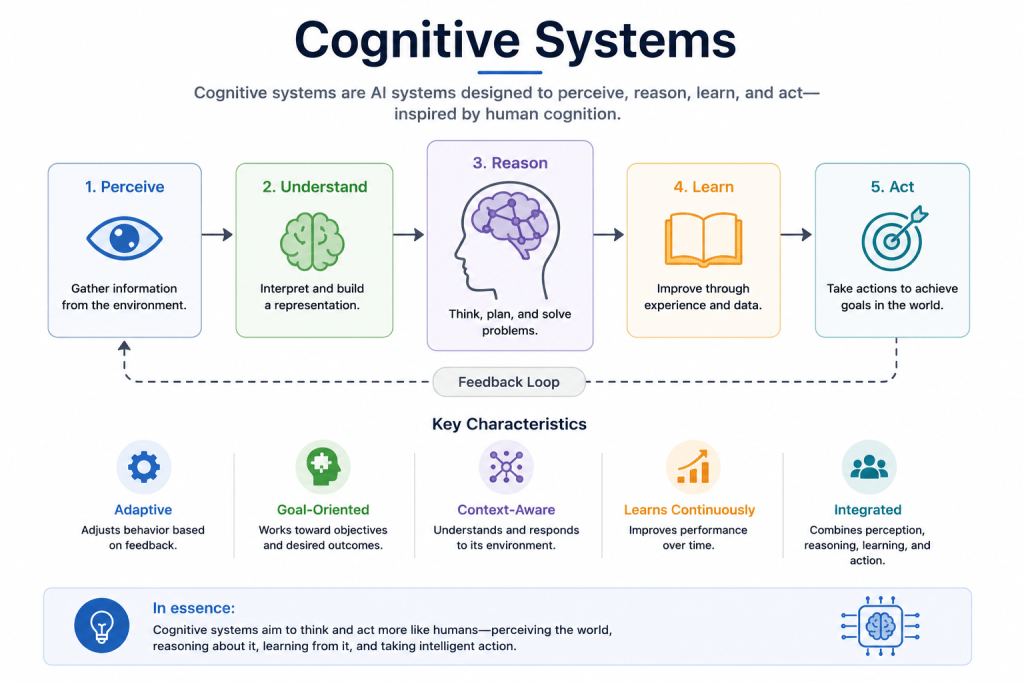
What Are Cognitive Systems?
A cognitive system is an intelligent system designed to:
- process information,
- reason about goals,
- adapt to changing environments,
- maintain memory,
- and make decisions over time.
Unlike narrow AI systems that perform isolated tasks, cognitive systems attempt to integrate multiple capabilities into coherent behavior.
Modern cognitive AI often combines:
- reasoning systems,
- memory layers,
- planning architectures,
- retrieval mechanisms,
- tool usage,
- and autonomous workflows.
The field draws inspiration from:
- cognitive science,
- neuroscience,
- symbolic AI,
- machine learning,
- and systems engineering.
Why Cognitive Systems Matter
Traditional AI systems are often limited to:
- pattern recognition,
- prediction,
- or short-context response generation.
However, many real-world environments require:
- long-term memory,
- adaptive planning,
- abstraction,
- contextual understanding,
- and goal-directed behavior.
Cognitive systems attempt to bridge this gap.
These architectures are becoming increasingly important for:
- autonomous agents,
- robotics,
- enterprise AI,
- scientific reasoning systems,
- and long-horizon problem solving.
As AI systems become more capable, cognitive architectures are likely to become one of the foundational disciplines of modern intelligent systems engineering.
Core Areas of Cognitive Systems
Memory Architectures
Memory is one of the most important components of intelligent behavior.
Without memory, AI systems struggle with:
- long tasks,
- persistent goals,
- contextual continuity,
- and adaptive behavior.
Modern cognitive systems may include:
- short-term memory,
- long-term memory,
- episodic memory,
- semantic memory,
- and working memory mechanisms.
Memory architectures are increasingly central to:
- autonomous agents,
- personalized assistants,
- and reasoning systems.
Related articles:
- Memory Systems in AI
- Episodic Memory Explained
- Semantic vs Episodic Memory
- Long-Term Context Architectures
Planning Systems
Planning allows cognitive systems to:
- organize goals,
- sequence actions,
- adapt strategies,
- and anticipate outcomes.
Instead of reacting immediately, planning systems may:
- analyze objectives,
- evaluate alternatives,
- simulate actions,
- and revise decisions dynamically.
Planning architectures are foundational to:
- autonomous agents,
- robotics,
- enterprise automation,
- and reasoning systems.
Related articles:
- Planning Systems Explained
- Goal-Oriented Architectures
- Deliberative AI Systems
- Hierarchical Planning in AI
Symbolic and Neural Reasoning
Modern cognitive systems increasingly combine:
- symbolic reasoning,
- neural architectures,
- and statistical learning.
Symbolic systems excel at:
- logic,
- structure,
- and explicit rules.
Neural systems excel at:
- pattern recognition,
- generalization,
- and representation learning.
Hybrid cognitive architectures attempt to combine both strengths.
Related articles:
- Symbolic AI Explained
- Neuro-Symbolic Systems
- Neural vs Symbolic Reasoning
- Hybrid Cognitive Architectures
Representation Learning
Intelligent systems rely heavily on internal representations.
Representation learning focuses on how AI systems:
- encode information,
- organize concepts,
- identify structure,
- and model relationships.
Modern cognitive systems increasingly depend on:
- embeddings,
- latent representations,
- semantic spaces,
- and abstract reasoning structures.
Representation learning is foundational to:
- language models,
- multimodal systems,
- and reasoning architectures.
Related articles:
- Representation Learning Explained
- Embeddings and Semantic Spaces
- Latent Representations in AI
- Concept Modeling Systems
World Models
World models attempt to help AI systems:
- simulate environments,
- predict future states,
- anticipate outcomes,
- and reason about dynamics.
These systems are becoming increasingly important in:
- robotics,
- autonomous vehicles,
- simulation systems,
- and planning architectures.
World models help AI systems move from:
reactive behavior
toward:
predictive and anticipatory reasoning.
Related articles:
- What Are World Models?
- Predictive Reasoning Systems
- Simulation Architectures in AI
- Environment Modeling Explained
Attention and Cognitive Focus
Modern AI systems rely heavily on attention mechanisms.
Attention systems allow models to:
- prioritize information,
- focus on relevant context,
- filter noise,
- and maintain reasoning coherence.
Attention has become one of the central mechanisms behind:
- transformers,
- reasoning systems,
- and large language models.
Related articles:
- Attention Mechanisms Explained
- Transformers and Cognitive Focus
- Selective Attention in AI
- Context Management Systems
Cognitive Routing and Orchestration
As AI systems become more complex, cognitive architectures increasingly require:
- routing systems,
- orchestration layers,
- and dynamic coordination mechanisms.
These systems determine:
- which models to use,
- which tools to call,
- which memory to retrieve,
- and how workflows should adapt dynamically.
Cognitive orchestration is becoming increasingly important for:
- autonomous agents,
- enterprise AI systems,
- and multi-agent architectures.
Related articles:
- Cognitive Routing Systems
- Dynamic Orchestration Architectures
- Context-Aware AI Systems
- Adaptive Workflow Coordination
Reflection and Self-Monitoring
Advanced cognitive systems increasingly include reflection mechanisms.
Reflection systems allow AI architectures to:
- critique outputs,
- identify weaknesses,
- revise conclusions,
- and improve reasoning quality.
Self-monitoring is becoming increasingly important for:
- reliability,
- alignment,
- planning consistency,
- and autonomous behavior.
Related articles:
- Reflection Systems in AI
- Self-Correcting Architectures
- Meta-Reasoning Systems
- Cognitive Self-Monitoring
Adaptive Learning Systems
Cognitive systems increasingly require the ability to:
- adapt dynamically,
- learn from experience,
- revise strategies,
- and update behavior over time.
Adaptive architectures may include:
- reinforcement learning,
- continual learning,
- memory adaptation,
- and feedback-driven optimization.
Adaptation is critical for:
- long-term autonomous systems,
- dynamic environments,
- and intelligent workflow agents.
Related articles:
- Continual Learning Explained
- Reinforcement Learning Systems
- Adaptive Reasoning Architectures
- Experience-Driven AI Systems
Multimodal Cognitive Systems
Modern intelligent systems increasingly combine:
- text,
- images,
- audio,
- video,
- sensor data,
- and environmental signals.
Multimodal cognitive systems attempt to integrate these signals into coherent reasoning and decision-making processes.
This is becoming increasingly important for:
- robotics,
- autonomous assistants,
- and real-world AI systems.
Related articles:
- Multimodal AI Systems
- Vision-Language Architectures
- Sensor Fusion in AI
- Cross-Modal Reasoning
Emerging Trends in Cognitive AI
The field of cognitive systems is evolving rapidly.
Major emerging trends include:
- memory-augmented reasoning,
- latent reasoning architectures,
- autonomous cognitive agents,
- world simulation systems,
- adaptive orchestration,
- neuro-symbolic AI,
- and self-improving reasoning systems.
The industry is increasingly shifting toward:
integrated systems capable of reasoning, planning, memory, adaptation, and autonomous behavior.
Cognitive Systems and Autonomous Agents
Modern autonomous agents increasingly depend on cognitive architectures.
Agents require:
- memory,
- planning,
- reflection,
- adaptation,
- and dynamic reasoning.
Without cognitive mechanisms, autonomous systems struggle with:
- long-term goals,
- contextual continuity,
- and intelligent adaptation.
This is why cognitive systems are becoming foundational to the future of:
- agent engineering,
- reasoning systems,
- and autonomous AI infrastructure.
Practical Applications of Cognitive Systems
Cognitive architectures are already influencing:
- autonomous assistants,
- robotics,
- scientific research systems,
- enterprise AI,
- adaptive learning systems,
- and intelligent workflow automation.
Applications increasingly involve:
- persistent memory,
- contextual reasoning,
- planning,
- and dynamic orchestration.
As AI systems become more autonomous, cognitive engineering is likely to become a defining layer of intelligent system design.
Python and Cognitive System Engineering
ReasoningSystems.org focuses not only on theory, but also on implementation.
Throughout this hub, you will find:
- Python-based reasoning systems,
- memory architectures,
- planning pipelines,
- orchestration workflows,
- retrieval systems,
- and cognitive experimentation examples.
The goal is to understand:
not only what cognitive systems are,
but also:
how intelligent architectures can be designed, tested, and built in practice.
Explore the Cognitive Systems Hub
This hub serves as a central entry point for understanding how modern AI systems:
- remember,
- reason,
- plan,
- adapt,
- and operate intelligently across environments.
Whether you are:
- studying cognitive AI,
- building autonomous agents,
- exploring memory architectures,
- researching reasoning systems,
- or experimenting with intelligent workflows,
cognitive systems are becoming one of the foundational disciplines shaping the future of artificial intelligence.
Recommended Starting Articles
- Memory Systems in AI
- What Are World Models?
- Representation Learning Explained
- Neuro-Symbolic AI Systems
- Planning Systems Explained
- Reflection Systems in AI
- Cognitive Routing Architectures
- Continual Learning Explained
- Attention Mechanisms Explained
- Multimodal Cognitive Systems
 Reasoning Systems