Artificial intelligence systems are becoming increasingly capable of solving:
- mathematical problems,
- coding challenges,
- logical puzzles,
- planning tasks,
- and multi-step reasoning problems.
One of the major breakthroughs enabling these improvements is a reasoning technique known as Chain-of-Thought reasoning.
Chain-of-Thought (CoT) reasoning encourages AI systems to generate intermediate reasoning steps before arriving at a final answer.
Instead of immediately producing a response, the model is guided to:
- think through the problem,
- break it into smaller steps,
- reason sequentially,
- and then produce a conclusion.
This simple shift has dramatically improved AI performance across many reasoning-heavy tasks.
Chain-of-Thought reasoning has become one of the foundational concepts behind modern reasoning AI systems.
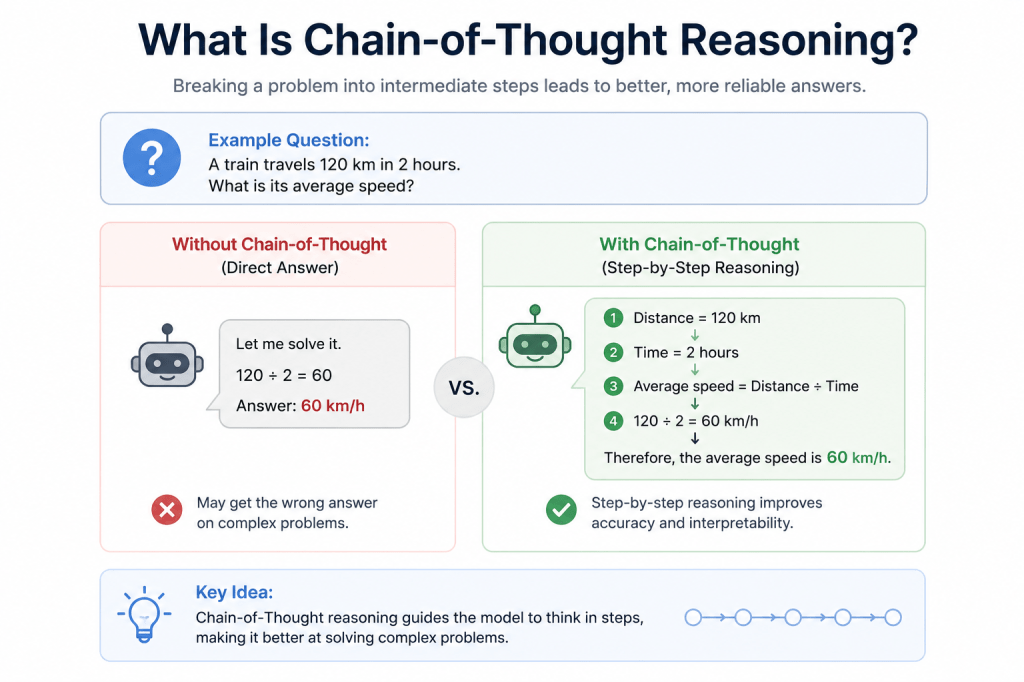
What Is Chain-of-Thought Reasoning?
Chain-of-Thought reasoning is a prompting and inference strategy where an AI system generates explicit intermediate reasoning steps before producing a final answer.
Instead of:
giving only the conclusion,
the model produces:
a sequence of reasoning steps that lead toward the conclusion.
For example, rather than answering a math problem immediately, the system may:
- identify variables,
- break down calculations,
- evaluate relationships,
- and solve the problem step-by-step.
The goal is to improve:
- logical consistency,
- reasoning quality,
- planning,
- and problem-solving accuracy.
A Simple Example
Without Chain-of-Thought reasoning:
“A store sells 3 notebooks for $12. How much do 5 notebooks cost?”
A direct-response model may attempt to guess the answer immediately.
With Chain-of-Thought reasoning, the system may reason like this:
- 3 notebooks cost $12
- One notebook costs $4
- Five notebooks cost 5 × 4
- Therefore, the answer is $20
By explicitly generating reasoning steps, the system often becomes:
- more accurate,
- more interpretable,
- and more reliable.
Why Chain-of-Thought Reasoning Matters
Traditional language models are highly effective at pattern prediction, but they often struggle with:
- multi-step logic,
- planning,
- arithmetic,
- symbolic reasoning,
- and long reasoning chains.
Chain-of-Thought reasoning helps models:
- slow down,
- structure reasoning,
- and maintain intermediate context.
This has become especially important for:
- reasoning models,
- autonomous agents,
- coding systems,
- and advanced AI workflows.
Modern reasoning AI increasingly depends on some form of structured intermediate reasoning.
How Chain-of-Thought Reasoning Works
At a high level, Chain-of-Thought reasoning works by encouraging the model to:
- decompose problems,
- generate intermediate reasoning traces,
- maintain logical structure,
- and iteratively build toward a solution.
This changes the inference process from:
direct prediction
toward:
sequential reasoning.
The intermediate reasoning steps are often called:
- reasoning traces,
- thought chains,
- or reasoning paths.
These traces may remain:
- visible to users,
- partially hidden,
- or internally generated during inference.
Why Step-by-Step Reasoning Improves Performance
Large language models often perform better when reasoning is externalized into intermediate steps.
This improves:
- context organization,
- error detection,
- reasoning continuity,
- and problem decomposition.
Instead of compressing all reasoning into a single prediction, the model can:
- maintain intermediate state,
- revisit assumptions,
- and process problems incrementally.
This is especially useful for:
- mathematics,
- coding,
- planning,
- and symbolic reasoning tasks.
Chain-of-Thought vs Direct Prompting
Traditional prompting often requests only the final answer.
Example:
“What is the answer?”
Chain-of-Thought prompting instead encourages:
“Think step-by-step.”
This difference may appear small, but it can dramatically change reasoning behavior.
Direct prompting tends to:
- optimize for speed,
- compress reasoning,
- and skip intermediate logic.
Chain-of-Thought prompting encourages:
- decomposition,
- intermediate analysis,
- and explicit reasoning structure.
Related article:
- Chain-of-Thought vs Direct Prompting
Zero-Shot vs Few-Shot Chain-of-Thought
There are multiple forms of Chain-of-Thought prompting.
Zero-Shot Chain-of-Thought
Zero-shot Chain-of-Thought uses simple reasoning instructions such as:
“Let’s think step-by-step.”
This surprisingly improves reasoning performance in many models.
The model generates reasoning traces dynamically without seeing examples beforehand.
Few-Shot Chain-of-Thought
Few-shot Chain-of-Thought provides:
- examples,
- demonstrations,
- or sample reasoning patterns.
The model learns the expected reasoning structure from these demonstrations.
Few-shot prompting often improves:
- consistency,
- reasoning format,
- and logical coherence.
Related articles:
- Zero-Shot Chain-of-Thought
- Few-Shot Prompting Explained
Chain-of-Thought and Reasoning Models
Modern reasoning-focused AI systems increasingly rely on structured reasoning processes.
Chain-of-Thought reasoning has strongly influenced:
- reasoning models,
- planning systems,
- autonomous agents,
- and deliberative inference architectures.
Many frontier AI systems now allocate:
- additional reasoning steps,
- extended inference,
- or iterative thought generation
before producing answers.
This trend is closely related to:
- test-time compute,
- reflection systems,
- and deliberative reasoning architectures.
Hidden vs Visible Reasoning
Some AI systems expose reasoning traces directly to users.
Others generate reasoning internally.
Visible reasoning improves:
- interpretability,
- transparency,
- and educational value.
Hidden reasoning may improve:
- efficiency,
- privacy,
- or optimization flexibility.
The balance between:
- explicit reasoning,
- hidden reasoning,
- and latent reasoning
is becoming an important research topic.
Related articles:
- Hidden Reasoning Tokens
- Latent Reasoning Systems
- Reasoning Traces Explained
Chain-of-Thought and AI Agents
Chain-of-Thought reasoning is increasingly important for autonomous agents.
Agents often need to:
- plan tasks,
- evaluate alternatives,
- coordinate tools,
- and solve multi-step objectives.
Without structured reasoning, autonomous agents may:
- lose context,
- hallucinate actions,
- or fail at long-horizon tasks.
Chain-of-Thought reasoning helps agents:
- maintain reasoning continuity,
- organize plans,
- and improve execution quality.
This is one reason reasoning systems and agent systems are increasingly converging.
Limitations of Chain-of-Thought Reasoning
Although powerful, Chain-of-Thought reasoning still has limitations.
Reasoning traces may:
- contain incorrect assumptions,
- reinforce hallucinations,
- or generate logically flawed steps.
More reasoning does not automatically guarantee:
- correctness,
- reliability,
- or truthfulness.
Some systems may also:
- generate plausible-looking but incorrect reasoning,
- overfit reasoning patterns,
- or produce unnecessarily verbose outputs.
This is why newer architectures increasingly combine Chain-of-Thought with:
- verifier models,
- reflection systems,
- self-consistency sampling,
- and evaluation pipelines.
Chain-of-Thought and Test-Time Compute
Modern reasoning systems increasingly allocate additional computation during inference.
Instead of answering immediately, models may:
- generate multiple reasoning paths,
- evaluate alternatives,
- revise conclusions,
- and deliberate longer.
This trend is known as:
test-time compute scaling.
Chain-of-Thought reasoning forms one of the foundational mechanisms behind this shift.
Related articles:
- Test-Time Compute Explained
- Deliberative Inference Systems
- Self-Consistency Sampling
Emerging Variants of Chain-of-Thought
The field is evolving rapidly.
Modern reasoning architectures increasingly extend Chain-of-Thought into:
- Tree-of-Thoughts,
- Reflection Systems,
- Multi-Agent Reasoning,
- Deliberative Search,
- and Process Supervision.
These architectures attempt to improve:
- robustness,
- planning quality,
- reliability,
- and autonomous reasoning behavior.
Chain-of-Thought is increasingly viewed as:
one of the foundational building blocks of reasoning AI systems.
Practical Applications
Chain-of-Thought reasoning is already used in:
- coding assistants,
- mathematical reasoning systems,
- AI research agents,
- autonomous workflows,
- enterprise AI,
- and scientific reasoning systems.
Applications increasingly require:
- structured planning,
- intermediate reasoning,
- and multi-step problem solving.
As AI systems become more autonomous, Chain-of-Thought reasoning will likely remain a central architectural mechanism.
Python Example: Simple Chain-of-Thought Prompt
Below is a simple Python example using a reasoning-oriented prompt structure.
prompt = """Question:A train travels 60 miles in 2 hours.What is its average speed?Let's think step-by-step."""response = model.generate(prompt)print(response)
The phrase:
“Let’s think step-by-step”
often encourages models to generate intermediate reasoning traces before answering.
Chain-of-Thought and the Future of AI
Chain-of-Thought reasoning represents an important transition in AI development.
The industry is moving from:
direct response generation
toward:
structured reasoning systems capable of planning, reflection, and deliberation.
This shift is influencing:
- reasoning architectures,
- autonomous agents,
- evaluation systems,
- and cognitive AI research.
Understanding Chain-of-Thought reasoning is increasingly essential for anyone studying modern AI systems.
Related Concepts
- Tree-of-Thoughts
- Reflection Systems
- Self-Consistency Sampling
- Verifier Models
- Process Supervision
- Deliberative Inference
- Test-Time Compute
- Multi-Agent Reasoning
- Reasoning Traces
- AI Planning Systems
Continue Exploring
Chain-of-Thought reasoning is one of the foundational concepts behind modern reasoning AI systems.
To continue exploring this area, consider reading:
- Tree-of-Thoughts Explained
- Reflection Loops in AI Systems
- Self-Consistency Sampling
- Deliberative Inference Explained
- What Are Verifier Models?
These concepts build directly on the reasoning foundations introduced by Chain-of-Thought architectures.
👉 You can experiment with a practical Python implementation of this concept in the official GitHub repository for the Reasoning Systems examples: https://github.com/BenardoKemp/reasoningsystems/tree/main/reasoning-architectures/what-is-chain-of-thought-reasoning
 Reasoning Systems