Modern AI systems can respond to prompts in dramatically different ways depending on how the problem is presented.
One of the most important differences in modern reasoning AI is the distinction between:
- direct prompting,
- and Chain-of-Thought prompting.
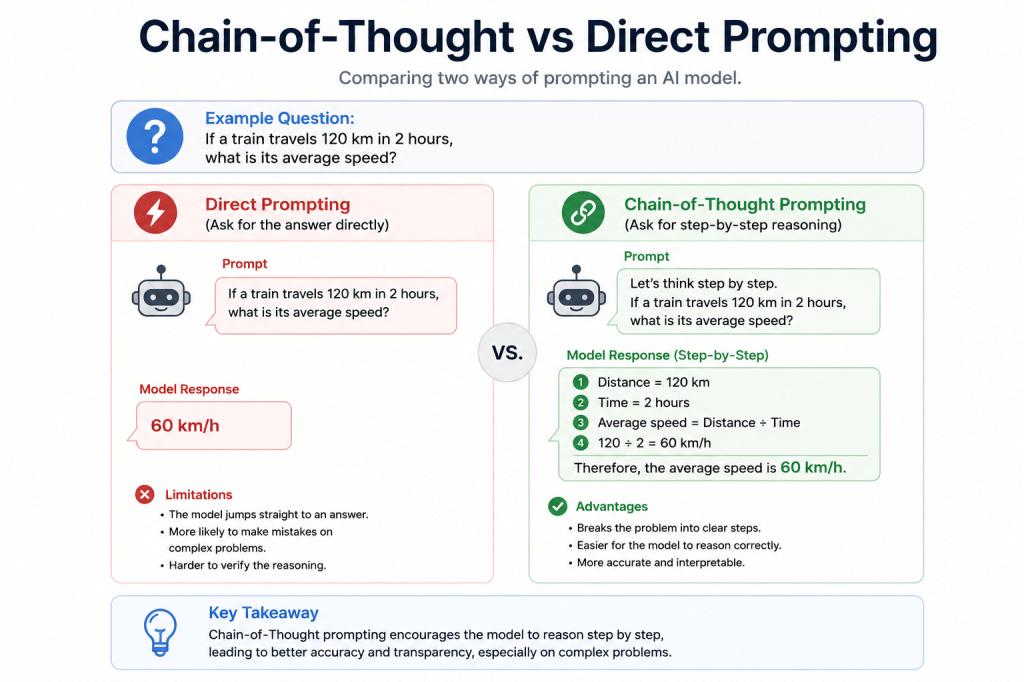
Direct prompting asks the model to immediately generate a final answer.
Chain-of-Thought prompting encourages the model to:
- reason step-by-step,
- generate intermediate thoughts,
- and gradually work toward a conclusion.
This difference has become increasingly important as AI systems evolve toward:
- reasoning models,
- planning systems,
- autonomous agents,
- and multi-step decision-making architectures.
Understanding the distinction between these approaches is foundational to modern reasoning AI engineering.
What Is Direct Prompting?
Direct prompting is the traditional prompting approach used in many language model interactions.
The model receives:
- a question,
- instruction,
- or task,
and attempts to immediately generate a final answer.
Example:
“What is 27 × 14?”
The system tries to produce:
“378”
without explicitly showing intermediate reasoning.
Direct prompting prioritizes:
- speed,
- concise outputs,
- and fast inference.
This approach works well for:
- simple factual queries,
- language generation,
- summarization,
- and pattern completion tasks.
However, it often struggles with:
- complex reasoning,
- planning,
- multi-step logic,
- and long problem-solving chains.
What Is Chain-of-Thought Prompting?
Chain-of-Thought prompting encourages the model to generate intermediate reasoning steps before arriving at a final answer.
Instead of:
answering immediately,
the model is guided to:
think through the problem sequentially.
Example:
“Let’s think step-by-step.”
The model may then:
- analyze the problem,
- break it into smaller parts,
- reason through intermediate calculations,
- and produce a conclusion.
This structured reasoning process often improves:
- accuracy,
- logical consistency,
- planning,
- and problem-solving performance.
Related article:
- What Is Chain-of-Thought Reasoning?
A Simple Comparison
Consider this question:
“A car travels 180 miles in 3 hours. What is its average speed?”
Direct Prompting
The model may simply output:
“60 miles per hour.”
This is efficient, but the reasoning remains implicit.
Chain-of-Thought Prompting
The model may instead reason like this:
- Distance = 180 miles
- Time = 3 hours
- Speed = distance ÷ time
- 180 ÷ 3 = 60
- Therefore, the average speed is 60 miles per hour
This makes the reasoning process explicit and interpretable.
Why Chain-of-Thought Often Improves Performance
Large language models are fundamentally probabilistic systems.
When forced to immediately compress reasoning into:
- a single prediction,
- a short answer,
- or minimal output,
they may:
- skip reasoning steps,
- lose intermediate structure,
- or generate incorrect conclusions.
Chain-of-Thought reasoning reduces this compression pressure by allowing:
- decomposition,
- intermediate context,
- and structured reasoning traces.
This is especially beneficial for:
- mathematics,
- coding,
- planning,
- and symbolic reasoning.
Direct Prompting Prioritizes Efficiency
Direct prompting still remains extremely useful.
Its advantages include:
- lower latency,
- shorter outputs,
- reduced token usage,
- and faster inference.
For many tasks, explicit reasoning is unnecessary.
Examples:
- factual recall,
- text rewriting,
- summarization,
- translation,
- and short classification tasks.
In these cases, direct prompting may actually perform better because:
- the reasoning overhead is unnecessary,
- and shorter responses reduce complexity.
When Chain-of-Thought Performs Better
Chain-of-Thought reasoning tends to improve performance on tasks requiring:
- logical decomposition,
- sequential reasoning,
- planning,
- symbolic manipulation,
- or long reasoning chains.
This includes:
- mathematics,
- coding,
- scientific reasoning,
- multi-step workflows,
- and autonomous planning systems.
Modern reasoning benchmarks often show significant improvements when Chain-of-Thought prompting is used.
Chain-of-Thought and Reasoning Benchmarks
Reasoning benchmarks increasingly reward:
- intermediate reasoning quality,
- planning consistency,
- and structured problem solving.
Benchmarks such as:
- GSM8K,
- MATH,
- GPQA,
- and ARC-AGI
often benefit substantially from Chain-of-Thought prompting strategies.
This is one reason modern reasoning models heavily incorporate:
- intermediate reasoning traces,
- deliberative inference,
- and structured reasoning architectures.
Related articles:
- What Is GSM8K?
- Understanding ARC-AGI
- Deliberative Inference Explained
Interpretability and Transparency
One major advantage of Chain-of-Thought prompting is interpretability.
Visible reasoning traces allow:
- developers,
- researchers,
- and users
to observe how the system reached a conclusion.
This can help:
- identify errors,
- diagnose hallucinations,
- and improve reasoning reliability.
Direct prompting often hides the internal reasoning process entirely.
Hidden Reasoning vs Explicit Reasoning
Modern AI systems increasingly explore different reasoning strategies.
Some systems:
- expose reasoning traces openly.
Others:
- generate hidden internal reasoning,
- or compress reasoning into latent representations.
This creates ongoing research questions involving:
- transparency,
- efficiency,
- interpretability,
- and reasoning quality.
Related articles:
- Hidden Reasoning Tokens
- Latent Reasoning Systems
- Process Supervision Explained
Limitations of Chain-of-Thought Prompting
Although powerful, Chain-of-Thought prompting is not perfect.
Reasoning traces may:
- contain errors,
- reinforce hallucinations,
- or produce plausible but incorrect logic.
Longer reasoning chains may sometimes:
- amplify mistakes,
- drift off-topic,
- or generate unnecessary complexity.
In some cases, direct prompting may actually outperform verbose reasoning.
This is why modern reasoning systems increasingly combine Chain-of-Thought with:
- verifier models,
- reflection systems,
- self-consistency sampling,
- and evaluation pipelines.
Direct Prompting in Production Systems
Many production AI systems still rely heavily on direct prompting because:
- it is faster,
- cheaper,
- and more computationally efficient.
Large-scale enterprise systems often balance:
- reasoning quality,
- latency,
- token cost,
- and operational scalability.
This creates important engineering tradeoffs between:
- fast inference,
- and deliberative reasoning.
Related articles:
- Test-Time Compute Explained
- AI Inference Optimization
- Deliberative Inference Systems
Chain-of-Thought and Autonomous Agents
Autonomous agents increasingly depend on structured reasoning.
Agents may need to:
- plan tasks,
- coordinate tools,
- maintain memory,
- evaluate alternatives,
- and revise strategies.
Direct prompting alone often struggles with:
- long-horizon objectives,
- adaptive workflows,
- and dynamic planning.
Chain-of-Thought reasoning helps agents:
- maintain reasoning continuity,
- structure plans,
- and improve execution reliability.
This is one reason reasoning architectures and agent systems are increasingly converging.
Zero-Shot vs Few-Shot Chain-of-Thought
Chain-of-Thought prompting itself has multiple variants.
Zero-Shot Chain-of-Thought
Simple prompts such as:
“Let’s think step-by-step.”
can already improve reasoning performance significantly.
Few-Shot Chain-of-Thought
The model receives:
- examples,
- demonstrations,
- or structured reasoning templates.
This often improves:
- consistency,
- reasoning structure,
- and output quality.
Related articles:
- Zero-Shot Chain-of-Thought
- Few-Shot Prompting Explained
Practical Example
Here is a simple example in Python.
Direct Prompt
prompt = """What is 48 divided by 6?"""
Chain-of-Thought Prompt
prompt = """What is 48 divided by 6?Let's think step-by-step."""
The Future of AI Reasoning
Modern AI systems are increasingly moving toward:
- structured reasoning,
- deliberative inference,
- reflection systems,
- and planning architectures.
Chain-of-Thought prompting represents one of the earliest and most influential steps in this evolution.
The industry is gradually shifting from:
immediate response generation
toward:
systems capable of structured reasoning and autonomous problem solving.
Understanding the differences between:
- direct prompting,
- and Chain-of-Thought reasoning
is becoming increasingly important for:
- AI engineering,
- agent systems,
- reasoning architectures,
- and cognitive AI development.
 Reasoning Systems