Modern AI systems are increasingly expected to:
- reason through complex problems,
- plan multi-step actions,
- evaluate outcomes,
- and operate autonomously across dynamic environments.
However, even advanced reasoning models still make mistakes.
AI systems may:
- hallucinate information,
- follow flawed assumptions,
- lose track of goals,
- or generate incorrect reasoning chains.
One important architectural strategy for improving reliability is the use of reflection loops.
Reflection loops allow AI systems to:
- critique their own outputs,
- identify weaknesses,
- revise conclusions,
- and iteratively improve reasoning quality.
Instead of generating a single final answer, reflective systems repeatedly:
think, evaluate, revise, and refine.
Reflection is becoming increasingly important for:
- reasoning models,
- autonomous agents,
- coding systems,
- planning architectures,
- and long-horizon AI workflows.
What Are Reflection Loops?
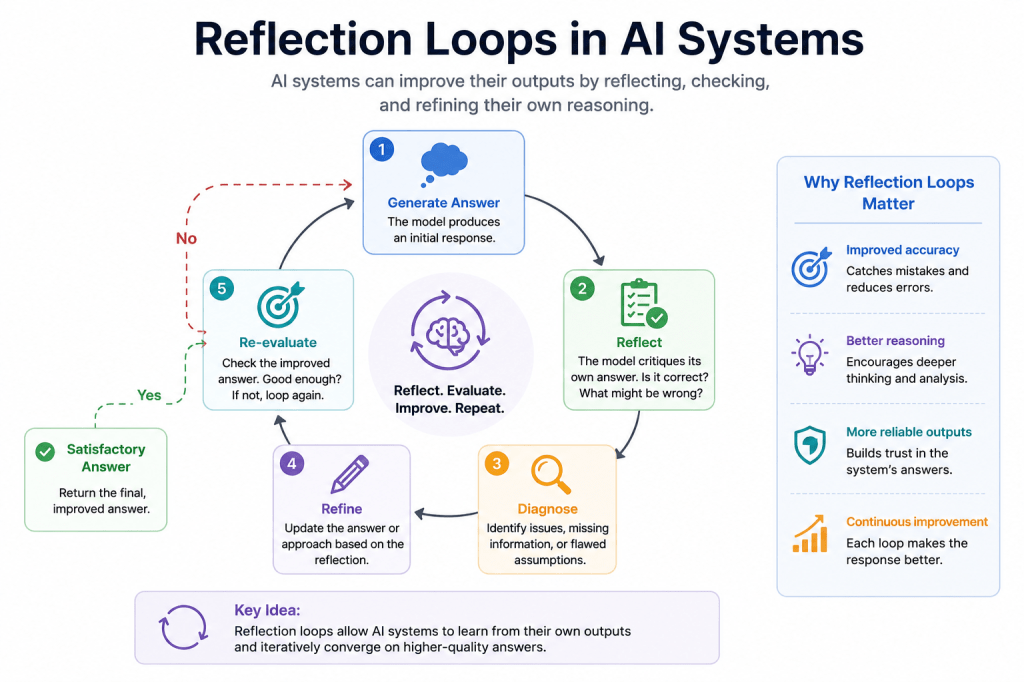
A reflection loop is a reasoning architecture where an AI system evaluates and revises its own outputs before finalizing a result.
Instead of:
generating one response and stopping,
the system:
- produces an initial answer,
- critiques the output,
- identifies problems,
- revises the reasoning,
- and repeats the process if necessary.
This creates an iterative reasoning cycle designed to improve:
- reliability,
- coherence,
- reasoning quality,
- and task performance.
Reflection loops are often viewed as a form of:
- self-correction,
- iterative reasoning,
- or meta-reasoning.
Why Reflection Loops Matter
Traditional language models often behave as:
- one-pass prediction systems.
Once a response is generated, the reasoning process effectively ends.
This creates problems because:
- early mistakes may remain uncorrected,
- flawed reasoning can propagate,
- and hallucinations may go unnoticed.
Reflection loops introduce:
- evaluation,
- verification,
- and iterative improvement.
This helps AI systems:
- reconsider assumptions,
- detect inconsistencies,
- and revise poor reasoning paths.
As AI systems become more autonomous, reflection is increasingly important for:
- planning,
- execution,
- and reliability.
A Simple Reflection Example
Imagine asking an AI system:
“Write Python code to sort a dictionary by value.”
Without Reflection
The model may:
- generate code once,
- output the result,
- and stop.
If the code contains:
- syntax errors,
- logical bugs,
- or edge-case failures,
the mistakes remain unresolved.
With Reflection
The system may:
- generate initial code,
- inspect the output,
- detect weaknesses,
- revise the implementation,
- and improve the final solution.
This iterative cycle often produces:
- cleaner code,
- more reliable reasoning,
- and stronger final outputs.
How Reflection Loops Work
At a high level, reflection systems typically involve several stages.
1. Initial Reasoning
The AI system generates:
- an answer,
- reasoning trace,
- plan,
- or proposed solution.
This becomes the starting point for evaluation.
2. Self-Evaluation
The system analyzes its own output.
It may ask questions such as:
- Is the reasoning consistent?
- Are there logical errors?
- Did the answer satisfy the objective?
- Are there missing steps?
- Could the solution be improved?
3. Revision
Based on the evaluation, the system:
- modifies reasoning,
- rewrites outputs,
- corrects errors,
- or restructures the solution.
4. Iteration
The process may repeat multiple times until:
- quality thresholds are met,
- reasoning stabilizes,
- or the system converges on a stronger solution.
This creates an iterative reasoning architecture.
Reflection vs Chain-of-Thought
Reflection loops and Chain-of-Thought reasoning are closely related, but they are not the same.
Chain-of-Thought
Chain-of-Thought reasoning focuses on:
generating intermediate reasoning steps sequentially.
The model:
- reasons step-by-step,
- and produces a final answer.
Reflection Loops
Reflection architectures go further by:
- evaluating the reasoning itself,
- critiquing outputs,
- and revising conclusions iteratively.
Reflection adds:
- self-monitoring,
- revision,
- and feedback-driven improvement.
Related articles:
Reflection and Meta-Reasoning
Reflection systems are often considered a form of:
meta-reasoning.
Meta-reasoning involves:
- reasoning about reasoning itself.
Instead of only solving the task, the system also evaluates:
- how well the reasoning process is functioning.
This introduces:
- self-analysis,
- error detection,
- and adaptive correction mechanisms.
Meta-reasoning is becoming increasingly important in:
- autonomous agents,
- planning systems,
- and reasoning architectures.
Reflection in Autonomous Agents
Autonomous agents often operate across:
- long tasks,
- changing environments,
- and uncertain objectives.
Without reflection mechanisms, agents may:
- repeat mistakes,
- drift off-task,
- misuse tools,
- or fail to adapt.
Reflection helps agents:
- monitor progress,
- revise plans,
- and improve execution quality.
This is especially important for:
- multi-step workflows,
- coding agents,
- research systems,
- and planning architectures.
Related articles:
- What Are AI Agents?
- Planning Systems in Autonomous AI
- Multi-Agent Systems Explained
Reflection and Verifier Systems
Some reflection architectures use separate verification systems.
In these workflows:
- one model generates solutions,
- another evaluates them.
Verifier systems may:
- score reasoning quality,
- detect inconsistencies,
- identify hallucinations,
- or recommend revisions.
This creates stronger reasoning pipelines.
Related articles:
- Verifier Models Explained
- Process Supervision
- AI Evaluation Systems
Reflection and Test-Time Compute
Reflection loops require additional inference computation.
Instead of:
generating one immediate answer,
the model performs:
- evaluation,
- revision,
- and repeated reasoning cycles.
This increases:
- latency,
- token usage,
- and computational cost.
However, it often improves:
- reliability,
- reasoning depth,
- and task success rates.
This tradeoff is closely connected to:
test-time compute scaling.
Related articles:
- Test-Time Compute Explained
- Deliberative Inference Systems
Reflection and Coding Systems
Reflection loops are especially useful in coding systems.
AI coding agents may:
- generate code,
- run tests,
- analyze failures,
- revise implementations,
- and retry automatically.
This iterative feedback cycle improves:
- correctness,
- debugging quality,
- and software reliability.
Modern coding agents increasingly depend on reflection architectures.
Reflection and Multi-Agent Systems
Some advanced systems distribute reflection across multiple agents.
Examples:
- one agent generates solutions,
- another critiques them,
- another verifies correctness,
- and another proposes revisions.
This creates:
- collaborative reasoning,
- distributed evaluation,
- and specialized feedback architectures.
Related articles:
- Multi-Agent Reasoning Systems
- Agent Communication Architectures
- Collaborative AI Systems
Limitations of Reflection Loops
Although powerful, reflection loops still have limitations.
Reflection systems may:
- reinforce incorrect assumptions,
- over-optimize flawed reasoning,
- generate repetitive loops,
- or increase computational overhead unnecessarily.
Poor reflection quality can sometimes:
- amplify hallucinations,
- rather than correct them.
This is why reflection systems increasingly combine:
- evaluation frameworks,
- verifier models,
- process supervision,
- and external testing systems.
Emerging Reflection Architectures
The field is evolving rapidly.
Modern reasoning systems increasingly explore:
- self-correcting agents,
- reflection-enhanced search,
- adaptive planning loops,
- recursive reasoning systems,
- and memory-aware reflection architectures.
Future AI systems will likely rely heavily on:
- self-monitoring,
- iterative reasoning,
- and autonomous correction mechanisms.
Practical Applications
Reflection systems are increasingly used in:
- coding assistants,
- research agents,
- autonomous workflows,
- enterprise AI,
- robotics,
- and scientific reasoning systems.
Applications often require:
- reliability,
- long-horizon planning,
- iterative refinement,
- and adaptive reasoning.
As AI systems become more autonomous, reflection loops are likely to become one of the foundational architectures behind reliable reasoning systems.
Python Example: Simplified Reflection Loop
Below is a conceptual example of a simplified reflection workflow.
response = generate_solution(problem)feedback = evaluate_response(response)if feedback == "needs_revision": response = revise_solution(response)print(response)
Real reflection systems may involve:
- multiple iterations,
- scoring systems,
- verifier models,
- and planning architectures.
Reflection and the Future of AI
Reflection loops represent an important shift in AI development.
The industry is increasingly moving from:
single-pass generation systems
toward:
iterative reasoning systems capable of self-evaluation and adaptive correction.
This transition is influencing:
- reasoning architectures,
- autonomous agents,
- coding systems,
- and cognitive AI research.
Reflection is increasingly viewed as:
one of the foundational mechanisms behind reliable reasoning AI systems.
Related Concepts
- Chain-of-Thought Reasoning
- Tree-of-Thoughts
- Verifier Models
- Process Supervision
- Self-Consistency Sampling
- Deliberative Inference
- Test-Time Compute
- Multi-Agent Systems
- Planning Systems
- Meta-Reasoning
Continue Exploring
To continue exploring reasoning architectures, consider reading:
- Self-Consistency Sampling
- What Are Verifier Models?
- Deliberative Inference Explained
- Process Supervision Explained
- Planning Systems in Autonomous AI
These concepts build directly on the reasoning foundations introduced by reflection-based AI systems.
👉 You can experiment with a practical Python implementation of this concept in the official GitHub repository for the Reasoning Systems examples: https://github.com/BenardoKemp/reasoningsystems/tree/main/reasoning-architectures/reflection-loops-in-ai-systems
 Reasoning Systems