As AI systems become more capable, one major challenge continues to persist:
How can we determine whether an AI system’s reasoning is actually correct?
Modern reasoning models can generate:
- convincing explanations,
- plausible reasoning traces,
- and highly fluent responses,
while still producing:
- logical errors,
- hallucinations,
- incorrect conclusions,
- or flawed plans.
One increasingly important solution to this problem is the use of Verifier Models.
Verifier models are AI systems designed to:
- evaluate reasoning quality,
- check intermediate reasoning steps,
- validate outputs,
- and improve reliability.
Instead of relying entirely on:
one model generating answers,
modern reasoning architectures increasingly separate:
- generation,
- and verification
into distinct stages.
Verifier models are becoming foundational to:
- reasoning AI,
- autonomous agents,
- coding systems,
- planning architectures,
- and evaluation pipelines.
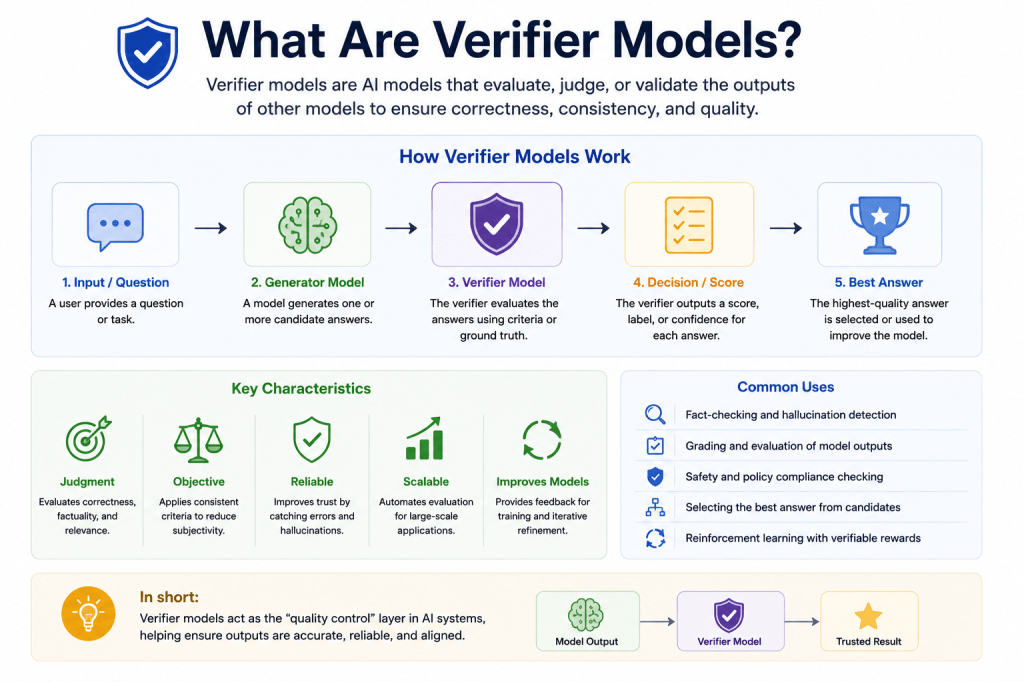
What Is a Verifier Model?
A verifier model is an AI system designed to evaluate whether another model’s reasoning or output is correct.
In many reasoning architectures:
- one model generates solutions,
- while another model evaluates them.
The verifier may assess:
- logical consistency,
- factual accuracy,
- reasoning quality,
- code correctness,
- or task completion reliability.
This creates a reasoning pipeline involving:
- generation,
- evaluation,
- and potential revision.
Verifier models help AI systems move from:
“generate an answer”
toward:
“generate, evaluate, and improve.”
Why Verifier Models Matter
Large language models are highly capable, but they still frequently:
- hallucinate,
- make arithmetic mistakes,
- generate flawed reasoning,
- or produce convincing but incorrect outputs.
A model may appear confident while still being wrong.
Verifier models help reduce these problems by introducing:
- validation,
- critique,
- and reasoning quality assessment.
This becomes increasingly important as AI systems gain:
- autonomy,
- planning ability,
- and tool execution capabilities.
Without verification, autonomous reasoning systems may become unreliable.
Generator vs Verifier Architectures
Modern reasoning systems increasingly separate:
- generation,
- and evaluation.
Generator Model
The generator:
- produces answers,
- reasoning traces,
- plans,
- code,
- or candidate solutions.
Its goal is:
solution creation.
Verifier Model
The verifier:
- evaluates outputs,
- checks reasoning quality,
- identifies weaknesses,
- and scores correctness.
Its goal is:
solution validation.
This architecture resembles:
- review systems,
- quality-control pipelines,
- and error-checking workflows.
A Simple Example
Imagine an AI coding system.
Generator Stage
The generator creates Python code intended to solve a problem.
Example:
“Write a function that sorts a dictionary by value.”
Verification Stage
The verifier may:
- inspect syntax,
- analyze logic,
- run tests,
- evaluate edge cases,
- and detect failures.
If problems are detected:
- the code may be revised,
- regenerated,
- or corrected.
This iterative workflow improves:
- reliability,
- correctness,
- and robustness.
Why Verification Improves Reasoning
Reasoning failures often occur because:
- intermediate steps are flawed,
- assumptions are incorrect,
- or logic becomes inconsistent.
Without verification, these errors may remain hidden.
Verifier systems help by:
- evaluating reasoning traces,
- detecting inconsistencies,
- and identifying weak solutions.
This often improves:
- mathematical reasoning,
- coding reliability,
- planning quality,
- and autonomous execution.
Verifier Models and Process Supervision
Traditional AI evaluation often focuses only on:
the final answer.
Process supervision instead evaluates:
how the reasoning unfolds.
Verifier models are central to this approach.
They may inspect:
- intermediate reasoning steps,
- planning sequences,
- tool usage,
- or execution traces.
This allows systems to evaluate:
- reasoning quality itself,
- not just the final outcome.
Related article:
Verifier Models and Reflection Systems
Verifier architectures are closely connected to:
- reflection loops,
- self-correction systems,
- and iterative reasoning.
A reflective reasoning pipeline may:
- generate a solution,
- verify the reasoning,
- identify problems,
- revise the answer,
- and repeat the process.
This creates increasingly sophisticated:
- self-improving reasoning systems.
Related articles:
Verifier Models and Chain-of-Thought
Chain-of-Thought reasoning improves reasoning by:
- generating intermediate reasoning steps.
Verifier systems extend this by:
- checking whether those reasoning steps are actually valid.
Instead of simply accepting:
any reasoning trace,
the verifier evaluates:
- consistency,
- correctness,
- and logical structure.
This is becoming increasingly important in:
- reasoning models,
- planning systems,
- and autonomous agents.
Related article:
Verifier Models and Coding Systems
Coding systems are one of the strongest use cases for verifier architectures.
AI coding agents may:
- generate code,
- execute tests,
- evaluate outputs,
- detect failures,
- and revise implementations automatically.
Verification workflows may involve:
- unit testing,
- execution tracing,
- static analysis,
- or reasoning evaluation.
Modern coding agents increasingly depend on:
- iterative verification pipelines.
Verifier Models in Autonomous Agents
Autonomous agents often:
- plan tasks,
- interact with tools,
- retrieve information,
- and execute workflows.
Without verification systems, agents may:
- misuse tools,
- hallucinate actions,
- or make unreliable decisions.
Verifier systems help agents:
- monitor reasoning quality,
- validate outputs,
- and improve execution safety.
This is increasingly important for:
- enterprise automation,
- coding agents,
- and long-horizon planning systems.
Types of Verifier Systems
Verifier architectures vary significantly.
Rule-Based Verifiers
Some systems rely on:
- predefined rules,
- validation constraints,
- or symbolic checking.
These systems are:
- predictable,
- interpretable,
- but less flexible.
Neural Verifiers
Other systems use:
- language models,
- reasoning models,
- or learned evaluators.
These systems are:
- more flexible,
- adaptive,
- and scalable.
However, they may still:
- hallucinate,
- or make incorrect judgments.
Hybrid Verification Systems
Modern reasoning systems increasingly combine:
- symbolic verification,
- neural reasoning,
- and external evaluation tools.
This creates more robust:
- multi-layer reasoning pipelines.
Verifier Models and Test-Time Compute
Verification requires additional inference computation.
Instead of:
generating one immediate answer,
the system:
- generates solutions,
- evaluates outputs,
- revises reasoning,
- and potentially retries.
This increases:
- latency,
- token usage,
- and computational cost.
However, it often dramatically improves:
- reliability,
- robustness,
- and reasoning quality.
This trend is closely connected to:
test-time reasoning scaling.
Related article:
Verifier Models and AI Safety
Verification systems are increasingly important in AI safety research.
As AI systems gain:
- autonomy,
- planning ability,
- and execution capabilities,
verification becomes critical for:
- reliability,
- alignment,
- and safe behavior.
Verifier systems may help:
- detect unsafe outputs,
- identify reasoning failures,
- or constrain risky actions.
This makes verification one of the key engineering layers behind:
- trustworthy AI systems.
Limitations of Verifier Models
Although powerful, verifier models still have limitations.
Verifier systems may:
- incorrectly validate flawed reasoning,
- miss subtle errors,
- or reinforce incorrect assumptions.
Neural verifiers themselves may also:
- hallucinate,
- or fail unpredictably.
Additionally, verification introduces:
- higher inference cost,
- increased complexity,
- and orchestration overhead.
This creates ongoing tradeoffs between:
- reliability,
- efficiency,
- and scalability.
Emerging Trends in Verification
The field is evolving rapidly.
Modern reasoning systems increasingly explore:
- process reward models,
- reasoning-aware verification,
- multi-agent verification,
- self-improving evaluators,
- and adaptive reasoning monitors.
Future AI systems will likely rely heavily on:
- verification layers,
- reflection systems,
- and iterative reasoning pipelines.
Practical Applications
Verifier architectures are increasingly used in:
- coding systems,
- autonomous agents,
- mathematical reasoning,
- scientific AI,
- enterprise automation,
- and evaluation pipelines.
Applications requiring:
- reliability,
- safety,
- and structured reasoning
often depend heavily on verification systems.
Python Example: Simplified Verification Workflow
Below is a simplified conceptual example.
solution = generate_solution(problem)verification = verify_solution(solution)if verification == "valid": print(solution)else: solution = revise_solution(solution)
Real systems often involve:
- multiple evaluators,
- scoring systems,
- test execution,
- and iterative revision loops.
Verifier Models and the Future of AI
Verifier models represent a major shift in reasoning AI.
The industry is increasingly moving from:
one-pass generation systems
toward:
systems that generate, evaluate, revise, and verify before acting.
This transition is influencing:
- reasoning architectures,
- autonomous agents,
- coding systems,
- evaluation pipelines,
- and AI safety research.
Verifier systems are increasingly viewed as:
one of the foundational mechanisms behind reliable reasoning AI.
Related Concepts
- Chain-of-Thought Reasoning
- Reflection Systems
- Self-Consistency Sampling
- Process Supervision
- Deliberative Inference
- Test-Time Compute
- AI Evaluation Systems
- Planning Systems
- Autonomous Agents
- Multi-Agent Reasoning
Continue Exploring
To continue exploring reasoning architectures, consider reading:
- Process Supervision Explained
- Deliberative Inference Explained
- Reflection Loops in AI Systems
- Self-Consistency Sampling
- Planning Systems in Autonomous AI
These concepts build directly on the reasoning foundations introduced by verifier-based AI systems.
👉 You can experiment with a practical Python implementation of this concept in the official GitHub repository for the Reasoning Systems examples: https://github.com/BenardoKemp/reasoningsystems/tree/main/reasoning-architectures/what-are-verifier-models
 Reasoning Systems