Modern reasoning AI systems are increasingly designed to:
- solve multi-step problems,
- evaluate alternatives,
- improve reliability,
- and reduce reasoning errors.
One important technique used to improve reasoning quality is known as Self-Consistency Sampling.
Instead of relying on:
a single reasoning path,
Self-Consistency Sampling generates:
- multiple reasoning chains,
- compares the results,
- and selects the most consistent answer.
This approach helps reasoning systems become:
- more robust,
- less sensitive to flawed reasoning paths,
- and more reliable on complex tasks.
Self-Consistency Sampling has become an increasingly important component of:
- reasoning architectures,
- planning systems,
- and autonomous AI workflows.
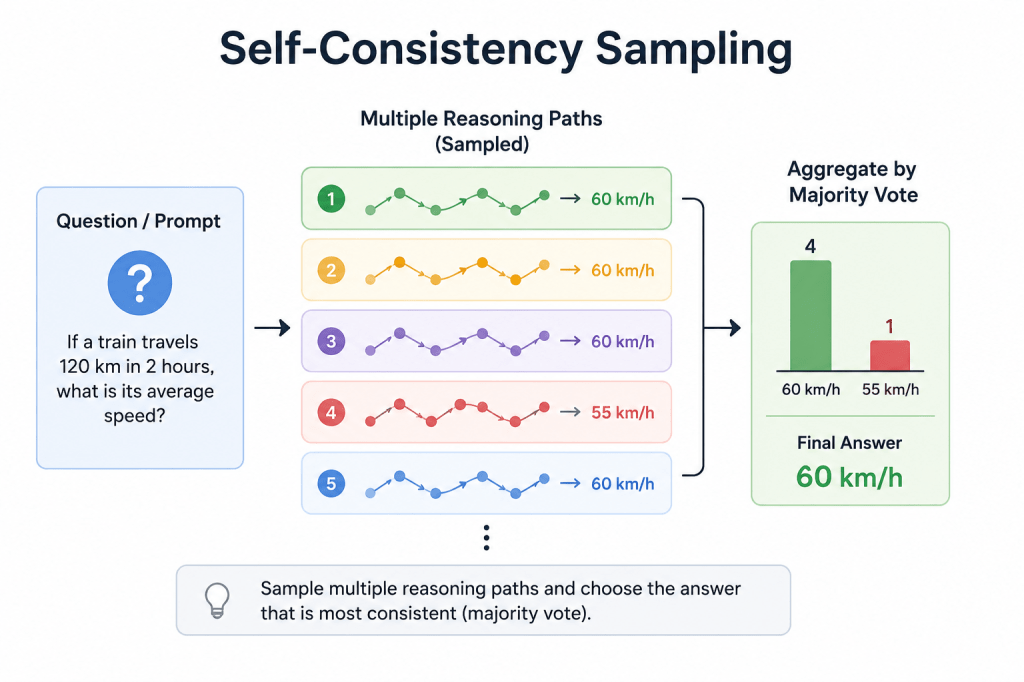
What Is Self-Consistency Sampling?
Self-Consistency Sampling is a reasoning strategy where an AI system:
- generates multiple reasoning paths,
- explores alternative solutions,
- compares the outputs,
- and selects the answer that appears most consistently.
Instead of trusting:
one reasoning trace,
the system relies on:
agreement across multiple independent reasoning attempts.
The assumption is simple:
If multiple reasoning paths independently converge on the same conclusion, the answer is more likely to be correct.
Why Self-Consistency Matters
Chain-of-Thought reasoning improves problem solving significantly, but individual reasoning paths may still:
- contain mistakes,
- follow flawed assumptions,
- drift into hallucinations,
- or fail unpredictably.
A single reasoning chain may:
- appear convincing,
- while still being incorrect.
Self-Consistency Sampling reduces this risk by introducing:
- redundancy,
- alternative exploration,
- and consensus-based reasoning.
Instead of asking:
“What is one possible answer?”
the system asks:
“What answer appears consistently across multiple reasoning paths?”
A Simple Example
Imagine asking an AI system:
“A train travels 240 miles in 4 hours. What is its average speed?”
Single Chain-of-Thought
The model generates:
- 240 ÷ 4 = 60
- The answer is 60 mph
This may be correct.
But if the reasoning path is flawed, the final answer may fail.
Self-Consistency Sampling
The system generates multiple independent reasoning paths.
Reasoning Path 1
- 240 ÷ 4 = 60
Reasoning Path 2
- Distance = 240
- Time = 4
- Speed = 60
Reasoning Path 3
- 240/4 = 60 mph
If all paths converge on:
60 mph
the answer gains additional confidence.
How Self-Consistency Sampling Works
At a high level, Self-Consistency Sampling usually involves several stages.
1. Generate Multiple Reasoning Paths
The model generates:
- several independent reasoning chains,
- often using randomness or sampling variation.
Each reasoning path attempts to solve the same problem independently.
2. Produce Candidate Answers
Each reasoning path produces:
- a conclusion,
- solution,
- or proposed answer.
Different paths may arrive at:
- the same result,
- or conflicting conclusions.
3. Compare Outputs
The system analyzes:
- agreement,
- consistency,
- and convergence across outputs.
4. Select the Most Consistent Answer
The answer that appears most frequently or most consistently is selected as the final output.
This creates a form of:
- consensus reasoning,
- or voting-based inference.
Why Multiple Reasoning Paths Help
Reasoning failures are often:
- local,
- path-dependent,
- or sensitive to intermediate mistakes.
A single reasoning chain may fail due to:
- one incorrect assumption,
- arithmetic drift,
- or logical inconsistency.
Generating multiple reasoning paths reduces dependence on:
one fragile reasoning trajectory.
This often improves:
- reasoning robustness,
- mathematical accuracy,
- and planning reliability.
Self-Consistency vs Chain-of-Thought
The two approaches are closely related.
Chain-of-Thought
Chain-of-Thought reasoning generates:
one explicit reasoning chain.
The system:
- reasons step-by-step,
- and produces an answer.
Self-Consistency Sampling
Self-Consistency extends this idea by:
- generating multiple reasoning chains,
- comparing outcomes,
- and selecting the strongest consensus result.
This introduces:
- redundancy,
- exploration,
- and reliability improvement.
Related article:
Self-Consistency vs Tree-of-Thoughts
Although related, these architectures differ.
Self-Consistency Sampling
Focuses primarily on:
- multiple independent reasoning chains,
- and consensus-based selection.
Tree-of-Thoughts
Focuses on:
- branching reasoning trees,
- search,
- evaluation,
- and structured exploration.
Tree-of-Thoughts is generally:
- more exploratory,
- more search-oriented,
- and more computationally complex.
Related article:
- Tree-of-Thoughts Explained
Self-Consistency and Reasoning Benchmarks
Self-Consistency Sampling often improves performance on:
- reasoning benchmarks,
- mathematical tasks,
- coding problems,
- and planning challenges.
Benchmarks such as:
- GSM8K,
- MATH,
- GPQA,
- and reasoning-heavy evaluation suites
often benefit from consensus-based reasoning strategies.
This is one reason modern reasoning models increasingly incorporate:
- multiple reasoning passes,
- deliberative inference,
- and structured evaluation pipelines.
Related articles:
- What Is GSM8K?
- Deliberative Inference Explained
- Test-Time Compute Explained
Self-Consistency and Test-Time Compute
Self-Consistency Sampling requires additional computation during inference.
Instead of:
generating one answer,
the model generates:
- many reasoning chains,
- multiple candidate outputs,
- and repeated reasoning passes.
This increases:
- token usage,
- latency,
- and computational cost.
The tradeoff is:
- stronger reasoning reliability,
- improved robustness,
- and better accuracy.
This reflects the broader trend toward:
test-time reasoning scaling.
Self-Consistency and Reflection Systems
Self-Consistency Sampling is often combined with:
- reflection loops,
- verifier systems,
- and process supervision architectures.
A reasoning system may:
- generate multiple reasoning paths,
- reflect on outputs,
- evaluate consistency,
- and refine the final answer.
This creates increasingly sophisticated:
- deliberative reasoning pipelines,
- and autonomous reasoning systems.
Related articles:
- Reflection Loops in AI Systems
- Verifier Models Explained
- Process Supervision
Self-Consistency in Autonomous Agents
Autonomous agents often face:
- uncertain environments,
- dynamic objectives,
- and long-horizon reasoning tasks.
A single flawed reasoning chain may:
- derail workflows,
- trigger incorrect actions,
- or produce unreliable plans.
Self-Consistency helps agents:
- compare alternatives,
- reduce reasoning failures,
- and improve planning quality.
This is becoming increasingly important for:
- coding agents,
- research systems,
- workflow orchestration,
- and autonomous planning architectures.
Limitations of Self-Consistency Sampling
Although powerful, Self-Consistency Sampling still has limitations.
Multiple reasoning chains may:
- repeat the same mistake,
- converge on incorrect assumptions,
- or amplify shared hallucinations.
Consensus does not always guarantee:
- correctness,
- truth,
- or reliability.
Additionally, the approach increases:
- computational expense,
- latency,
- and inference complexity.
This creates important engineering tradeoffs between:
- reliability,
- and efficiency.
Emerging Variants of Self-Consistency
The field is evolving rapidly.
Modern systems increasingly combine Self-Consistency with:
- reflection architectures,
- verifier models,
- tree search,
- multi-agent reasoning,
- and adaptive planning systems.
Future reasoning systems may dynamically:
- allocate reasoning depth,
- explore alternative solutions,
- and evaluate confidence adaptively.
Practical Applications
Self-Consistency Sampling is increasingly useful for:
- mathematics,
- coding,
- planning,
- scientific reasoning,
- autonomous agents,
- and evaluation systems.
Applications requiring:
- reliability,
- robustness,
- and long reasoning chains
often benefit significantly from consensus-based inference strategies.
Python Example: Simplified Self-Consistency Workflow
Below is a simplified conceptual example.
answers = []for _ in range(5): reasoning_path = generate_reasoning(problem) answer = extract_answer(reasoning_path) answers.append(answer)final_answer = most_common(answers)print(final_answer)
This simplified workflow demonstrates:
- repeated reasoning generation,
- answer aggregation,
- and consensus selection.
Real systems often include:
- scoring systems,
- verifier models,
- and reflection architectures.
Self-Consistency and the Future of AI
Self-Consistency Sampling represents an important step toward:
- more reliable reasoning,
- deliberative inference,
- and autonomous problem solving.
The industry is increasingly moving from:
single-pass prediction systems
toward:
systems that explore, evaluate, compare, and deliberate before acting.
This shift is influencing:
- reasoning architectures,
- autonomous agents,
- evaluation systems,
- and cognitive AI research.
Self-Consistency is increasingly viewed as:
one of the foundational mechanisms behind reliable reasoning AI systems.
Related Concepts
- Chain-of-Thought Reasoning
- Tree-of-Thoughts
- Reflection Systems
- Verifier Models
- Process Supervision
- Deliberative Inference
- Test-Time Compute
- Planning Systems
- Multi-Agent Reasoning
- Consensus-Based Inference
👉 You can experiment with a practical Python implementation of this concept in the official GitHub repository for the Reasoning Systems examples: https://github.com/BenardoKemp/reasoningsystems/tree/main/reasoning-architectures/self-consistency-sampling
 Reasoning Systems