As AI systems become more capable, researchers are increasingly exploring ways to improve:
- reasoning quality,
- planning ability,
- problem solving,
- and long-horizon decision-making.
One important development in this area is a reasoning architecture known as Tree-of-Thoughts (ToT).
Tree-of-Thoughts expands upon Chain-of-Thought reasoning by allowing AI systems to:
- explore multiple reasoning paths,
- compare alternatives,
- evaluate intermediate states,
- backtrack from poor decisions,
- and search through solution spaces more systematically.
Instead of following a single linear chain of reasoning, Tree-of-Thoughts structures reasoning more like:
- a search tree,
- a branching decision process,
- or a planning architecture.
This approach is becoming increasingly important for:
- reasoning models,
- autonomous agents,
- planning systems,
- and advanced AI problem-solving architectures.
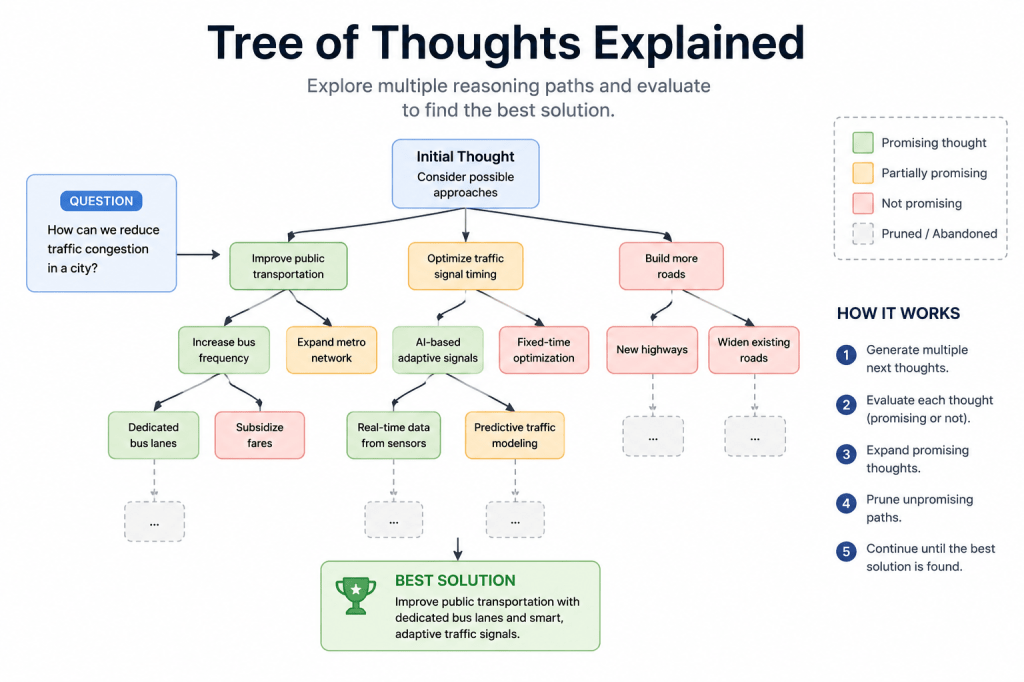
What Is Tree-of-Thoughts?
Tree-of-Thoughts is a reasoning framework where an AI system explores multiple possible reasoning paths instead of relying on a single sequential chain of thought.
Rather than:
generating one reasoning path from start to finish,
the system:
- branches into multiple candidate thoughts,
- evaluates alternatives,
- explores promising paths,
- and discards weaker reasoning trajectories.
This process resembles:
- search algorithms,
- planning systems,
- decision trees,
- and game-tree exploration.
Tree-of-Thoughts attempts to improve:
- reasoning robustness,
- planning quality,
- and complex problem solving.
Why Tree-of-Thoughts Was Developed
Traditional Chain-of-Thought reasoning works well for many tasks, but it still has limitations.
A single reasoning chain may:
- make early mistakes,
- follow poor assumptions,
- drift into incorrect logic,
- or fail to explore better alternatives.
Once the reasoning path becomes flawed, the final answer may also fail.
Tree-of-Thoughts attempts to solve this problem by introducing:
- branching,
- exploration,
- evaluation,
- and backtracking.
Instead of committing to one reasoning trajectory, the system explores multiple possibilities.
Chain-of-Thought vs Tree-of-Thoughts
The difference between the two architectures is fundamental.
Chain-of-Thought
Chain-of-Thought reasoning follows:
one sequential reasoning path.
The system:
- generates step 1,
- generates step 2,
- continues reasoning,
- and produces a conclusion.
This is:
- linear,
- sequential,
- and relatively efficient.
Tree-of-Thoughts
Tree-of-Thoughts reasoning instead:
- branches into multiple possibilities,
- evaluates candidate thoughts,
- explores alternatives,
- and searches for stronger reasoning paths.
This creates:
- a reasoning tree,
- rather than a single reasoning chain.
Related articles:
A Simple Example
Imagine solving a maze.
Chain-of-Thought Approach
The AI chooses:
- one direction,
- and continues moving forward step-by-step.
If the reasoning path is incorrect, the model may fail entirely.
Tree-of-Thoughts Approach
The AI instead:
- explores multiple routes,
- evaluates progress,
- backtracks when necessary,
- and compares alternatives.
This often improves:
- reliability,
- flexibility,
- and problem-solving quality.
How Tree-of-Thoughts Works
At a high level, Tree-of-Thoughts systems typically involve several stages.
1. Generate Candidate Thoughts
The model generates multiple possible reasoning steps or solution paths.
These become:
- branches,
- or nodes within the reasoning tree.
2. Evaluate Candidate Paths
The system evaluates:
- logical quality,
- progress,
- consistency,
- or estimated usefulness.
Some branches are prioritized.
Others are discarded.
3. Expand Promising Paths
The strongest reasoning branches are explored further.
The system continues:
- branching,
- evaluating,
- and expanding reasoning states.
4. Search for Solutions
Eventually the system:
- identifies strong reasoning trajectories,
- converges on a solution,
- or selects the best available path.
This resembles:
- heuristic search,
- planning systems,
- and decision-tree exploration.
Why Tree-of-Thoughts Improves Reasoning
Linear reasoning can become trapped by:
- early mistakes,
- flawed assumptions,
- or incomplete exploration.
Tree-of-Thoughts reduces this risk by:
- exploring alternatives,
- revisiting decisions,
- and searching more broadly.
This often improves:
- problem decomposition,
- planning quality,
- mathematical reasoning,
- and strategic decision-making.
The architecture is particularly useful for:
- tasks requiring exploration,
- multi-step planning,
- and complex reasoning chains.
rch and Planning in AI
Tree-of-Thoughts connects modern language models with classical AI search techniques.
Historically, AI systems often relied on:
- tree search,
- planning algorithms,
- game search,
- and heuristic exploration.
Tree-of-Thoughts reintroduces these ideas into modern reasoning systems.
This creates an important bridge between:
- neural reasoning,
- and classical symbolic search architectures.
Related articles:
- Planning Systems Explained
- Deliberative Search in AI
- Symbolic vs Neural Reasoning
Tree-of-Thoughts and Deliberative Reasoning
Tree-of-Thoughts is closely related to:
- deliberative inference,
- reflection systems,
- and test-time compute scaling.
Instead of immediately generating answers, the system allocates:
- more reasoning steps,
- more search depth,
- and more exploration.
This trend represents a major shift in AI development:
from immediate prediction
toward:
structured reasoning and deliberation.
Related articles:
- Deliberative Inference Explained
- Test-Time Compute Explained
- Reflection Systems in AI
Evaluation and Branch Scoring
One major challenge in Tree-of-Thoughts systems is evaluating reasoning branches.
The system must decide:
- which paths are promising,
- which should be expanded,
- and which should be discarded.
Evaluation strategies may involve:
- heuristic scoring,
- verifier models,
- self-evaluation,
- or external feedback systems.
This creates strong connections with:
- process supervision,
- reflection architectures,
- and evaluation systems.
Related articles:
- Verifier Models Explained
- Process Supervision
- Self-Consistency Sampling
Tree-of-Thoughts and Autonomous Agents
Autonomous agents often face:
- uncertain environments,
- long-horizon tasks,
- dynamic objectives,
- and complex planning requirements.
Linear reasoning may not be sufficient for:
- adaptive workflows,
- strategic planning,
- or multi-step execution.
Tree-of-Thoughts architectures help agents:
- evaluate alternatives,
- simulate plans,
- compare strategies,
- and adapt dynamically.
This makes Tree-of-Thoughts increasingly important for:
- autonomous AI systems,
- planning agents,
- and orchestration frameworks.
Computational Tradeoffs
Tree-of-Thoughts reasoning is more computationally expensive than simple Chain-of-Thought prompting.
The system may generate:
- multiple reasoning branches,
- many candidate thoughts,
- and repeated evaluations.
This increases:
- inference cost,
- latency,
- and computational complexity.
The tradeoff is:
- improved reasoning quality,
- greater robustness,
- and stronger planning ability.
This balance between:
- compute efficiency,
- and reasoning depth
is becoming a central issue in modern reasoning AI.
Tree-of-Thoughts and Test-Time Compute
Modern reasoning systems increasingly allocate additional computation during inference.
Tree-of-Thoughts naturally fits into this trend because:
- more branches,
- more evaluations,
- and deeper search
require additional compute resources.
This is part of the broader movement toward:
test-time reasoning scaling.
Related articles:
- Test-Time Compute Scaling
- Deliberative Inference Systems
- Long-Horizon Reasoning
Emerging Variants of Tree-of-Thoughts
The field is evolving rapidly.
Researchers are increasingly exploring:
- graph-based reasoning,
- reflection-enhanced search,
- multi-agent reasoning trees,
- adaptive branching systems,
- and hierarchical planning architectures.
Modern reasoning systems are gradually becoming:
- more exploratory,
- more reflective,
- and more planning-oriented.
Practical Applications
Tree-of-Thoughts architectures are increasingly relevant for:
- coding systems,
- autonomous agents,
- mathematical reasoning,
- strategic planning,
- robotics,
- and scientific problem solving.
Applications often involve:
- complex search spaces,
- multiple solution paths,
- and dynamic decision-making.
As reasoning systems become more autonomous, Tree-of-Thoughts-like architectures are likely to become increasingly important.
Python Example: Simplified Tree-of-Thoughts Workflow
Below is a conceptual example of a simplified Tree-of-Thoughts reasoning structure.
candidate_thoughts = generate_possible_steps(problem)scored_paths = []for thought in candidate_thoughts: score = evaluate_reasoning(thought) scored_paths.append((thought, score))best_paths = select_top_paths(scored_paths)expand(best_paths)
This simplified workflow demonstrates:
- branching,
- evaluation,
- selection,
- and reasoning expansion.
Real systems are often significantly more sophisticated.
Tree-of-Thoughts and the Future of AI
Tree-of-Thoughts represents an important shift in AI reasoning.
The industry is increasingly moving from:
direct answer generation
toward:
structured reasoning systems capable of exploration, planning, and deliberation.
This transition is influencing:
- reasoning architectures,
- autonomous agents,
- evaluation systems,
- and cognitive AI research.
Tree-of-Thoughts is increasingly viewed as:
one of the foundational architectures behind advanced reasoning AI systems.
Related Concepts
- Chain-of-Thought Reasoning
- Reflection Systems
- Self-Consistency Sampling
- Verifier Models
- Deliberative Inference
- Process Supervision
- Planning Systems
- Test-Time Compute
- Multi-Agent Reasoning
- Cognitive Search Architectures
Continue Exploring
To continue exploring reasoning architectures, consider reading:
- Reflection Loops in AI Systems
- Self-Consistency Sampling
- What Are Verifier Models?
- Deliberative Inference Explained
- Planning Systems in Autonomous AI
These concepts build directly on the reasoning foundations introduced by Tree-of-Thoughts architectures.
👉 You can experiment with a practical Python implementation of this concept in the official GitHub repository for the Reasoning Systems examples: https://github.com/BenardoKemp/reasoningsystems/tree/main/reasoning-architectures/tree-of-thoughts-explained
 Reasoning Systems