Modern AI systems are increasingly moving beyond:
- immediate response generation,
- single-pass prediction,
- and shallow reasoning workflows.
Instead, many advanced reasoning architectures are beginning to allocate:
- additional reasoning time,
- structured exploration,
- intermediate evaluation,
- and iterative planning
before producing an answer.
This shift is often described as deliberative inference.
Deliberative inference refers to reasoning systems that:
- think longer,
- evaluate alternatives,
- revise intermediate reasoning,
- and allocate additional computation during inference.
Rather than instantly generating outputs, deliberative systems attempt to:
reason through problems more carefully before acting.
This approach is becoming increasingly important for:
- reasoning models,
- autonomous agents,
- planning systems,
- coding assistants,
- and complex decision-making architectures.
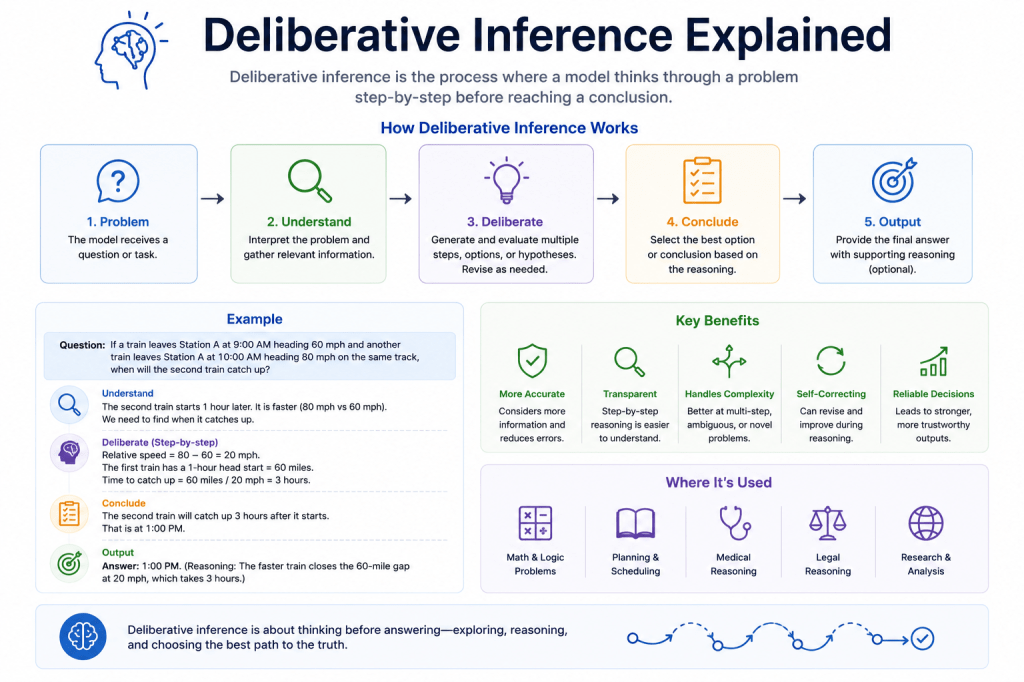
What Is Deliberative Inference?
Deliberative inference is an AI reasoning strategy where the system performs:
- extended reasoning,
- structured exploration,
- evaluation,
- or iterative refinement
during inference time before producing a final output.
Instead of:
generating one immediate answer,
the system may:
- explore alternatives,
- generate intermediate reasoning paths,
- evaluate candidate solutions,
- revise conclusions,
- and select stronger outputs.
This creates a more:
- reflective,
- planning-oriented,
- and reliability-focused reasoning process.
Why Deliberative Inference Matters
Traditional language models often behave like:
- next-token prediction systems.
They generate outputs rapidly, but this speed may come at the cost of:
- reasoning quality,
- consistency,
- planning,
- and reliability.
Many difficult tasks require:
- exploration,
- evaluation,
- revision,
- and structured reasoning.
Deliberative inference attempts to improve these capabilities by allowing systems to:
spend more computational effort reasoning before responding.
This is especially important for:
- mathematics,
- coding,
- scientific reasoning,
- planning,
- and autonomous workflows.
Fast Inference vs Deliberative Inference
The distinction between these approaches is increasingly important.
Fast Inference
Traditional inference prioritizes:
- speed,
- efficiency,
- and immediate output generation.
The model:
- receives a prompt,
- predicts tokens,
- and generates a response directly.
This works well for:
- conversational tasks,
- summarization,
- translation,
- and simple requests.
Deliberative Inference
Deliberative systems instead:
- reason longer,
- evaluate alternatives,
- revise outputs,
- and perform structured exploration.
This often improves:
- reasoning quality,
- planning consistency,
- and robustness.
The tradeoff is:
- higher compute cost,
- increased latency,
- and more complex inference pipelines.
Deliberative Inference and Test-Time Compute
One of the most important concepts connected to deliberative inference is:
test-time compute.
Test-time compute refers to allocating additional computational resources during inference.
Instead of:
solving problems immediately,
the system may:
- generate multiple reasoning paths,
- evaluate candidate solutions,
- perform reflection,
- and deliberate before answering.
Modern reasoning systems increasingly scale intelligence through:
- additional reasoning effort during inference,
- not only through larger training datasets.
Related article:
- Test-Time Compute Explained
Deliberative Inference and Chain-of-Thought
Chain-of-Thought reasoning was one of the earliest major steps toward deliberative inference.
Chain-of-Thought systems:
- generate intermediate reasoning traces,
- and solve problems step-by-step.
Deliberative inference extends this idea by introducing:
- reflection,
- branching,
- evaluation,
- search,
- and iterative revision.
This creates richer reasoning architectures.
Related article:
Deliberative Inference and Tree-of-Thoughts
Tree-of-Thoughts is one of the clearest examples of deliberative reasoning.
Instead of following:
one reasoning chain,
Tree-of-Thoughts systems:
- explore multiple reasoning branches,
- evaluate alternatives,
- backtrack,
- and search for stronger solutions.
This creates a more:
- exploratory,
- planning-oriented,
- and deliberative reasoning process.
Related article:
Deliberative Inference and Reflection
Reflection loops are another major component of deliberative systems.
Reflective architectures may:
- generate an answer,
- critique the reasoning,
- revise the solution,
- and repeat the process iteratively.
This introduces:
- self-monitoring,
- revision,
- and adaptive correction mechanisms.
Reflection significantly increases reasoning depth.
Related article:
Deliberative Inference and Self-Consistency
Some reasoning systems improve reliability by generating:
- multiple reasoning paths,
- multiple candidate answers,
- and consensus-based outputs.
This is known as:
Self-Consistency Sampling.
Instead of trusting:
one reasoning chain,
the system compares multiple solutions and selects the most consistent result.
This creates another form of deliberative reasoning.
Related article:
Search and Exploration in Deliberative Systems
Many deliberative architectures increasingly resemble:
- search systems,
- planning systems,
- or decision-making frameworks.
The system may:
- explore alternative strategies,
- simulate outcomes,
- compare reasoning paths,
- and evaluate future states.
This creates strong connections between:
- modern reasoning AI,
- and classical AI search techniques.
Related articles:
- Planning Systems Explained
- Deliberative Search in AI
- Cognitive Search Architectures
Deliberative Inference in Autonomous Agents
Autonomous agents often require:
- long-horizon planning,
- adaptive workflows,
- tool coordination,
- and dynamic decision-making.
Simple one-pass generation is often insufficient for:
- complex execution environments,
- evolving goals,
- or uncertain tasks.
Deliberative reasoning helps agents:
- plan more carefully,
- revise strategies,
- and improve reliability.
This is becoming increasingly important for:
- coding agents,
- research agents,
- and enterprise automation systems.
Related article:
- What Are AI Agents?
Deliberative Inference and Coding Systems
Coding systems benefit heavily from deliberative reasoning.
A coding agent may:
- generate code,
- evaluate outputs,
- run tests,
- revise implementations,
- and retry iteratively.
This creates:
- more reliable code generation,
- stronger debugging capabilities,
- and improved planning quality.
Modern coding agents increasingly depend on:
- reflection,
- verification,
- and iterative reasoning pipelines.
Computational Tradeoffs
Deliberative inference introduces major computational tradeoffs.
The system may require:
- more tokens,
- more reasoning steps,
- more evaluation passes,
- and deeper search.
This increases:
- inference cost,
- latency,
- and orchestration complexity.
However, it often significantly improves:
- reasoning quality,
- robustness,
- planning ability,
- and task reliability.
This balance between:
- efficiency,
- and reasoning depth
is becoming one of the central engineering challenges in modern AI.
Deliberative Inference and AI Scaling
Historically, AI progress often focused on:
- larger models,
- larger datasets,
- and more training compute.
Modern reasoning systems increasingly suggest another scaling path:
scaling reasoning effort during inference.
This means intelligence may increasingly depend not only on:
- model size,
but also on:
- how effectively systems deliberate,
- search,
- evaluate,
- and reason dynamically.
This is one of the most important trends in modern reasoning AI research.
Emerging Deliberative Architectures
The field is evolving rapidly.
Modern systems increasingly explore:
- reasoning-aware routing,
- recursive planning,
- reflection-enhanced search,
- multi-agent deliberation,
- verifier-guided reasoning,
- and adaptive reasoning depth.
Future AI systems may dynamically:
- allocate reasoning effort,
- adapt planning complexity,
- and balance speed versus reliability automatically.
Practical Applications
Deliberative inference is increasingly important for:
- mathematics,
- coding,
- scientific reasoning,
- autonomous agents,
- robotics,
- and enterprise workflows.
Applications requiring:
- planning,
- reliability,
- or long reasoning chains
often benefit heavily from deliberative reasoning architectures.
Python Example: Simplified Deliberative Workflow
Below is a simplified conceptual example.
candidate_solutions = generate_multiple_paths(problem)evaluated = evaluate_solutions(candidate_solutions)best_solution = select_best(evaluated)print(best_solution)
Real deliberative systems may involve:
- search trees,
- reflection loops,
- verifier models,
- and orchestration pipelines.
Deliberative Inference and the Future of AI
Deliberative inference represents a major transition in AI development.
The industry is increasingly moving from:
immediate prediction systems
toward:
reasoning systems capable of exploration, reflection, planning, and iterative problem solving.
This shift is influencing:
- reasoning architectures,
- autonomous agents,
- coding systems,
- evaluation frameworks,
- and cognitive AI research.
Deliberative inference is increasingly viewed as:
one of the foundational mechanisms behind advanced reasoning AI systems.
Related Concepts
- Chain-of-Thought Reasoning
- Tree-of-Thoughts
- Reflection Systems
- Self-Consistency Sampling
- Verifier Models
- Test-Time Compute
- Planning Systems
- Process Supervision
- Autonomous Agents
- Cognitive Search Architectures
Continue Exploring
To continue exploring reasoning architectures, consider reading:
- Test-Time Compute Explained
- Process Supervision Explained
- Planning Systems in Autonomous AI
- Reflection Loops in AI Systems
- What Are Verifier Models?
These concepts build directly on the reasoning foundations introduced by deliberative inference systems.
 Reasoning Systems