Modern AI systems are increasingly capable of:
- reasoning through problems,
- planning multi-step workflows,
- generating code,
- and operating autonomously.
However, one major challenge remains:
How do we know whether an AI system is reasoning correctly internally?
Traditional AI evaluation often focuses only on:
- the final answer,
- the final prediction,
- or the final output.
But reasoning systems may still:
- arrive at correct answers using flawed reasoning,
- hallucinate intermediate logic,
- or produce convincing but unreliable reasoning traces.
This has led to growing interest in a concept known as Process Supervision.
Process supervision evaluates:
how an AI system reasons,
not only:
what final answer it produces.
This is becoming increasingly important for:
- reasoning models,
- autonomous agents,
- coding systems,
- and reliable AI architectures.
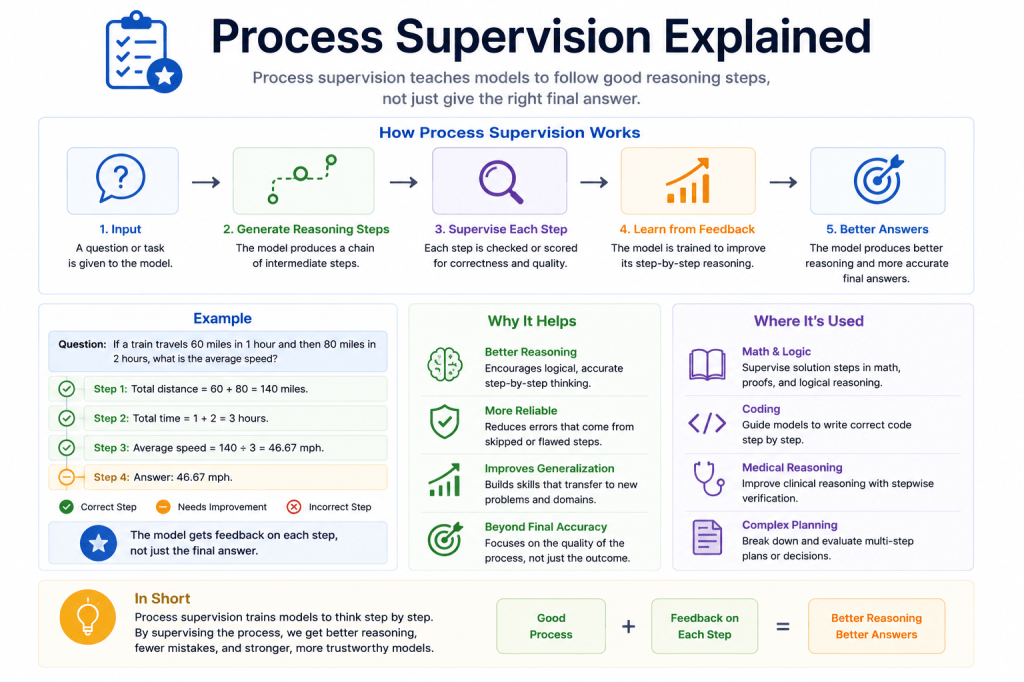
What Is Process Supervision?
Process supervision is an AI training and evaluation approach that focuses on supervising:
- intermediate reasoning steps,
- thought processes,
- planning sequences,
- and reasoning traces.
Instead of evaluating only:
the final output,
process supervision evaluates:
the reasoning process itself.
This means AI systems may receive feedback on:
- intermediate thoughts,
- logical structure,
- planning quality,
- and reasoning correctness.
The goal is to improve:
- reliability,
- transparency,
- robustness,
- and reasoning quality.
Why Process Supervision Matters
Traditional outcome-based evaluation has an important limitation.
A model may:
- accidentally arrive at the correct answer,
- while using flawed reasoning internally.
For example:
- arithmetic mistakes may cancel each other,
- reasoning shortcuts may appear successful,
- or hallucinated logic may still lead to correct outputs.
This creates problems because:
- unreliable reasoning may fail unpredictably,
- and autonomous systems may become unsafe.
Process supervision attempts to solve this by evaluating:
the reasoning trajectory itself.
Outcome Supervision vs Process Supervision
The distinction between these approaches is fundamental.
Outcome Supervision
Outcome supervision evaluates:
- the final answer,
- final prediction,
- or final task completion.
Example:
“Did the model get the correct answer?”
This is:
- simple,
- scalable,
- and efficient.
However, it ignores:
- how the answer was produced.
Process Supervision
Process supervision instead evaluates:
- intermediate reasoning steps,
- planning structure,
- and logical progression.
Example:
“Did the reasoning process itself make sense?”
This creates:
- deeper reasoning oversight,
- improved interpretability,
- and stronger reliability mechanisms.
A Simple Example
Imagine solving a math problem.
Outcome Supervision
The model outputs:
“42”
If the answer is correct, the system passes.
The reasoning itself may never be evaluated.
Process Supervision
The system instead evaluates:
- intermediate calculations,
- logical consistency,
- reasoning steps,
- and problem decomposition.
Even if the final answer is correct, flawed intermediate reasoning may still be penalized.
This encourages:
- stronger reasoning behavior,
- not just successful outcomes.
Why Intermediate Reasoning Matters
Reasoning failures often occur because:
- early assumptions are incorrect,
- logic becomes inconsistent,
- or hallucinated reasoning propagates through the solution.
Final-answer evaluation may fail to detect these issues.
Process supervision helps identify:
- unstable reasoning,
- weak logical structure,
- and inconsistent planning.
This becomes increasingly important as AI systems gain:
- autonomy,
- tool usage,
- and long-horizon planning capabilities.
Process Supervision and Chain-of-Thought
Chain-of-Thought reasoning introduced explicit reasoning traces into AI systems.
Instead of:
directly generating answers,
the system:
- reasons step-by-step,
- and exposes intermediate thoughts.
Process supervision naturally builds on this idea.
It evaluates:
- whether those intermediate reasoning steps are actually valid.
Related article:
Process Supervision and Verifier Models
Verifier systems are often central to process supervision.
A verifier model may:
- inspect reasoning traces,
- evaluate intermediate steps,
- identify logical inconsistencies,
- and score reasoning quality.
This creates a reasoning architecture involving:
- generation,
- verification,
- and revision.
Related article:
Process Supervision and Reflection Systems
Reflection architectures often rely heavily on process supervision.
Reflective systems may:
- generate reasoning,
- critique intermediate thoughts,
- revise flawed logic,
- and improve outputs iteratively.
This creates:
- self-monitoring reasoning systems,
- and iterative correction pipelines.
Related article:
Process Supervision and Autonomous Agents
Autonomous agents increasingly require:
- reliable planning,
- adaptive reasoning,
- and structured decision-making.
A final task outcome alone may not reveal:
- whether the reasoning process was safe,
- reliable,
- or stable.
Process supervision helps agents:
- evaluate reasoning quality,
- monitor execution,
- and improve planning reliability.
This is becoming increasingly important for:
- coding agents,
- workflow systems,
- and enterprise AI automation.
Related article:
- What Are AI Agents?
Process Reward Models
Some advanced reasoning systems use:
Process Reward Models (PRMs).
These systems assign rewards not only for:
- final success,
but also for:
- high-quality intermediate reasoning.
This creates stronger incentives for:
- coherent planning,
- logical structure,
- and reliable reasoning behavior.
PRMs are becoming increasingly important in:
- reasoning model research,
- and advanced AI alignment systems.
Process Supervision and AI Alignment
Process supervision is increasingly viewed as an important alignment mechanism.
If AI systems become:
- more autonomous,
- more capable,
- and more strategic,
understanding:
how they reason
may become critically important.
Process supervision helps improve:
- transparency,
- interpretability,
- and behavioral oversight.
This makes it increasingly relevant for:
- trustworthy AI,
- safe autonomous systems,
- and long-term AI governance.
Challenges of Process Supervision
Although powerful, process supervision also introduces major challenges.
Evaluating reasoning processes can be:
- expensive,
- subjective,
- computationally intensive,
- and difficult to scale.
Reasoning traces themselves may also:
- be incomplete,
- misleading,
- or strategically optimized.
Additionally, high-quality reasoning supervision often requires:
- expert human feedback,
- verifier systems,
- or sophisticated evaluation pipelines.
Process Supervision vs Outcome Optimization
One important research question is whether:
- optimizing reasoning quality
produces more reliable intelligence than:
- optimizing final outcomes alone.
Many researchers increasingly believe:
reliable reasoning processes matter as much as final answers.
This is especially important for:
- autonomous systems,
- scientific AI,
- and long-horizon planning architectures.
Emerging Trends in Process Supervision
The field is evolving rapidly.
Modern reasoning systems increasingly explore:
- process reward models,
- reasoning-aware verification,
- recursive reflection,
- multi-agent critique systems,
- and adaptive reasoning evaluation.
Future AI systems may increasingly:
- monitor their own reasoning,
- evaluate internal plans,
- and revise intermediate logic dynamically.
Practical Applications
Process supervision is increasingly relevant for:
- mathematical reasoning,
- coding systems,
- autonomous agents,
- scientific AI,
- enterprise workflows,
- and reasoning benchmarks.
Applications requiring:
- reliability,
- transparency,
- and structured reasoning
often benefit heavily from process-based evaluation systems.
Python Example: Simplified Process Supervision Workflow
Below is a simplified conceptual example.
reasoning_steps = generate_reasoning(problem)evaluation = evaluate_reasoning_steps(reasoning_steps)if evaluation == "valid": final_answer = extract_answer(reasoning_steps) print(final_answer)
Real systems may involve:
- verifier models,
- scoring systems,
- reflection loops,
- and iterative revision pipelines.
Process Supervision and the Future of AI
Process supervision represents a major transition in reasoning AI.
The industry is increasingly moving from:
outcome-only evaluation
toward:
systems that monitor, evaluate, and improve reasoning processes themselves.
This transition is influencing:
- reasoning architectures,
- autonomous agents,
- evaluation frameworks,
- AI alignment research,
- and cognitive AI systems.
Process supervision is increasingly viewed as:
one of the foundational mechanisms behind reliable and trustworthy reasoning AI.
Related Concepts
- Chain-of-Thought Reasoning
- Reflection Systems
- Verifier Models
- Self-Consistency Sampling
- Deliberative Inference
- Test-Time Compute
- Process Reward Models
- Autonomous Agents
- Planning Systems
- AI Evaluation Systems
Continue Exploring
To continue exploring reasoning architectures, consider reading:
- What Are Verifier Models?
- Reflection Loops in AI Systems
- Deliberative Inference Explained
- Test-Time Compute Explained
- Planning Systems in Autonomous AI
These concepts build directly on the reasoning foundations introduced by process supervision systems.
👉 You can experiment with a practical Python implementation of this concept in the official GitHub repository for the Reasoning Systems examples: https://github.com/BenardoKemp/reasoningsystems/tree/main/reasoning-architectures/process-supervision-explained
 Reasoning Systems