Artificial intelligence is rapidly evolving beyond:
- chatbots,
- static prediction systems,
- and simple prompt-response workflows.
Modern AI systems are increasingly expected to:
- pursue goals,
- coordinate tools,
- plan tasks,
- maintain memory,
- adapt dynamically,
- and operate autonomously across complex environments.
These systems are commonly known as:
AI agents.
AI agents are becoming one of the defining architectural trends in modern artificial intelligence.
They represent a major shift from:
passive response generation
toward:
autonomous reasoning and action-oriented systems.
AI agents are increasingly influencing:
- software engineering,
- enterprise automation,
- robotics,
- coding systems,
- research workflows,
- and intelligent operations platforms.
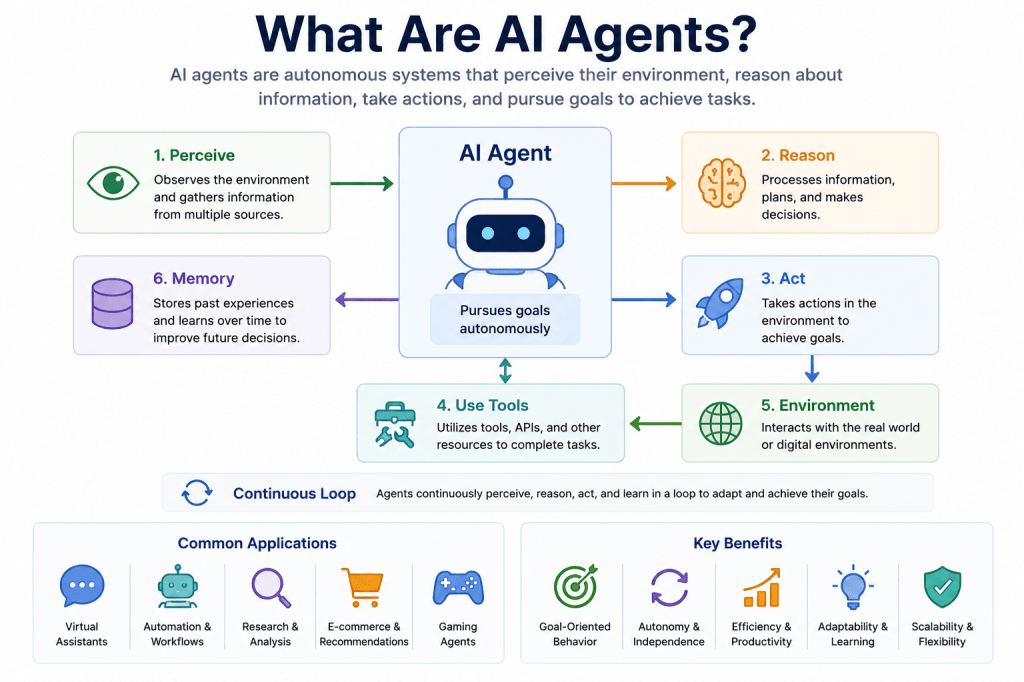
What Is an AI Agent?
An AI agent is a system designed to:
- perceive information,
- reason about objectives,
- plan actions,
- execute tasks,
- and adapt dynamically over time.
Unlike traditional AI chat systems that simply generate responses, agents attempt to:
actively pursue goals.
An AI agent may:
- retrieve information,
- call APIs,
- write code,
- search documents,
- coordinate tools,
- execute workflows,
- and revise strategies autonomously.
Modern agents increasingly combine:
- reasoning systems,
- planning architectures,
- memory systems,
- tool use,
- and orchestration pipelines.
Why AI Agents Matter
Traditional language models are highly capable, but they still have limitations.
Many models:
- operate reactively,
- lack persistent memory,
- struggle with long tasks,
- and cannot reliably coordinate complex workflows.
AI agents attempt to solve these limitations by introducing:
- autonomy,
- planning,
- memory,
- and execution capabilities.
This allows systems to move from:
“Generate an answer.”
toward:
“Understand objectives, plan actions, execute workflows, and adapt dynamically.”
This transition is becoming one of the biggest shifts in modern AI engineering.
A Simple AI Agent Example
Imagine asking an AI system:
“Research the best reasoning AI frameworks and generate a comparison report.”
A modern AI agent may:
- search the web,
- retrieve documentation,
- compare frameworks,
- summarize findings,
- generate tables,
- revise outputs,
- and produce a structured report.
Instead of:
one isolated response,
the system performs:
- coordinated multi-step execution.
This is the essence of agent-based AI systems.
Core Components of AI Agents
Modern AI agents often combine multiple architectural layers.
Reasoning Systems
Agents rely heavily on reasoning architectures to:
- analyze tasks,
- evaluate options,
- solve problems,
- and structure decisions.
This often includes:
- Chain-of-Thought reasoning,
- reflection systems,
- planning architectures,
- and deliberative inference.
Related articles:
- What Is Chain-of-Thought Reasoning?
- Reflection Loops in AI Systems
- Deliberative Inference Explained
Planning Systems
Planning systems help agents:
- organize goals,
- sequence actions,
- prioritize tasks,
- and adapt strategies.
Without planning, agents may:
- behave reactively,
- lose objectives,
- or fail at long workflows.
Planning is one of the foundational mechanisms behind autonomous behavior.
Related article:
- Planning Systems in Autonomous AI
Memory Systems
Agents often require:
- persistent memory,
- workflow continuity,
- and contextual awareness.
Memory systems may include:
- short-term conversational memory,
- vector memory,
- episodic memory,
- or semantic retrieval systems.
Memory allows agents to:
- maintain objectives,
- track state,
- and operate across extended workflows.
Related articles:
- Memory Architectures for AI Agents
- Vector Memory Systems
Tool Use
Modern AI agents increasingly interact with:
- APIs,
- databases,
- browsers,
- spreadsheets,
- shell environments,
- and external software systems.
Tool use transforms language models into:
action-oriented systems.
This is one of the defining characteristics of modern AI agents.
Related article:
- Tool Calling Explained
Reflection and Self-Correction
Advanced agents increasingly use:
- reflection loops,
- verifier systems,
- and iterative reasoning.
This allows systems to:
- critique outputs,
- revise plans,
- detect failures,
- and improve execution quality.
Reflection becomes increasingly important as agents gain:
- autonomy,
- and long-horizon planning ability.
Related article:
- Reflection Loops in AI Systems
Reactive Systems vs Autonomous Agents
The distinction between these systems is important.
Reactive AI Systems
Reactive systems:
- respond immediately,
- generate outputs directly,
- and often lack planning or memory.
Examples:
- simple chatbots,
- basic assistants,
- or static prompt systems.
Autonomous AI Agents
Agents instead:
- pursue goals,
- coordinate workflows,
- maintain state,
- and adapt dynamically.
This creates:
- more flexible,
- more capable,
- and more autonomous systems.
Single-Agent vs Multi-Agent Systems
AI agent architectures vary significantly.
Single-Agent Systems
One agent handles:
- reasoning,
- planning,
- tool use,
- and execution.
These systems are:
- simpler,
- easier to coordinate,
- and easier to deploy.
Multi-Agent Systems
Tasks are distributed across:
- multiple specialized agents.
Examples:
- planner agents,
- researcher agents,
- coding agents,
- verifier agents,
- and orchestration agents.
Multi-agent systems improve:
- specialization,
- scalability,
- and coordination.
Related article:
- Multi-Agent Systems Explained
AI Agents and Long-Horizon Tasks
One of the defining capabilities of AI agents is:
long-horizon execution.
Agents may work through:
- large workflows,
- evolving objectives,
- and dynamic environments.
Examples:
- coding projects,
- enterprise automation,
- autonomous research,
- or operational workflows.
This requires:
- planning,
- memory,
- reasoning,
- and adaptive coordination.
AI Agents and Deliberative Reasoning
Many advanced agents increasingly use:
- deliberative inference,
- reflection systems,
- and structured reasoning pipelines.
Instead of:
acting immediately,
the system may:
- evaluate alternatives,
- revise plans,
- simulate outcomes,
- and deliberate before executing actions.
This improves:
- reliability,
- planning quality,
- and execution safety.
Related articles:
- Deliberative Inference Explained
- Test-Time Compute Explained
AI Agents and Coding Systems
Coding systems are among the most important applications of agent architectures.
Coding agents may:
- analyze requirements,
- generate code,
- run tests,
- debug failures,
- revise implementations,
- and iterate autonomously.
This creates:
- more reliable development workflows,
- and increasingly autonomous software engineering systems.
Modern coding assistants increasingly function as:
agentic reasoning systems.
AI Agents and Enterprise Automation
Enterprise AI increasingly relies on agents for:
- workflow automation,
- monitoring,
- reporting,
- document processing,
- orchestration,
- and operational coordination.
Agents may:
- integrate APIs,
- update systems,
- trigger workflows,
- and coordinate business processes autonomously.
This is becoming one of the largest commercial applications of agent systems.
Challenges of AI Agents
Although powerful, AI agents still face major challenges.
Agents may:
- hallucinate actions,
- misuse tools,
- lose objectives,
- fail at long tasks,
- or behave unpredictably.
Additional challenges include:
- orchestration complexity,
- memory management,
- verification,
- safety,
- and reliability.
This is why modern agent systems increasingly depend on:
- reflection,
- planning,
- verifier models,
- and evaluation frameworks.
Emerging Trends in AI Agents
The field is evolving rapidly.
Modern systems increasingly explore:
- autonomous coding agents,
- memory-augmented agents,
- reasoning-aware orchestration,
- collaborative multi-agent systems,
- and adaptive workflow architectures.
Future AI systems may increasingly operate as:
- persistent,
- autonomous,
- reasoning-driven software systems.
Practical Applications
AI agents are increasingly important for:
- software engineering,
- cybersecurity,
- enterprise automation,
- scientific research,
- workflow orchestration,
- robotics,
- and intelligent operations systems.
Applications requiring:
- long-horizon reasoning,
- adaptive workflows,
- or autonomous coordination
often benefit heavily from agent architectures.
Python Example: Simplified AI Agent Workflow
Below is a simplified conceptual example.
goal = "Research reasoning AI frameworks"plan = create_plan(goal)for task in plan: execute(task)review_results()
Real agent systems may involve:
- memory layers,
- orchestration frameworks,
- tool routing,
- reflection systems,
- and verifier architectures.
AI Agents and the Future of AI
AI agents represent one of the most important transitions in modern artificial intelligence.
The industry is increasingly moving from:
static generation systems
toward:
autonomous reasoning systems capable of planning, execution, adaptation, and goal-directed behavior.
This transition is influencing:
- reasoning architectures,
- enterprise automation,
- software engineering,
- robotics,
- and cognitive AI research.
AI agents are increasingly viewed as:
one of the foundational architectures behind next-generation intelligent systems.
Related Concepts
- Planning Systems
- Chain-of-Thought Reasoning
- Reflection Systems
- Tool Calling
- Multi-Agent Systems
- Deliberative Inference
- Memory Architectures
- Workflow Orchestration
- Test-Time Compute
- Autonomous Systems
Continue Exploring
To continue exploring agent architectures, consider reading:
- Planning Systems in Autonomous AI
- Tool Calling Explained
- Multi-Agent Systems Explained
- Reflection Loops in AI Systems
- Deliberative Inference Explained
These concepts build directly on the foundations introduced by modern AI agent systems.
👉 You can experiment with a practical Python implementation of this concept in the official GitHub repository for the Reasoning Systems examples: https://github.com/BenardoKemp/reasoningsystems/tree/main/agent-systems/what-are-ai-agents
 Reasoning Systems