As AI systems become more autonomous, one capability is becoming increasingly important:
planning.
Modern AI agents are no longer expected to simply:
- answer questions,
- generate text,
- or predict the next token.
Increasingly, they must:
- pursue goals,
- coordinate actions,
- evaluate alternatives,
- manage workflows,
- and operate across long reasoning horizons.
These capabilities depend heavily on planning systems.
Planning systems allow AI architectures to:
- organize objectives,
- sequence actions,
- simulate outcomes,
- revise strategies,
- and adapt dynamically to changing environments.
Planning is becoming one of the foundational mechanisms behind:
- autonomous agents,
- reasoning systems,
- robotics,
- coding agents,
- and enterprise AI workflows.
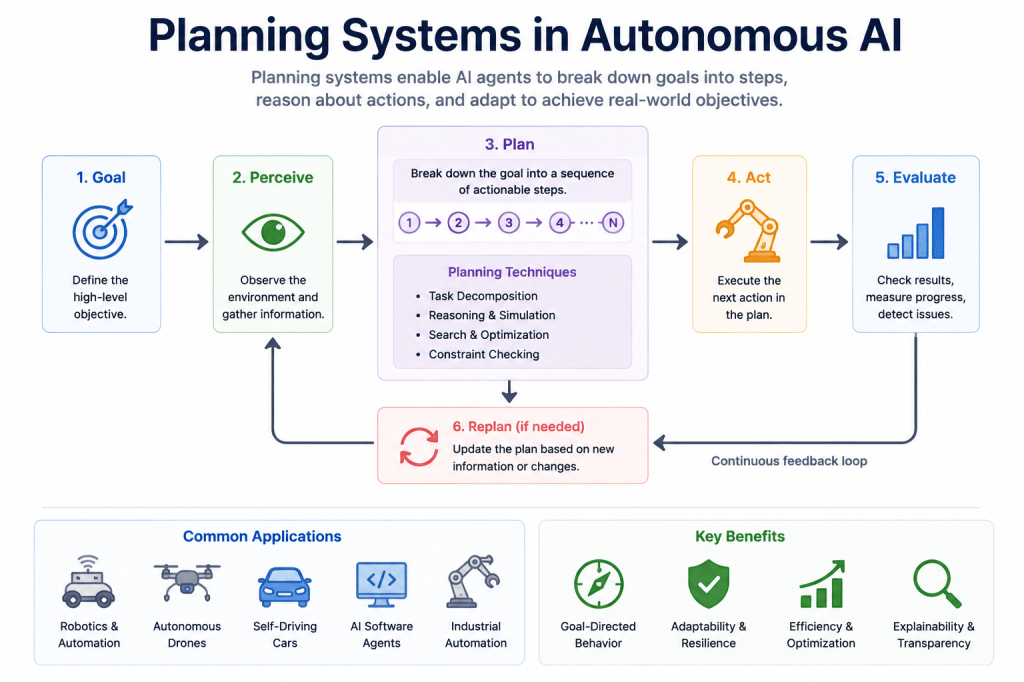
What Are Planning Systems?
A planning system is an AI architecture designed to:
- determine goals,
- organize tasks,
- sequence actions,
- and optimize decision-making over time.
Instead of reacting immediately, planning systems attempt to:
- analyze objectives,
- evaluate options,
- predict consequences,
- and execute structured action sequences.
Planning introduces:
- foresight,
- deliberation,
- and strategic reasoning
into AI systems.
This moves AI from:
reactive behavior
toward:
goal-directed intelligent behavior.
Why Planning Matters in AI
Traditional language models are often:
- reactive,
- short-context,
- and response-oriented.
They may struggle with:
- long tasks,
- evolving objectives,
- dynamic environments,
- and multi-step execution.
Planning systems help solve these limitations by allowing AI systems to:
- maintain objectives,
- coordinate workflows,
- adapt strategies,
- and reason over extended time horizons.
As AI systems become more autonomous, planning becomes increasingly critical for:
- reliability,
- coordination,
- and execution quality.
A Simple Planning Example
Imagine asking an autonomous AI agent:
“Research the top reasoning AI frameworks and generate a comparison report.”
This requires:
- information gathering,
- prioritization,
- summarization,
- organization,
- and structured execution.
A planning system may:
- identify subtasks,
- sequence actions,
- retrieve information,
- compare frameworks,
- generate summaries,
- and compile the final report.
Without planning, the system may:
- lose structure,
- forget objectives,
- or execute tasks inconsistently.
Reactive Systems vs Planning Systems
The distinction between these architectures is fundamental.
Reactive Systems
Reactive systems:
- respond immediately,
- generate outputs directly,
- and often lack long-term coordination.
These systems work well for:
- conversation,
- summarization,
- translation,
- and short tasks.
However, they may struggle with:
- long-horizon reasoning,
- workflow management,
- and adaptive execution.
Planning Systems
Planning systems instead:
- organize objectives,
- evaluate alternatives,
- and coordinate multi-step behavior.
They introduce:
- structured reasoning,
- task decomposition,
- and strategic execution.
Planning systems are foundational to:
- autonomous AI,
- robotics,
- and advanced reasoning architectures.
Core Components of Planning Systems
Modern planning architectures often combine several mechanisms.
Goal Definition
Planning begins with:
- objectives,
- constraints,
- or desired outcomes.
The system must determine:
- what success looks like,
- and what actions are required.
Task Decomposition
Complex goals are often broken into:
- smaller subtasks,
- intermediate objectives,
- or structured workflows.
This improves:
- coordination,
- scalability,
- and execution reliability.
Related article:
Action Sequencing
The system determines:
- execution order,
- dependencies,
- and workflow progression.
This creates:
- structured execution plans.
Evaluation and Revision
Advanced planning systems often:
- monitor progress,
- evaluate outcomes,
- revise strategies,
- and adapt dynamically.
This introduces:
- feedback-driven planning,
- and adaptive reasoning.
Planning and Chain-of-Thought Reasoning
Chain-of-Thought reasoning introduced:
- step-by-step reasoning traces.
Planning systems extend this idea toward:
- action coordination,
- workflow sequencing,
- and strategic execution.
Instead of only:
reasoning sequentially,
planning systems reason about:
future actions and outcomes.
Related article:
Planning and Tree-of-Thoughts
Tree-of-Thoughts architectures naturally support planning behavior.
Instead of:
following one reasoning path,
the system:
- explores alternatives,
- evaluates branches,
- and searches through decision spaces.
This resembles:
- strategic planning,
- search algorithms,
- and decision-tree exploration.
Related article:
Planning and Reflection Systems
Reflection systems improve planning quality by allowing AI systems to:
- critique plans,
- revise strategies,
- identify weaknesses,
- and improve execution.
Reflective planning loops help systems:
- adapt dynamically,
- recover from mistakes,
- and improve reliability.
Related article:
Planning and Autonomous Agents
Planning is one of the defining capabilities of autonomous agents.
Agents often need to:
- coordinate tools,
- manage workflows,
- sequence tasks,
- and pursue long-horizon objectives.
Without planning systems, agents may:
- behave reactively,
- lose objectives,
- or execute actions inconsistently.
Planning architectures help agents:
- maintain structure,
- prioritize tasks,
- and improve reliability.
Related article:
Hierarchical Planning
Some planning systems organize reasoning into multiple layers.
Example:
- high-level goals,
- intermediate strategies,
- and low-level execution steps.
This is known as:
hierarchical planning.
Hierarchical architectures improve:
- scalability,
- coordination,
- and complex workflow management.
These systems are increasingly important for:
- robotics,
- enterprise automation,
- and autonomous AI systems.
Dynamic and Adaptive Planning
Modern environments are often:
- uncertain,
- changing,
- or unpredictable.
Static planning may fail under dynamic conditions.
Adaptive planning systems instead:
- revise strategies continuously,
- respond to feedback,
- and update execution plans dynamically.
This creates more:
- flexible,
- resilient,
- and autonomous systems.
Planning and Tool Use
Planning systems often coordinate:
- external tools,
- APIs,
- databases,
- browsers,
- and execution environments.
The planner may determine:
- which tools to call,
- when to use them,
- and how to sequence actions.
This becomes increasingly important in:
- enterprise AI,
- coding agents,
- and orchestration systems.
Related article:
Planning and Test-Time Compute
Planning often requires:
- additional inference computation,
- deeper reasoning,
- and structured evaluation.
Planning systems may:
- simulate outcomes,
- compare alternatives,
- and deliberate before acting.
This increases:
- latency,
- compute cost,
- and orchestration complexity.
However, it also improves:
- reasoning depth,
- execution quality,
- and reliability.
Related article:
Planning in Coding Agents
Coding systems benefit heavily from planning architectures.
A coding agent may:
- analyze requirements,
- design implementation steps,
- generate code,
- run tests,
- revise failures,
- and iterate dynamically.
Planning improves:
- software reliability,
- debugging quality,
- and workflow coordination.
Modern coding agents increasingly rely on:
- planning loops,
- reflection systems,
- and verifier architectures.
Planning and Multi-Agent Systems
Some advanced architectures distribute planning across:
- multiple specialized agents.
Examples:
- planner agents,
- researcher agents,
- coding agents,
- and verifier agents.
Multi-agent planning systems improve:
- scalability,
- specialization,
- and coordination.
Related article:
Challenges of Planning Systems
Although powerful, planning systems introduce major challenges.
Planning architectures may suffer from:
- reasoning drift,
- incorrect assumptions,
- orchestration failures,
- excessive complexity,
- or unreliable long-horizon execution.
Planning also increases:
- inference cost,
- computational overhead,
- and system complexity.
This creates important tradeoffs between:
- autonomy,
- reliability,
- and efficiency.
Emerging Trends in AI Planning
The field is evolving rapidly.
Modern systems increasingly explore:
- adaptive planning,
- recursive reasoning,
- multi-agent coordination,
- world-model planning,
- reflection-enhanced execution,
- and reasoning-aware orchestration.
Future AI systems will likely depend heavily on:
- dynamic planning architectures,
- and autonomous workflow coordination.
Practical Applications
Planning systems are increasingly important for:
- autonomous agents,
- enterprise AI,
- robotics,
- coding systems,
- research automation,
- and workflow orchestration.
Applications requiring:
- long-horizon reasoning,
- coordination,
- or adaptive execution
often depend heavily on planning architectures.
Python Example: Simplified Planning Workflow
Below is a simplified conceptual planning workflow.
goal = "Generate AI framework comparison report"tasks = decompose_goal(goal)for task in tasks: execute(task)evaluate_results()
Real planning systems may involve:
- memory systems,
- reflection loops,
- verifier models,
- and orchestration frameworks.
Planning Systems and the Future of AI
Planning systems represent one of the biggest transitions in modern AI.
The industry is increasingly moving from:
reactive generation systems
toward:
autonomous reasoning systems capable of goal-directed planning and adaptive execution.
This transition is influencing:
- reasoning architectures,
- autonomous agents,
- robotics,
- cognitive AI systems,
- and enterprise AI workflows.
Planning is increasingly viewed as:
one of the foundational mechanisms behind autonomous intelligence.
Related Concepts
- Chain-of-Thought Reasoning
- Tree-of-Thoughts
- Reflection Systems
- Autonomous Agents
- Deliberative Inference
- Test-Time Compute
- Tool Calling
- Multi-Agent Systems
- Workflow Orchestration
- Cognitive Architectures
Continue Exploring
To continue exploring reasoning architectures, consider reading:
- What Are AI Agents?
- Tool Calling Explained
- Reflection Loops in AI Systems
- Deliberative Inference Explained
- Multi-Agent Systems Explained
These concepts build directly on the reasoning foundations introduced by planning systems in autonomous AI.
👉 You can experiment with a practical Python implementation of this concept in the official GitHub repository for the Reasoning Systems examples: https://github.com/BenardoKemp/reasoningsystems/tree/main/reasoning-architectures/planning-systems-in-autonomous-ai
 Reasoning Systems