As AI systems become more capable, many researchers and engineers are beginning to move beyond:
- single-model architectures,
- isolated reasoning systems,
- and standalone AI agents.
Instead, modern AI increasingly explores systems composed of:
multiple cooperating agents.
These architectures are known as Multi-Agent Systems.
Rather than relying on:
one monolithic AI system,
multi-agent architectures distribute tasks across:
- specialized agents,
- collaborative reasoning systems,
- planning agents,
- verifier agents,
- and orchestration layers.
This approach is becoming increasingly important for:
- autonomous workflows,
- coding systems,
- enterprise automation,
- scientific reasoning,
- and large-scale AI coordination.
Multi-agent systems represent a major transition from:
isolated AI behavior
toward:
collaborative intelligent systems.
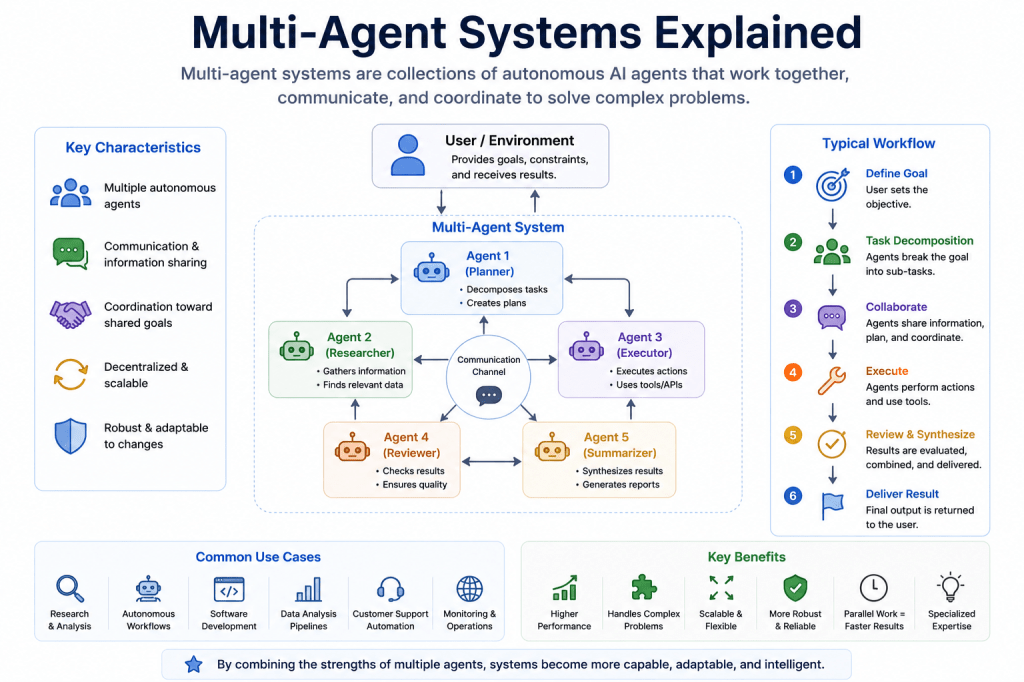
What Is a Multi-Agent System?
A multi-agent system (MAS) is an AI architecture where:
- multiple agents,
- models,
- or autonomous components
interact to solve problems collaboratively.
Each agent may:
- specialize in specific tasks,
- possess unique capabilities,
- maintain separate memory,
- or perform different reasoning functions.
Instead of:
one agent doing everything,
the system distributes work across:
- multiple coordinated reasoning units.
This often improves:
- scalability,
- specialization,
- reliability,
- and complex task handling.
Why Multi-Agent Systems Matter
Single-agent systems often struggle with:
- large workflows,
- long-horizon tasks,
- complex coordination,
- or highly specialized objectives.
A single model may become:
- overloaded,
- inconsistent,
- or inefficient.
Multi-agent systems solve this by introducing:
- division of labor,
- specialization,
- coordination,
- and collaborative reasoning.
This mirrors how:
- human organizations,
- software systems,
- and distributed computing architectures
solve complex problems.
A Simple Multi-Agent Example
Imagine an AI research workflow.
Instead of:
one giant agent,
the system may use:
Research Agent
- gathers information.
Planner Agent
- organizes tasks.
Writer Agent
- generates documentation.
Verifier Agent
- checks accuracy.
Orchestrator Agent
- coordinates workflows.
Together, the system performs:
- collaborative autonomous reasoning.
Single-Agent vs Multi-Agent Systems
The distinction between these architectures is increasingly important.
Single-Agent Systems
One agent handles:
- reasoning,
- planning,
- memory,
- tool use,
- and execution.
Advantages:
- simpler architecture,
- easier coordination,
- lower orchestration overhead.
Limitations:
- scalability challenges,
- reduced specialization,
- cognitive overload on complex tasks.
Multi-Agent Systems
Tasks are distributed across:
- multiple specialized agents.
Advantages:
- specialization,
- parallelism,
- modularity,
- scalability,
- and collaborative reasoning.
Limitations:
- orchestration complexity,
- communication overhead,
- coordination failures.
Core Components of Multi-Agent Systems
Modern multi-agent systems often combine several layers.
Specialized Agents
Each agent may focus on:
- planning,
- coding,
- research,
- verification,
- memory,
- or execution.
Specialization improves:
- efficiency,
- reasoning quality,
- and workflow coordination.
Communication Systems
Agents must exchange:
- goals,
- context,
- outputs,
- memory,
- and execution state.
Communication becomes one of the most important challenges in multi-agent architectures.
Orchestration Layers
An orchestration system may:
- route tasks,
- coordinate workflows,
- manage execution order,
- and resolve conflicts.
This creates:
- structured multi-agent coordination.
Shared Memory Systems
Some architectures allow agents to:
- share context,
- access vector memory,
- retrieve documents,
- or maintain collaborative state.
Shared memory improves:
- continuity,
- coordination,
- and contextual awareness.
Types of Multi-Agent Architectures
Multi-agent systems vary significantly.
Cooperative Multi-Agent Systems
Agents collaborate toward:
- shared objectives.
These systems focus on:
- coordination,
- communication,
- and collective reasoning.
Competitive Multi-Agent Systems
Agents may:
- evaluate each other,
- challenge reasoning,
- or simulate adversarial scenarios.
This can improve:
- robustness,
- evaluation quality,
- and reasoning reliability.
Hierarchical Agent Systems
Some systems organize agents hierarchically.
Examples:
- supervisor agents,
- planner agents,
- worker agents,
- verifier agents.
This creates:
- structured workflow coordination.
Swarm Architectures
Large collections of agents coordinate dynamically through:
- distributed interaction,
- local rules,
- and adaptive collaboration.
These systems are inspired partly by:
- swarm intelligence,
- distributed systems,
- and collective behavior models.
Multi-Agent Systems and Planning
Planning systems are central to many multi-agent architectures.
Agents may:
- divide objectives,
- assign subtasks,
- coordinate execution,
- and revise workflows dynamically.
Planning becomes increasingly important as:
- task complexity grows,
- and agent coordination expands.
Related article:
- Planning Systems in Autonomous AI
Multi-Agent Systems and Reflection
Some systems use:
- critique agents,
- verifier agents,
- or reflection agents.
One agent may:
- generate solutions,
while another:
- critiques reasoning,
- detects weaknesses,
- or proposes revisions.
This improves:
- reliability,
- reasoning depth,
- and error correction.
Related article:
- Reflection Loops in AI Systems
Multi-Agent Systems and Verifier Models
Verifier agents are increasingly important in collaborative reasoning architectures.
Verification agents may:
- evaluate outputs,
- inspect reasoning traces,
- test code,
- or validate plans.
This introduces:
- distributed reasoning oversight,
- and collaborative evaluation.
Related article:
- What Are Verifier Models?
Multi-Agent Systems and Tool Calling
Different agents may specialize in:
- different tools,
- APIs,
- databases,
- or execution environments.
Examples:
- search agents,
- coding agents,
- database agents,
- orchestration agents.
Tool specialization improves:
- modularity,
- flexibility,
- and operational scalability.
Related article:
- Tool Calling Explained
Multi-Agent Systems and Memory
Collaborative systems often require:
- shared memory,
- distributed context,
- and persistent workflow state.
Memory architectures help agents:
- maintain continuity,
- coordinate objectives,
- and avoid reasoning drift.
This becomes increasingly important in:
- long-running workflows,
- enterprise systems,
- and autonomous operations.
Related article:
- Memory Architectures for AI Agents
Multi-Agent Systems in Coding
Coding systems are among the strongest applications for multi-agent architectures.
Examples:
- planner agents design software structure,
- coding agents generate implementations,
- verifier agents run tests,
- debugger agents revise failures.
This creates:
- iterative collaborative software engineering systems.
Modern coding agents increasingly resemble:
- distributed development teams.
Multi-Agent Systems and Enterprise AI
Enterprise workflows often involve:
- many interconnected tasks,
- APIs,
- databases,
- approvals,
- and operational systems.
Multi-agent architectures help distribute:
- workflow coordination,
- monitoring,
- automation,
- and decision-making.
This is becoming one of the largest commercial applications of autonomous AI systems.
Challenges of Multi-Agent Systems
Although powerful, multi-agent systems introduce major challenges.
Potential problems include:
- communication failures,
- coordination complexity,
- inconsistent memory,
- orchestration overhead,
- conflicting goals,
- and reasoning drift.
Large agent ecosystems may become:
- difficult to monitor,
- expensive to operate,
- and unpredictable.
This creates major engineering challenges involving:
- orchestration,
- evaluation,
- and system reliability.
Multi-Agent Systems and Test-Time Compute
Multi-agent reasoning often requires:
- additional inference passes,
- coordination overhead,
- and collaborative evaluation.
Instead of:
one reasoning process,
the system may involve:
- many interacting reasoning systems.
This increases:
- compute cost,
- latency,
- and orchestration complexity.
However, it can dramatically improve:
- specialization,
- planning quality,
- and reasoning robustness.
Related article:
- Test-Time Compute Explained
Emerging Trends in Multi-Agent AI
The field is evolving rapidly.
Modern systems increasingly explore:
- autonomous research teams,
- collaborative coding systems,
- distributed reasoning architectures,
- swarm intelligence,
- and self-organizing AI ecosystems.
Future AI systems may increasingly resemble:
- coordinated digital organizations,
- rather than standalone models.
Practical Applications
Multi-agent systems are increasingly important for:
- enterprise automation,
- coding systems,
- research workflows,
- scientific AI,
- cybersecurity,
- robotics,
- and autonomous operations.
Applications requiring:
- large-scale coordination,
- specialization,
- or distributed reasoning
often benefit heavily from multi-agent architectures.
Python Example: Simplified Multi-Agent Workflow
Below is a simplified conceptual example.
research = research_agent(task)plan = planning_agent(research)draft = writer_agent(plan)verified_output = verifier_agent(draft)print(verified_output)
Real systems often involve:
- orchestration frameworks,
- memory layers,
- reflection loops,
- and distributed execution pipelines.
Multi-Agent Systems and the Future of AI
Multi-agent systems represent one of the biggest architectural shifts in modern AI.
The industry is increasingly moving from:
isolated reasoning systems
toward:
collaborative autonomous ecosystems composed of multiple specialized agents.
This transition is influencing:
- reasoning architectures,
- enterprise AI,
- coding systems,
- robotics,
- and cognitive AI research.
Multi-agent systems are increasingly viewed as:
one of the foundational architectures behind large-scale autonomous intelligence.
Related Concepts
- AI Agents
- Planning Systems
- Reflection Systems
- Verifier Models
- Tool Calling
- Workflow Orchestration
- Memory Architectures
- Deliberative Inference
- Autonomous Workflows
- Cognitive Architectures
Continue Exploring
To continue exploring agent architectures, consider reading:
- Planning Systems in Autonomous AI
- Tool Calling Explained
- Reflection Loops in AI Systems
- What Are Verifier Models?
- Memory Architectures for AI Agents
These concepts build directly on the foundations introduced by multi-agent AI systems.
👉 You can experiment with a practical Python implementation of this concept in the official GitHub repository for the Reasoning Systems examples:
 Reasoning Systems