One of the biggest limitations of traditional language models is that they cannot directly interact with the outside world.
A standard AI model may:
- generate text,
- answer questions,
- and reason about information,
but it often cannot:
- access live data,
- execute software actions,
- retrieve files,
- interact with APIs,
- or manipulate external systems.
Modern AI systems increasingly solve this problem through:
tool calling.
Tool calling allows AI systems to:
- interact with external tools,
- access APIs,
- retrieve information,
- execute workflows,
- and perform real-world actions.
This capability is becoming foundational to:
- AI agents,
- autonomous workflows,
- coding systems,
- enterprise automation,
- and reasoning architectures.
Tool use is one of the key transitions transforming AI from:
passive text generation
into:
action-oriented intelligent systems.
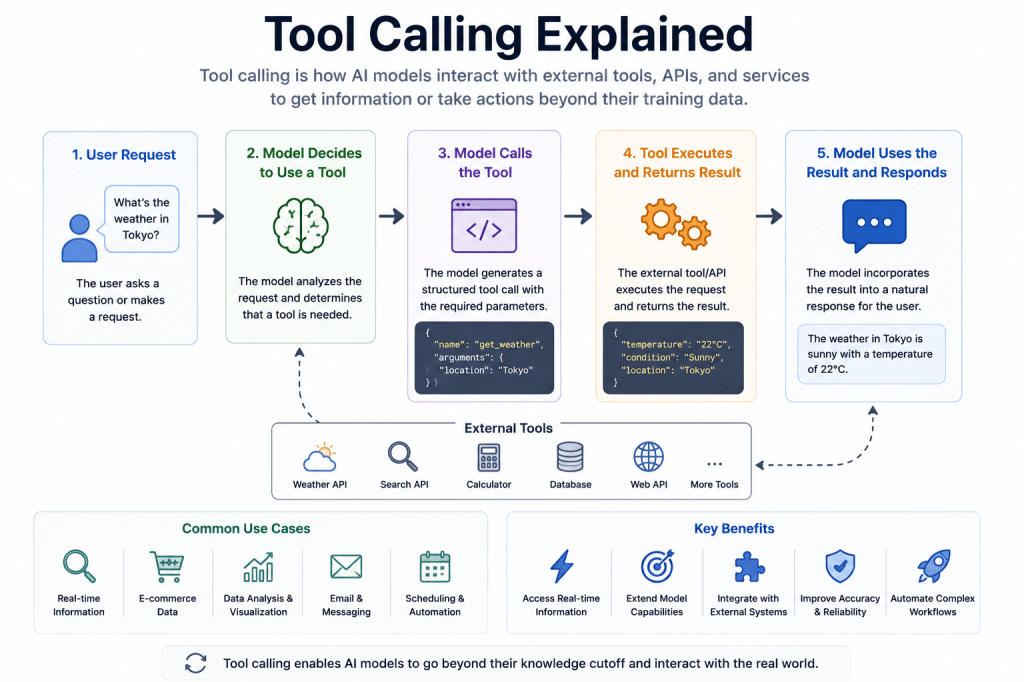
What Is Tool Calling?
Tool calling is a mechanism that allows an AI system to:
- invoke external functions,
- interact with APIs,
- access software systems,
- and execute actions outside the model itself.
Instead of only generating text, the AI system can:
- request external operations,
- retrieve live information,
- run code,
- search databases,
- or coordinate workflows.
Tool calling effectively extends AI systems beyond:
static language prediction.
This enables models to interact dynamically with:
- environments,
- software systems,
- and external knowledge sources.
Why Tool Calling Matters
Traditional language models have major limitations.
They often:
- lack real-time information,
- cannot verify outputs,
- cannot execute actions,
- and cannot directly manipulate external systems.
Tool calling helps overcome these limitations by allowing AI systems to:
- retrieve current information,
- validate reasoning,
- automate tasks,
- and interact with real-world systems.
This dramatically expands AI capabilities.
Modern AI agents increasingly rely on tools for:
- planning,
- execution,
- memory,
- orchestration,
- and autonomous workflows.
A Simple Tool Calling Example
Imagine asking an AI system:
“What is the current weather in Amsterdam?”
Without tool access:
- the model may hallucinate outdated information.
With tool calling:
- the AI invokes a weather API,
- retrieves live weather data,
- processes the response,
- and generates an updated answer.
The AI system becomes:
- connected,
- dynamic,
- and environment-aware.
How Tool Calling Works
At a high level, tool calling usually follows several stages.
1. Task Understanding
The AI system analyzes:
- the prompt,
- user intent,
- and required actions.
The model determines whether:
- external information,
- computation,
- or execution
is necessary.
2. Tool Selection
The system identifies:
- which tool,
- API,
- or function
should be used.
Examples:
- weather APIs,
- calculators,
- databases,
- search systems,
- code execution environments,
- or workflow tools.
3. Tool Invocation
The AI generates:
- structured tool requests,
- parameters,
- or function calls.
The external system executes the operation.
4. Result Integration
The AI system receives:
- external outputs,
- retrieved information,
- or execution results.
The model then integrates the data into:
- reasoning,
- planning,
- or response generation.
AI Models vs Tool-Augmented Systems
This distinction is increasingly important.
Traditional AI Models
Traditional models:
- generate responses directly,
- but remain isolated from external systems.
They rely entirely on:
- internal training data.
Tool-Augmented AI Systems
Tool-augmented systems instead:
- retrieve external information,
- execute workflows,
- and interact dynamically with environments.
This creates:
- more capable,
- more adaptive,
- and more autonomous AI systems.
Types of AI Tools
Modern AI systems can interact with many different categories of tools.
Information Retrieval Tools
These tools allow AI systems to:
- search the web,
- query databases,
- retrieve documents,
- and access knowledge sources.
Examples:
- search engines,
- vector databases,
- enterprise knowledge systems.
Computational Tools
Some tools perform:
- calculations,
- simulations,
- or code execution.
Examples:
- Python interpreters,
- mathematical engines,
- spreadsheet systems.
Software Integration Tools
AI systems increasingly connect with:
- APIs,
- CRMs,
- ticketing systems,
- cloud platforms,
- and operational software.
This enables:
- workflow automation,
- and enterprise orchestration.
Execution Tools
Some systems can:
- manipulate files,
- run shell commands,
- update databases,
- or trigger workflows.
These capabilities transform AI into:
action-oriented systems.
Tool Calling and AI Agents
Tool calling is one of the defining capabilities of modern AI agents.
Agents often need to:
- retrieve information,
- execute actions,
- coordinate APIs,
- and manipulate environments.
Without tool use, agents remain:
- informational,
- rather than operational.
Tool calling enables agents to:
- interact with real systems,
- perform workflows,
- and pursue goals autonomously.
Related article:
Tool Calling and Planning Systems
Planning systems often determine:
- which tools to use,
- when to call them,
- and how to sequence actions.
An agent may:
- analyze a goal,
- create a plan,
- invoke tools strategically,
- evaluate outcomes,
- and revise execution dynamically.
Tool use and planning are increasingly interconnected.
Related article:
Tool Calling and Reasoning Systems
Modern reasoning systems increasingly combine:
- reasoning,
- planning,
- and tool interaction.
Instead of:
reasoning in isolation,
AI systems can:
- retrieve evidence,
- verify outputs,
- perform calculations,
- and ground reasoning externally.
This often improves:
- reliability,
- accuracy,
- and task completion quality.
Related articles:
Tool Calling and Memory Systems
Tool use often interacts closely with memory architectures.
Agents may:
- retrieve long-term memory,
- search vector databases,
- access workflow state,
- and maintain contextual continuity.
Memory tools are increasingly central to:
- persistent AI assistants,
- autonomous workflows,
- and adaptive reasoning systems.
Related article:
- Memory Architectures for AI Agents
Tool Calling and Coding Systems
Coding systems heavily rely on tools.
A coding agent may:
- execute Python code,
- run tests,
- inspect repositories,
- query documentation,
- and debug software automatically.
Tool integration dramatically improves:
- coding reliability,
- debugging quality,
- and autonomous software engineering.
Modern coding agents increasingly function as:
- tool-driven reasoning systems.
Tool Calling and Enterprise AI
Enterprise AI systems increasingly depend on:
- API orchestration,
- workflow automation,
- document systems,
- and operational integration.
Tool-enabled AI systems can:
- automate reports,
- update systems,
- monitor workflows,
- and coordinate business processes autonomously.
This is becoming one of the largest commercial applications of AI agents.
Challenges of Tool Calling
Although powerful, tool use introduces major challenges.
AI systems may:
- misuse tools,
- generate incorrect parameters,
- trigger unsafe actions,
- or fail during orchestration.
Additional challenges include:
- reliability,
- permissions,
- security,
- latency,
- and workflow coordination.
This is why modern agent systems increasingly rely on:
- planning,
- reflection,
- verification,
- and evaluation architectures.
Tool Calling and AI Safety
As AI systems gain the ability to:
- interact with environments,
- execute actions,
- and coordinate workflows,
tool safety becomes increasingly important.
Future systems may require:
- permission controls,
- action verification,
- policy constraints,
- and execution monitoring.
Tool-enabled AI systems introduce both:
- enormous capability,
- and significant operational risk.
Emerging Trends in Tool-Augmented AI
The field is evolving rapidly.
Modern systems increasingly explore:
- adaptive tool routing,
- reasoning-aware tool use,
- autonomous orchestration,
- multi-agent tool coordination,
- and dynamic workflow execution.
Future AI systems may increasingly function as:
- tool-centric reasoning architectures.
Practical Applications
Tool calling is increasingly important for:
- AI agents,
- coding systems,
- enterprise automation,
- cybersecurity,
- scientific research,
- workflow orchestration,
- and autonomous operations systems.
Applications requiring:
- external interaction,
- execution,
- or dynamic information retrieval
often depend heavily on tool integration.
Python Example: Simplified Tool Calling Workflow
Below is a simplified conceptual example.
user_request = "Get latest weather data"tool_response = weather_api(location="Amsterdam")final_answer = summarize(tool_response)print(final_answer)
Real systems often involve:
- orchestration frameworks,
- memory systems,
- verifier architectures,
- and adaptive planning pipelines.
Tool Calling and the Future of AI
Tool calling represents one of the most important transitions in modern artificial intelligence.
The industry is increasingly moving from:
isolated language models
toward:
AI systems capable of interacting dynamically with external environments and operational systems.
This transition is influencing:
- reasoning architectures,
- autonomous agents,
- enterprise automation,
- coding systems,
- and cognitive AI research.
Tool calling is increasingly viewed as:
one of the foundational mechanisms behind autonomous AI systems.
Related Concepts
- AI Agents
- Planning Systems
- Reflection Systems
- Memory Architectures
- Workflow Orchestration
- Deliberative Inference
- Multi-Agent Systems
- Verifier Models
- Autonomous Workflows
- Cognitive Architectures
Continue Exploring
To continue exploring agent architectures, consider reading:
- What Are AI Agents?
- Planning Systems in Autonomous AI
- Multi-Agent Systems Explained
- Reflection Loops in AI Systems
- Memory Architectures for AI Agents
These concepts build directly on the foundations introduced by tool-enabled AI systems.
👉 You can experiment with a practical Python implementation of this concept in the official GitHub repository for the Reasoning Systems examples: https://github.com/BenardoKemp/reasoningsystems/tree/main/agent-systems/tool-calling-explained
 Reasoning Systems