Artificial intelligence is rapidly evolving beyond:
- isolated prompts,
- static chat interactions,
- and single-step automation.
Modern AI systems are increasingly expected to:
- complete multi-step objectives,
- coordinate tools,
- manage workflows,
- adapt dynamically,
- and operate with minimal human intervention.
These systems increasingly rely on:
autonomous workflows.
Autonomous workflows allow AI systems to:
- plan tasks,
- execute actions,
- evaluate outcomes,
- revise strategies,
- and continue operating toward objectives independently.
This is becoming one of the foundational shifts in modern AI.
Autonomous workflows are increasingly important for:
- AI agents,
- enterprise automation,
- coding systems,
- research workflows,
- and intelligent operations platforms.
They represent a transition from:
reactive AI systems
toward:
persistent goal-directed autonomous execution systems.
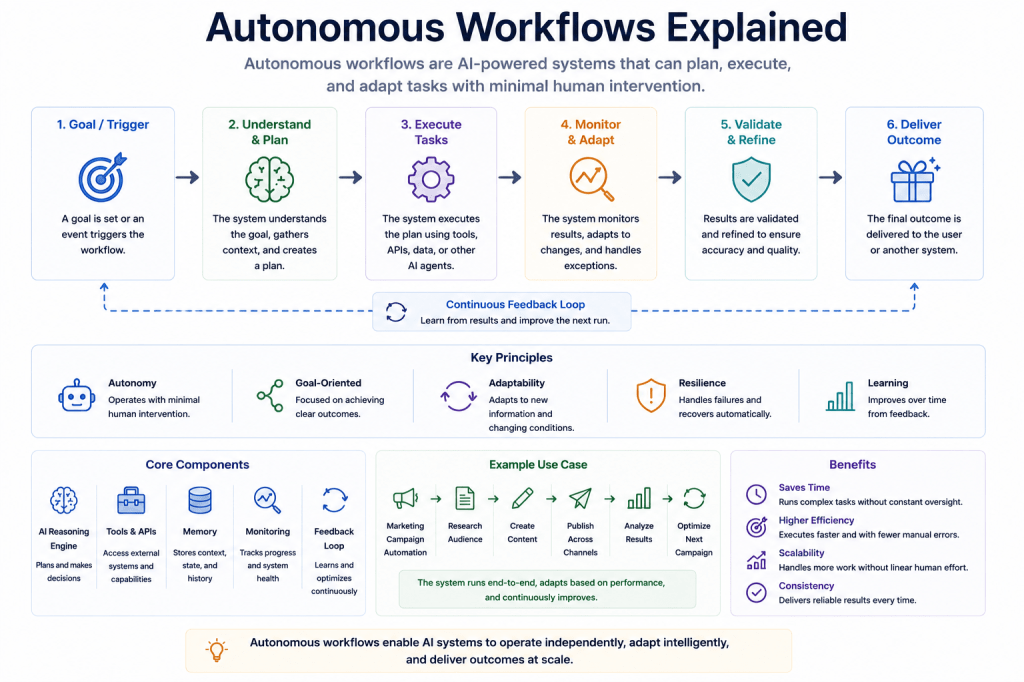
What Is an Autonomous Workflow?
An autonomous workflow is a coordinated sequence of:
- reasoning,
- planning,
- tool use,
- execution,
- evaluation,
- and adaptation
performed by an AI system with limited human intervention.
Instead of:
responding to one request at a time,
the system:
- manages objectives continuously,
- coordinates multiple actions,
- and adapts dynamically during execution.
Autonomous workflows often involve:
- AI agents,
- orchestration systems,
- memory architectures,
- and reasoning pipelines.
Why Autonomous Workflows Matter
Traditional AI systems are often:
- reactive,
- session-limited,
- and task-isolated.
They may struggle with:
- long objectives,
- dynamic environments,
- multi-step execution,
- and persistent coordination.
Autonomous workflows solve this by allowing AI systems to:
- maintain goals,
- coordinate execution,
- recover from failures,
- and adapt over time.
This dramatically expands AI capabilities beyond:
simple prompt-response interactions.
A Simple Autonomous Workflow Example
Imagine asking an AI system:
“Monitor cybersecurity vulnerabilities and generate weekly risk reports.”
An autonomous workflow may:
- retrieve vulnerability feeds,
- analyze threat data,
- classify risk levels,
- generate reports,
- update dashboards,
- notify teams,
- revise monitoring priorities,
- and repeat continuously.
This creates:
- persistent autonomous operational behavior.
Automation vs Autonomous Workflows
These concepts are related but fundamentally different.
Traditional Automation
Traditional automation often:
- follows predefined rules,
- executes static workflows,
- and requires explicit programming.
Examples:
- scheduled scripts,
- workflow triggers,
- rule-based pipelines.
These systems are:
- deterministic,
- predictable,
- but inflexible.
Autonomous Workflows
Autonomous workflows instead:
- reason dynamically,
- adapt execution,
- revise plans,
- and coordinate actions independently.
These systems are:
- adaptive,
- goal-driven,
- and reasoning-oriented.
Core Components of Autonomous Workflows
Modern autonomous workflows often combine multiple architectural layers.
Reasoning Systems
Reasoning systems help workflows:
- analyze tasks,
- evaluate decisions,
- and solve problems dynamically.
This often includes:
- Chain-of-Thought reasoning,
- reflection,
- and deliberative inference.
Related articles:
Planning Systems
Planning systems organize:
- objectives,
- subtasks,
- and execution order.
Without planning, autonomous workflows may:
- lose structure,
- or fail at long-horizon coordination.
Related article:
Tool Calling
Autonomous workflows often depend on:
- APIs,
- databases,
- code execution,
- browsers,
- and operational systems.
Tool calling enables workflows to:
- interact with real environments.
Related article:
Memory Architectures
Memory systems help workflows:
- maintain continuity,
- track progress,
- and preserve workflow state.
Without memory, autonomous workflows remain:
- fragile,
- repetitive,
- and context-limited.
Related article:
Workflow Orchestration
Orchestration systems coordinate:
- execution order,
- dependencies,
- retries,
- and agent collaboration.
This creates:
- structured autonomous execution pipelines.
Related article:
Autonomous Workflows and AI Agents
AI agents are one of the foundational building blocks behind autonomous workflows.
Agents may:
- pursue goals,
- coordinate tools,
- retrieve information,
- revise strategies,
- and execute tasks autonomously.
Autonomous workflows often emerge from:
- coordinated agent behavior.
Related article:
Autonomous Workflows and Reflection
Reflection systems improve workflow reliability by allowing AI systems to:
- critique execution,
- identify failures,
- revise plans,
- and retry tasks dynamically.
This creates:
- self-correcting workflows.
Reflection becomes increasingly important as workflows become:
- larger,
- more complex,
- and more autonomous.
Related article:
Autonomous Workflows and Verifier Systems
Verifier architectures help workflows:
- validate outputs,
- inspect reasoning,
- and monitor execution quality.
Without verification, autonomous workflows may:
- drift,
- hallucinate actions,
- or execute unreliably.
Related article:
Autonomous Workflows and Multi-Agent Systems
Many autonomous workflows distribute tasks across:
- multiple specialized agents.
Examples:
- planner agents,
- retrieval agents,
- coding agents,
- verifier agents,
- orchestration agents.
This improves:
- scalability,
- specialization,
- and parallel execution.
Related article:
Autonomous Workflows and Enterprise AI
Enterprise AI is increasingly adopting autonomous workflows for:
- operations,
- reporting,
- monitoring,
- support,
- security,
- and workflow coordination.
Examples:
- AI-driven ticket handling,
- automated compliance workflows,
- autonomous monitoring systems,
- intelligent operations coordination.
This is becoming one of the largest commercial applications of reasoning AI.
Autonomous Workflows in Coding Systems
Coding systems increasingly function as:
- autonomous software engineering pipelines.
A coding workflow may:
- analyze requirements,
- retrieve documentation,
- generate code,
- run tests,
- debug failures,
- revise implementations,
- and deploy software automatically.
Modern coding agents increasingly operate as:
- autonomous workflow systems.
Long-Horizon Execution
One of the defining characteristics of autonomous workflows is:
long-horizon execution.
These systems may operate:
- continuously,
- asynchronously,
- and adaptively over extended periods.
Examples:
- autonomous research,
- infrastructure monitoring,
- software maintenance,
- and enterprise coordination.
Long-horizon execution requires:
- memory,
- planning,
- orchestration,
- and adaptive reasoning.
Challenges of Autonomous Workflows
Although powerful, autonomous workflows introduce major challenges.
Potential problems include:
- reasoning drift,
- orchestration failures,
- hallucinated actions,
- tool misuse,
- workflow instability,
- or execution loops.
Large autonomous systems may become:
- difficult to monitor,
- expensive to operate,
- and operationally unpredictable.
This creates important engineering challenges involving:
- reliability,
- oversight,
- and safety.
Autonomous Workflows and AI Safety
As workflows become more autonomous, safety becomes increasingly important.
Future systems may require:
- verification layers,
- permission systems,
- action monitoring,
- policy constraints,
- and execution oversight.
Autonomous workflows dramatically increase:
- both capability,
- and operational risk.
Autonomous Workflows and Test-Time Compute
Autonomous workflows often involve:
- continuous reasoning,
- iterative planning,
- and repeated inference cycles.
This increases:
- inference complexity,
- orchestration overhead,
- and computational cost.
However, it also improves:
- autonomy,
- reliability,
- and execution depth.
Related article:
Emerging Trends in Autonomous Workflows
The field is evolving rapidly.
Modern systems increasingly explore:
- self-improving workflows,
- adaptive orchestration,
- collaborative agent ecosystems,
- persistent autonomous systems,
- and reasoning-aware execution architectures.
Future AI systems may increasingly function as:
- autonomous operational platforms,
- rather than isolated assistants.
Practical Applications
Autonomous workflows are increasingly important for:
- enterprise automation,
- cybersecurity,
- software engineering,
- scientific research,
- operations monitoring,
- workflow coordination,
- and intelligent infrastructure management.
Applications requiring:
- persistence,
- coordination,
- or adaptive execution
often depend heavily on autonomous workflow architectures.
Python Example: Simplified Autonomous Workflow
Below is a simplified conceptual example.
goal = "Monitor AI infrastructure health"while True: data = collect_metrics() analysis = evaluate(data) if analysis.requires_action: execute_response() update_memory()
Real autonomous workflows often involve:
- orchestration frameworks,
- agent systems,
- verifier architectures,
- and distributed reasoning pipelines.
Autonomous Workflows and the Future of AI
Autonomous workflows represent one of the biggest transitions in modern artificial intelligence.
The industry is increasingly moving from:
reactive prompt-based systems
toward:
persistent autonomous systems capable of reasoning, planning, coordinating, and operating continuously across complex environments.
This transition is influencing:
- reasoning architectures,
- enterprise AI,
- autonomous agents,
- robotics,
- and cognitive AI research.
Autonomous workflows are increasingly viewed as:
one of the foundational architectures behind next-generation intelligent systems.
Related Concepts
- AI Agents
- Planning Systems
- Workflow Orchestration
- Tool Calling
- Reflection Systems
- Multi-Agent Systems
- Memory Architectures
- Verifier Models
- Deliberative Inference
- Autonomous Systems
Continue Exploring
To continue exploring reasoning architectures, consider reading:
- Workflow Orchestration in AI Systems
- What Are AI Agents?
- Planning Systems in Autonomous AI
- Reflection Loops in AI Systems
- Multi-Agent Systems Explained
These concepts build directly on the foundations introduced by autonomous workflow systems.
👉 You can experiment with a practical Python implementation of this concept in the official GitHub repository for the Reasoning Systems examples:
 Reasoning Systems