Artificial intelligence is rapidly evolving beyond:
- basic chatbots,
- simple text generation,
- and reactive language models.
A new generation of AI systems is emerging that focuses heavily on:
- structured reasoning,
- planning,
- reflection,
- problem solving,
- and deliberative inference.
These systems are commonly referred to as:
reasoning models.
Reasoning models are increasingly capable of:
- solving complex mathematics,
- writing and debugging code,
- planning workflows,
- coordinating tools,
- and performing multi-step reasoning tasks.
As interest in reasoning AI grows, many developers, researchers, and businesses are asking:
Where can I actually find and use reasoning models?
This article explores:
- what reasoning models are,
- where they are available,
- which platforms provide them,
- and how the ecosystem is evolving.
What Are Reasoning Models?
Reasoning models are AI systems specifically optimized for:
- structured problem solving,
- multi-step reasoning,
- planning,
- verification,
- and deliberative inference.
Unlike traditional language models that often prioritize:
- fluent text generation,
- and immediate responses,
reasoning models increasingly focus on:
- deeper inference,
- extended reasoning,
- and improved reliability.
Many reasoning systems use techniques such as:
- Chain-of-Thought reasoning,
- reflection loops,
- verifier models,
- and test-time compute scaling.
Related articles:
- What Is Chain-of-Thought Reasoning?
- Reflection Loops in AI Systems
- What Are Verifier Models?
Why Reasoning Models Matter
Traditional language models often struggle with:
- long-horizon reasoning,
- mathematics,
- coding reliability,
- and complex planning.
Reasoning models improve performance by:
- thinking longer,
- evaluating intermediate logic,
- and revising reasoning dynamically.
This makes them increasingly important for:
- coding systems,
- autonomous agents,
- enterprise AI,
- and scientific reasoning.
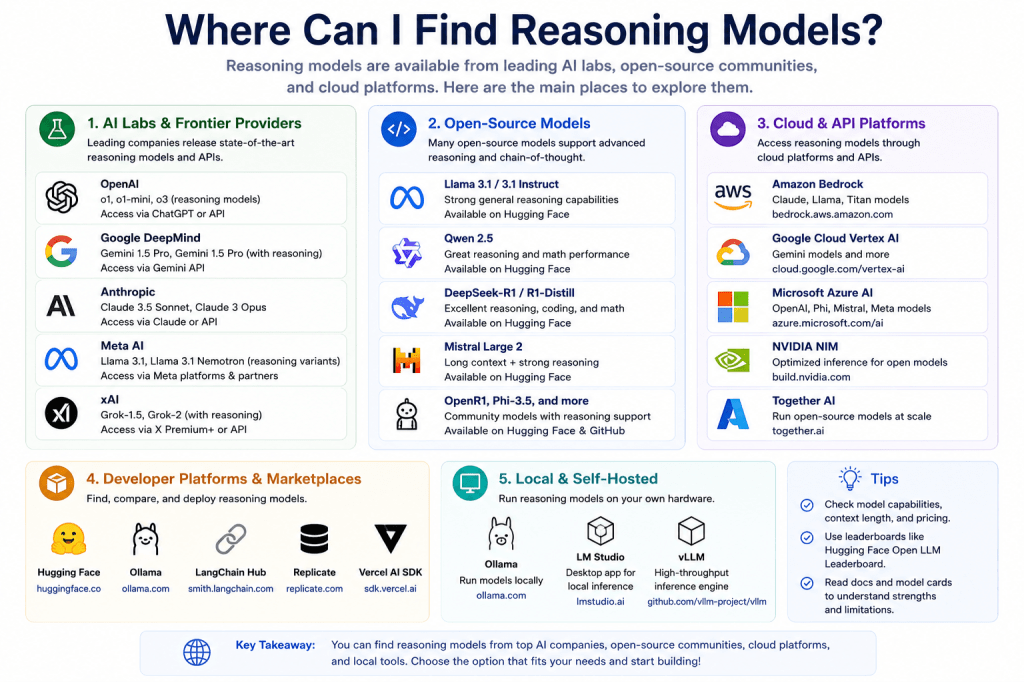
Major Places Where You Can Find Reasoning Models
The reasoning-model ecosystem is evolving rapidly.
Today, reasoning models are available across:
- AI platforms,
- APIs,
- open-source communities,
- cloud providers,
- and research ecosystems.
1. OpenAI Platform
One of the most important providers of reasoning-oriented AI systems is:
OpenAI.
Modern OpenAI models increasingly support:
- deeper reasoning,
- coding workflows,
- planning,
- tool use,
- and agent-style behavior.
Examples include:
- reasoning-oriented GPT systems,
- tool-enabled agents,
- and advanced inference architectures.
Reasoning-focused capabilities increasingly involve:
- extended inference,
- structured reasoning traces,
- and verifier-style workflows.
OpenAI reasoning systems are accessible through:
- ChatGPT,
- APIs,
- enterprise integrations,
- and developer platforms.
2. Anthropic Claude
Anthropic develops the Claude family of models, which are increasingly known for:
- structured reasoning,
- long-context processing,
- coding assistance,
- and workflow-oriented reasoning.
Claude models are widely used for:
- enterprise workflows,
- research tasks,
- document reasoning,
- and coding systems.
Anthropic strongly emphasizes:
- constitutional AI,
- reasoning safety,
- and reliable inference.
3. Google DeepMind Gemini
Google DeepMind is heavily investing in:
- reasoning architectures,
- multimodal reasoning,
- planning systems,
- and agentic AI.
The Gemini family increasingly focuses on:
- long-context reasoning,
- multimodal understanding,
- coding,
- and advanced planning.
DeepMind research has also contributed heavily to:
- world models,
- reinforcement learning,
- and deliberative reasoning systems.
4. xAI Grok
xAI is building reasoning-oriented systems focused on:
- real-time information,
- reasoning workflows,
- coding,
- and tool-enabled AI interaction.
The Grok ecosystem increasingly explores:
- agent behavior,
- retrieval-enhanced reasoning,
- and real-time contextual awareness.
5. Meta AI & Llama Models
Meta AI provides open-weight models such as:
- Llama.
These models are widely used for:
- experimentation,
- research,
- fine-tuning,
- and custom reasoning systems.
The open-source ecosystem around Llama is extremely large.
Developers increasingly build:
- reasoning agents,
- RAG systems,
- and autonomous workflows
on top of open-weight models.
6. Mistral AI
Mistral AI focuses heavily on:
- efficient open models,
- reasoning-capable systems,
- enterprise AI,
- and developer tooling.
Mistral models are increasingly popular for:
- local deployment,
- RAG pipelines,
- and custom AI agent systems.
7. Hugging Face
Hugging Face is one of the most important ecosystems for:
- open-source reasoning models,
- research experimentation,
- and model discovery.
You can find:
- reasoning-oriented LLMs,
- coding models,
- RAG architectures,
- and agent frameworks.
Popular reasoning-related models often appear here first.
Hugging Face also provides:
- Spaces,
- datasets,
- inference APIs,
- and deployment tooling.
8. Open-Source Reasoning Model Communities
Many reasoning systems now emerge from:
- research communities,
- GitHub ecosystems,
- and open-source collectives.
Popular open-source ecosystems include:
- Llama derivatives,
- DeepSeek models,
- Qwen models,
- Mistral variants,
- and reasoning-tuned instruction models.
These systems are increasingly optimized for:
- coding,
- mathematics,
- reasoning traces,
- and autonomous workflows.
9. Local Reasoning Models
Many reasoning-capable systems can now run:
- locally,
- on consumer GPUs,
- or even laptops.
Popular local deployment tools include:
- Ollama,
- LM Studio,
- Text Generation WebUI,
- and llama.cpp.
This enables:
- private reasoning systems,
- offline AI workflows,
- and enterprise-local deployment.
Local reasoning systems are becoming increasingly important for:
- privacy,
- customization,
- and cost control.
10. AI Coding Platforms
Many reasoning models are now embedded inside:
- coding environments,
- development tools,
- and autonomous software engineering systems.
Examples include:
- GitHub Copilot,
- Cursor,
- Windsurf,
- Replit AI,
- and AI IDE ecosystems.
These systems increasingly rely on:
- reasoning,
- planning,
- debugging,
- and verifier architectures.
Related article:
- What Is SWE-bench?
Open vs Closed Reasoning Models
The ecosystem increasingly divides into:
- proprietary reasoning systems,
- and open-weight reasoning models.
Closed Models
Examples:
- OpenAI,
- Anthropic,
- Gemini.
Advantages:
- strong reasoning quality,
- large infrastructure,
- frontier-scale capabilities.
Limitations:
- API dependence,
- less transparency,
- limited customization.
Open Models
Examples:
- Llama,
- Mistral,
- Qwen,
- DeepSeek.
Advantages:
- local deployment,
- fine-tuning,
- flexibility,
- experimentation.
Limitations:
- infrastructure complexity,
- variable reasoning quality.
Reasoning Models and AI Agents
Many reasoning models are increasingly integrated into:
- AI agents,
- workflow orchestrators,
- and autonomous systems.
These models often support:
- planning,
- memory,
- retrieval,
- reflection,
- and tool calling.
This is creating:
- agentic reasoning ecosystems.
Related article:
- What Are AI Agents?
Reasoning Models and RAG Systems
Reasoning models increasingly combine with:
- retrieval architectures,
- vector databases,
- and enterprise memory systems.
This creates:
- retrieval-augmented reasoning systems.
Related article:
- How to Build a RAG Pipeline
Reasoning Models and Long Context
Many frontier reasoning systems now support:
- extremely large context windows.
This allows:
- repository-scale reasoning,
- document analysis,
- workflow continuity,
- and long-horizon planning.
Long-context reasoning is becoming one of the defining capabilities behind:
- advanced reasoning AI systems.
How to Choose a Reasoning Model
The best reasoning model depends heavily on:
- your use case,
- budget,
- deployment requirements,
- and technical goals.
For Coding
Strong options include:
- GPT systems,
- Claude,
- DeepSeek,
- and specialized coding agents.
For Enterprise RAG
Strong options include:
- Claude,
- OpenAI APIs,
- Mistral,
- and local Llama deployments.
For Local AI
Popular choices include:
- Llama,
- Mistral,
- Qwen,
- and Ollama-based systems.
For Research
Researchers often explore:
- Hugging Face ecosystems,
- open-weight reasoning models,
- and experimental inference architectures.
Emerging Trends in Reasoning Models
The field is evolving rapidly.
Modern reasoning systems increasingly explore:
- reflection,
- verifier architectures,
- adaptive compute allocation,
- world models,
- agentic workflows,
- and multi-agent reasoning.
Future reasoning systems may increasingly resemble:
- autonomous cognitive architectures,
- rather than simple chat interfaces.
Practical Applications
Reasoning models are increasingly important for:
- coding,
- enterprise AI,
- autonomous agents,
- scientific research,
- cybersecurity,
- workflow orchestration,
- and strategic planning systems.
Applications requiring:
- structured reasoning,
- planning,
- or adaptive workflows
often benefit dramatically from:
- reasoning-oriented AI systems.
Python Example: Accessing a Reasoning Model API
Below is a simplified conceptual example.
from openai import OpenAIclient = OpenAI()response = client.chat.completions.create( model="gpt-4.1", messages=[ { "role": "user", "content": "Explain Chain-of-Thought reasoning." } ])print(response.choices[0].message.content)
Similar workflows exist across:
- Anthropic,
- Google,
- Mistral,
- and Hugging Face ecosystems.
The Future of Reasoning Models
Reasoning models represent one of the most important transitions in modern artificial intelligence.
The industry is increasingly moving from:
reactive language generation systems
toward:
structured reasoning systems capable of planning, reflection, retrieval, simulation, and autonomous execution.
This transition is influencing:
- enterprise AI,
- coding systems,
- autonomous agents,
- scientific AI,
- and cognitive architectures.
Reasoning models are increasingly viewed as:
one of the foundational technologies behind next-generation intelligent systems.
Related Concepts
- AI Agents
- Retrieval-Augmented Reasoning
- Reflection Systems
- Verifier Models
- Test-Time Compute
- Workflow Orchestration
- World Models
- Deliberative Inference
- RAG Pipelines
- Autonomous Workflows
Continue Exploring
To continue exploring reasoning architectures and autonomous AI systems, consider reading:
- How to Build a RAG Pipeline
- What Are AI Agents?
- Reflection Loops in AI Systems
- What Are World Models?
- Why Reasoning Models “Think Longer”
These concepts build directly on the foundations behind modern reasoning AI systems.
 Reasoning Systems