As artificial intelligence systems become increasingly capable at:
- reasoning,
- planning,
- prediction,
- and autonomous behavior,
researchers are exploring a powerful idea inspired partly by:
- human cognition,
- simulation,
- and mental imagination.
This idea is known as:
world models.
World models allow AI systems to:
- internally simulate environments,
- predict future outcomes,
- reason about actions,
- and anticipate consequences before acting.
Instead of reacting only to immediate inputs, systems with world models attempt to:
build internal representations of how the world works.
World models are becoming increasingly important for:
- autonomous agents,
- robotics,
- reasoning AI,
- planning systems,
- reinforcement learning,
- and cognitive architectures.
They represent one of the foundational shifts from:
reactive AI systems
toward:
predictive reasoning systems.
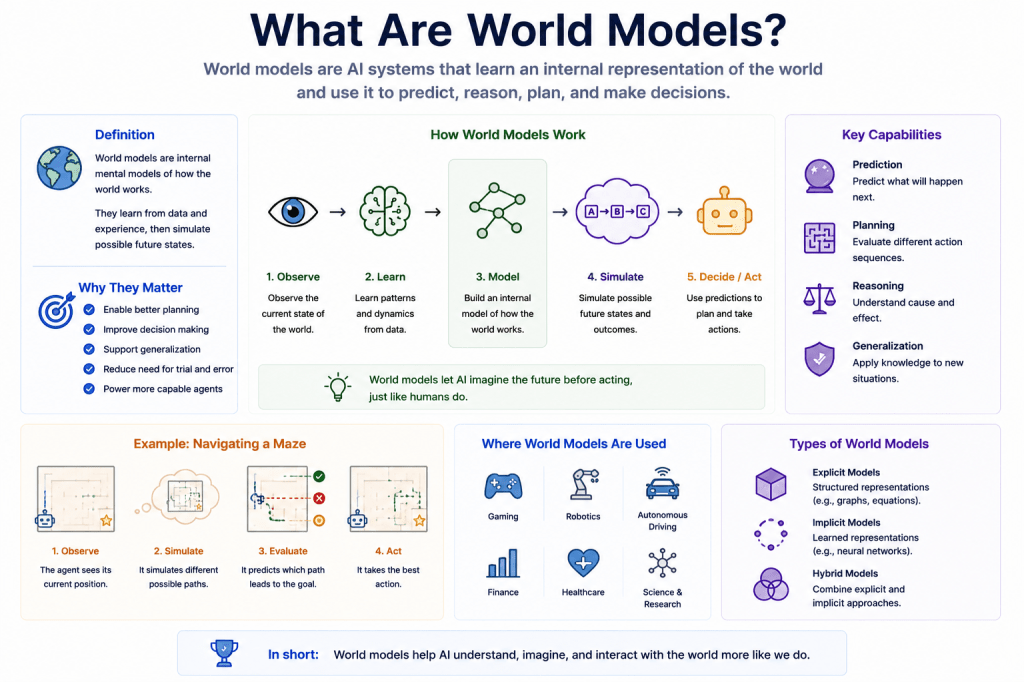
What Is a World Model?
A world model is an internal representation an AI system uses to:
- model environments,
- predict outcomes,
- simulate future states,
- and reason about possible actions.
The system attempts to learn:
- how objects behave,
- how environments change,
- how actions affect outcomes,
- and how future events may unfold.
Instead of:
responding only to current inputs,
a world-model-based system can:
- imagine future scenarios,
- simulate consequences,
- and plan strategically.
Why World Models Matter
Traditional AI systems are often:
- reactive,
- short-context,
- and prediction-oriented.
They may struggle with:
- long-horizon planning,
- strategic reasoning,
- adaptive decision-making,
- and complex environments.
World models help solve these limitations by enabling systems to:
- anticipate outcomes,
- simulate environments,
- and reason before acting.
This becomes increasingly important for:
- autonomous agents,
- robotics,
- scientific AI,
- and advanced reasoning systems.
A Simple Example
Imagine a robot navigating a room.
Without a world model:
- the robot reacts only to immediate sensor input.
With a world model:
- the robot internally predicts:
- where obstacles may move,
- what paths are safest,
- and what future states may occur.
The robot can therefore:
- plan ahead,
- avoid collisions,
- and adapt strategically.
This transforms behavior from:
reactive navigation
into:
predictive reasoning.
World Models vs Reactive Systems
The distinction between these architectures is fundamental.
Reactive Systems
Reactive systems:
- respond immediately to input,
- without explicit internal simulation.
These systems may:
- perform well in simple environments,
- but struggle with:
- planning,
- prediction,
- and long-horizon coordination.
World-Model Systems
World-model systems instead:
- build internal representations,
- simulate future states,
- and reason about consequences.
This creates:
- predictive intelligence,
- strategic reasoning,
- and adaptive planning.
Core Components of World Models
Modern world-model architectures often combine several layers.
Environment Representation
The system learns:
- patterns,
- structure,
- dynamics,
- and relationships within environments.
This becomes the internal:
model of the world.
State Prediction
The model predicts:
- future states,
- environmental changes,
- or possible outcomes.
This enables:
- forecasting,
- planning,
- and simulation.
Action Simulation
The system evaluates:
- how actions may influence future states.
This allows agents to:
- compare strategies,
- estimate consequences,
- and optimize behavior.
Latent Representations
Many world models operate using:
- compressed latent representations.
Instead of simulating raw environments directly, the system reasons within:
- abstract internal state spaces.
This improves:
- efficiency,
- scalability,
- and reasoning flexibility.
World Models and Planning Systems
World models are deeply connected to:
planning systems.
Planning often requires:
- simulating future outcomes,
- evaluating alternatives,
- and predicting environmental responses.
World models help planning systems:
- anticipate consequences,
- compare strategies,
- and coordinate long-horizon execution.
Related article:
- Planning Systems in Autonomous AI
World Models and Deliberative Inference
Deliberative systems increasingly rely on:
- internal simulation,
- hypothetical reasoning,
- and future-state prediction.
Instead of:
acting immediately,
the system may:
- mentally simulate actions,
- evaluate possible outcomes,
- and revise strategies before execution.
This creates:
- deliberative world-model architectures.
Related article:
- Deliberative Inference Explained
World Models and AI Agents
Autonomous agents often depend heavily on:
- prediction,
- planning,
- and adaptive reasoning.
World models help agents:
- anticipate environmental changes,
- coordinate workflows,
- and improve strategic execution.
Without world models, agents remain:
- reactive,
- brittle,
- and short-horizon.
Related article:
- What Are AI Agents?
World Models and Reinforcement Learning
World models became especially influential in:
reinforcement learning.
Traditional reinforcement learning often requires:
- enormous amounts of interaction data.
World-model-based reinforcement learning instead allows agents to:
- simulate environments internally,
- train within imagined environments,
- and reduce real-world interaction cost.
This dramatically improves:
- efficiency,
- planning,
- and strategic exploration.
World Models and Robotics
Robotics is one of the strongest applications for:
- world-model architectures.
Robots must often:
- predict motion,
- understand physics,
- estimate consequences,
- and coordinate actions dynamically.
World models help robots:
- navigate environments,
- manipulate objects,
- and adapt to changing conditions.
This is becoming increasingly important for:
- autonomous robotics systems.
World Models and Memory Architectures
World models often interact closely with:
- memory systems.
Agents may use memory to:
- store environmental history,
- maintain state continuity,
- and refine predictive representations over time.
Memory improves:
- environmental consistency,
- and long-term prediction quality.
Related article:
- Memory Architectures for AI Agents
World Models and Reasoning Systems
Modern reasoning architectures increasingly combine:
- reasoning,
- simulation,
- planning,
- and prediction.
Instead of only:
generating answers,
systems may internally:
- simulate scenarios,
- evaluate alternatives,
- and reason about hypothetical outcomes.
This creates:
- simulation-driven reasoning systems.
World Models and Multi-Agent Systems
In multi-agent environments, world models may include:
- representations of other agents,
- collaborative behavior,
- or adversarial dynamics.
Agents may predict:
- how other agents behave,
- react,
- or coordinate.
This becomes increasingly important for:
- collaborative AI,
- strategic systems,
- and autonomous ecosystems.
Related article:
- Multi-Agent Systems Explained
World Models and Test-Time Compute
World-model reasoning often requires:
- additional inference-time computation,
- simulation depth,
- and internal prediction cycles.
Instead of:
direct response generation,
the system may:
- simulate futures,
- compare outcomes,
- and deliberate before acting.
This strongly connects world models to:
- test-time compute scaling.
Related article:
- Test-Time Compute Explained
World Models and Cognitive Architectures
World models are strongly connected to:
- cognitive science,
- neuroscience,
- and theories of human intelligence.
Humans often reason by:
- imagining scenarios,
- simulating outcomes,
- and predicting consequences mentally.
AI world models attempt to create similar:
- predictive internal representations.
This makes world models highly relevant for:
- cognitive AI research.
Challenges of World Models
Although powerful, world models introduce major challenges.
Potential problems include:
- inaccurate simulations,
- prediction drift,
- incomplete environmental understanding,
- hallucinated dynamics,
- or excessive computational cost.
Complex environments may become:
- difficult to model accurately,
- especially under uncertainty.
This creates important research challenges involving:
- scalability,
- reliability,
- and generalization.
World Models and AI Safety
World models are increasingly important in:
- AI safety research.
Advanced systems capable of:
- simulating environments,
- predicting outcomes,
- and planning strategically
may become:
- significantly more capable,
- but also harder to control.
This creates important questions involving:
- alignment,
- oversight,
- and strategic reasoning safety.
Emerging Trends in World Models
The field is evolving rapidly.
Modern systems increasingly explore:
- latent simulation architectures,
- predictive reasoning,
- embodied world models,
- multimodal simulation systems,
- and autonomous planning ecosystems.
Future AI systems may increasingly function as:
- predictive simulation systems,
- rather than purely reactive language models.
Practical Applications
World models are increasingly important for:
- robotics,
- autonomous vehicles,
- AI agents,
- scientific simulation,
- enterprise planning,
- game AI,
- and reasoning architectures.
Applications requiring:
- prediction,
- strategic reasoning,
- or long-horizon planning
often depend heavily on world-model architectures.
Python Example: Simplified World Model Workflow
Below is a simplified conceptual example.
current_state = observe_environment()future_state = simulate_future(current_state, action)best_action = evaluate_outcome(future_state)execute(best_action)
Real world-model systems often involve:
- latent representations,
- neural simulators,
- reinforcement learning,
- and planning architectures.
World Models and the Future of AI
World models represent one of the most important architectural shifts in modern AI.
The industry is increasingly moving from:
reactive prediction systems
toward:
predictive reasoning systems capable of internally simulating environments and future outcomes.
This transition is influencing:
- reasoning architectures,
- autonomous agents,
- robotics,
- cognitive AI research,
- and advanced planning systems.
World models are increasingly viewed as:
one of the foundational mechanisms behind advanced autonomous intelligence.
Related Concepts
- Planning Systems
- Deliberative Inference
- AI Agents
- Reinforcement Learning
- Memory Architectures
- Multi-Agent Systems
- Test-Time Compute
- Cognitive Architectures
- Autonomous Workflows
- Reflection Systems
Continue Exploring
To continue exploring reasoning architectures, consider reading:
- Planning Systems in Autonomous AI
- Deliberative Inference Explained
- What Are AI Agents?
- Memory Architectures for AI Agents
- Multi-Agent Systems Explained
These concepts build directly on the predictive reasoning foundations introduced by world models.
👉 You can experiment with a practical Python implementation of this concept in the official GitHub repository for the Reasoning Systems examples: https://github.com/BenardoKemp/reasoningsystems/tree/main/cognitive-systems/what-are-world-models
 Reasoning Systems