s modern AI systems become increasingly capable of:
- solving complex problems,
- planning workflows,
- writing code,
- and performing multi-step reasoning,
researchers are paying growing attention to:
how these systems reason internally.
One of the most important concepts in modern reasoning AI is the idea of:
reasoning traces.
Reasoning traces are the intermediate reasoning steps generated by an AI system while solving a task.
Instead of producing:
only a final answer,
the model generates:
- thought sequences,
- intermediate logic,
- planning steps,
- or structured reasoning paths.
Reasoning traces are becoming increasingly important for:
- interpretability,
- debugging,
- evaluation,
- reflection systems,
- and autonomous reasoning architectures.
They form one of the foundational layers behind:
- Chain-of-Thought reasoning,
- reflection loops,
- verifier systems,
- and deliberative inference.
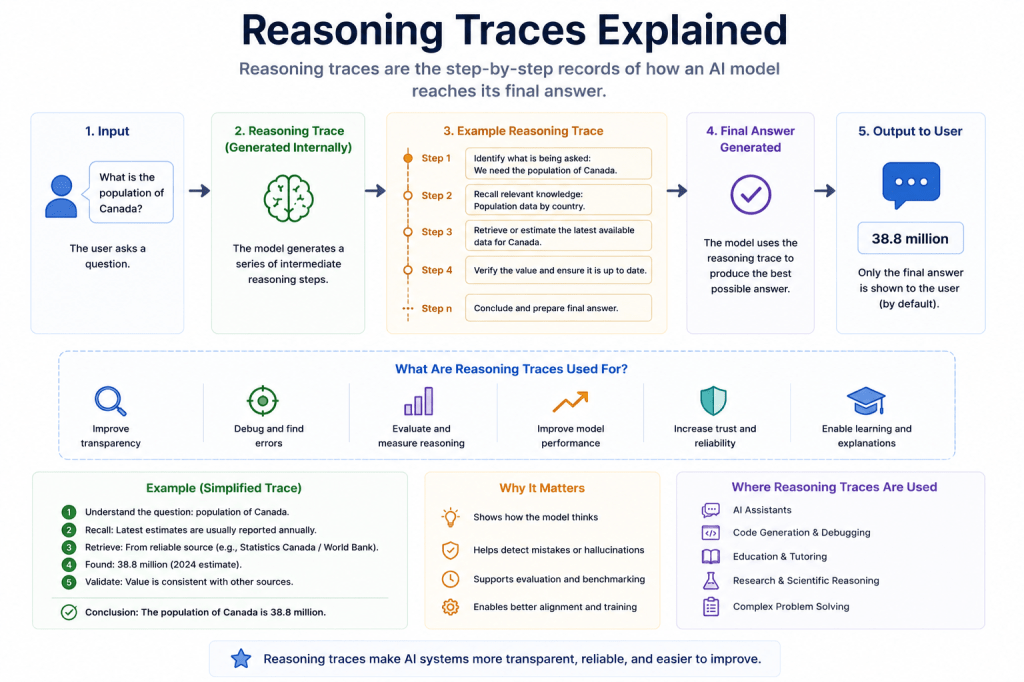
What Are Reasoning Traces?
A reasoning trace is the sequence of intermediate reasoning steps an AI system generates while solving a problem.
These traces may include:
- calculations,
- planning steps,
- logical deductions,
- intermediate conclusions,
- or task decomposition.
Reasoning traces help reveal:
- how the system arrived at an answer,
- not just what answer it produced.
This creates:
- more transparent,
- more interpretable,
- and more analyzable reasoning systems.
Why Reasoning Traces Matter
Traditional AI systems often behave like:
- black boxes.
They generate outputs directly without exposing:
- intermediate logic,
- planning structure,
- or decision processes.
This creates major problems:
- reasoning errors become difficult to diagnose,
- hallucinations become harder to detect,
- and reasoning reliability becomes difficult to evaluate.
Reasoning traces help solve this by exposing:
- the reasoning process itself.
This improves:
- transparency,
- debugging,
- verification,
- and reasoning oversight.
A Simple Reasoning Trace Example
Imagine asking an AI system:
“A store sells 5 notebooks for $20. What is the price of 1 notebook?”
Final Answer Only
The system outputs:
“$4”
The reasoning remains hidden.
Reasoning Trace
The system may instead produce:
- 5 notebooks cost $20
- One notebook costs 20 ÷ 5
- 20 ÷ 5 = 4
- Therefore, the answer is $4
This sequence becomes:
the reasoning trace.
Reasoning Traces and Chain-of-Thought
Reasoning traces became especially important through:
Chain-of-Thought reasoning.
Chain-of-Thought prompting encourages models to:
- expose intermediate reasoning,
- solve problems step-by-step,
- and generate explicit thought sequences.
This dramatically improved:
- reasoning quality,
- planning,
- and interpretability.
Reasoning traces are essentially:
the observable outputs of Chain-of-Thought reasoning.
Related article:
Visible vs Hidden Reasoning Traces
Modern systems increasingly distinguish between:
- visible reasoning traces,
- and hidden reasoning traces.
Visible Reasoning Traces
These are exposed directly to users.
Advantages:
- interpretability,
- transparency,
- educational value.
Limitations:
- verbosity,
- reasoning leakage,
- and additional token usage.
Hidden Reasoning Traces
These occur internally during inference.
The model reasons:
- silently,
- or partially internally,
while exposing only selected outputs.
Advantages:
- efficiency,
- cleaner responses,
- flexible optimization.
Limitations:
- reduced transparency,
- harder debugging.
Related article:
- Hidden Reasoning Tokens Explained
Reasoning Traces and Reflection Systems
Reflection systems often analyze:
- previous reasoning traces,
- failed reasoning paths,
- or inconsistent logic.
A reflective system may:
- inspect reasoning traces,
- critique intermediate steps,
- revise logic,
- and improve outputs iteratively.
This creates:
- self-correcting reasoning architectures.
Related article:
Reasoning Traces and Verifier Models
Verifier systems frequently evaluate:
- reasoning traces,
- intermediate calculations,
- planning structure,
- or logical consistency.
Instead of validating only:
final answers,
verifier models inspect:
the reasoning process itself.
This improves:
- reasoning oversight,
- robustness,
- and reliability.
Related article:
Reasoning Traces and Process Supervision
Process supervision relies heavily on reasoning traces.
Instead of supervising only:
outcomes,
process supervision evaluates:
- intermediate reasoning quality,
- planning structure,
- and logical consistency.
Reasoning traces provide the data needed for:
- process-level evaluation.
Related article:
Reasoning Traces and Deliberative Inference
Deliberative systems often generate:
- multiple reasoning traces,
- alternative planning paths,
- or iterative reasoning revisions.
These traces allow systems to:
- compare alternatives,
- evaluate reasoning quality,
- and improve reliability.
Reasoning traces are increasingly central to:
- deliberative reasoning architectures.
Related article:
Reasoning Traces and Test-Time Compute
Additional inference computation often produces:
- longer,
- deeper,
- and more structured reasoning traces.
Instead of:
immediate answers,
systems may:
- explore multiple reasoning paths,
- revise intermediate logic,
- and deliberate before responding.
This increases:
- reasoning depth,
- and trace complexity.
Related article:
Reasoning Traces in Autonomous Agents
Autonomous agents often rely heavily on:
- planning traces,
- execution histories,
- workflow state,
- and reasoning continuity.
Agents may generate traces involving:
- task decomposition,
- tool usage,
- planning revisions,
- and execution decisions.
These traces help improve:
- coordination,
- debugging,
- and workflow oversight.
Related article:
Reasoning Traces and Multi-Agent Systems
In multi-agent systems, reasoning traces may be:
- distributed across agents,
- shared collaboratively,
- or coordinated through orchestration systems.
Agents may:
- critique each other’s reasoning,
- compare traces,
- or validate collaborative outputs.
This creates:
- distributed reasoning architectures.
Related article:
Why Reasoning Traces Improve Reliability
Reasoning traces make it easier to:
- identify logical errors,
- detect hallucinations,
- diagnose failures,
- and evaluate reasoning quality.
This is especially important for:
- autonomous systems,
- coding agents,
- scientific reasoning,
- and safety-critical AI systems.
Without reasoning traces, many failures remain:
- opaque,
- difficult to analyze,
- and hard to correct.
Challenges of Reasoning Traces
Although valuable, reasoning traces introduce major challenges.
Potential issues include:
- verbosity,
- computational overhead,
- misleading reasoning,
- hallucinated logic,
- and reasoning leakage.
Some traces may appear:
- coherent,
- while still being incorrect.
This creates important research challenges involving:
- interpretability,
- reasoning reliability,
- and verification.
Reasoning Traces and AI Safety
Reasoning traces are increasingly important in AI safety research.
Visible reasoning may improve:
- oversight,
- monitoring,
- and alignment evaluation.
However, fully exposing reasoning may also:
- reveal unsafe strategies,
- leak internal behavior,
- or create optimization challenges.
Future systems may increasingly use:
- selective reasoning visibility,
- hybrid reasoning architectures,
- and adaptive trace exposure.
Emerging Trends in Reasoning Traces
The field is evolving rapidly.
Modern systems increasingly explore:
- latent reasoning traces,
- compressed reasoning representations,
- multi-agent trace coordination,
- reflection-aware reasoning,
- and adaptive reasoning visibility.
Future AI systems may dynamically:
- generate,
- evaluate,
- compress,
- and expose reasoning traces selectively.
Practical Applications
Reasoning traces are increasingly important for:
- reasoning models,
- coding systems,
- autonomous agents,
- enterprise AI,
- scientific reasoning,
- workflow orchestration,
- and evaluation systems.
Applications requiring:
- transparency,
- debugging,
- or structured reasoning
often depend heavily on reasoning traces.
Python Example: Simplified Reasoning Trace Workflow
Below is a simplified conceptual example.
trace = generate_reasoning_trace(problem)evaluation = verify(trace)final_answer = extract_answer(trace)print(final_answer)
Real systems may involve:
- reflection loops,
- verifier models,
- search trees,
- and orchestration frameworks.
Reasoning Traces and the Future of AI
Reasoning traces represent one of the foundational concepts behind modern reasoning AI systems.
The industry is increasingly moving from:
opaque prediction systems
toward:
systems capable of exposing, evaluating, and refining structured reasoning processes.
This transition is influencing:
- reasoning architectures,
- autonomous agents,
- AI safety research,
- enterprise AI,
- and cognitive AI systems.
Reasoning traces are increasingly viewed as:
one of the foundational mechanisms behind interpretable reasoning AI.
Related Concepts
- Chain-of-Thought Reasoning
- Reflection Systems
- Verifier Models
- Process Supervision
- Hidden Reasoning Tokens
- Deliberative Inference
- Test-Time Compute
- Autonomous Agents
- Planning Systems
- Multi-Agent Systems
Continue Exploring
To continue exploring reasoning architectures, consider reading:
- Process Supervision Explained
- Reflection Loops in AI Systems
- What Are Verifier Models?
- Hidden Reasoning Tokens Explained
- Deliberative Inference Explained
These concepts build directly on the foundations introduced by reasoning trace architectures.
👉 You can experiment with a practical Python implementation of this concept in the official GitHub repository for the Reasoning Systems examples:
 Reasoning Systems