As AI systems become increasingly capable at:
- mathematics,
- reasoning,
- planning,
- and problem solving,
researchers need reliable ways to measure:
whether models can actually reason through multi-step problems.
One of the most important reasoning benchmarks developed for this purpose is:
GSM8K.
GSM8K has become one of the foundational benchmarks for evaluating:
- mathematical reasoning,
- Chain-of-Thought performance,
- and multi-step problem solving in language models.
It is now widely used in:
- reasoning model research,
- AI evaluation,
- benchmark comparisons,
- and autonomous reasoning system development.
Unlike simple factual QA benchmarks, GSM8K focuses heavily on:
structured reasoning rather than memorization.
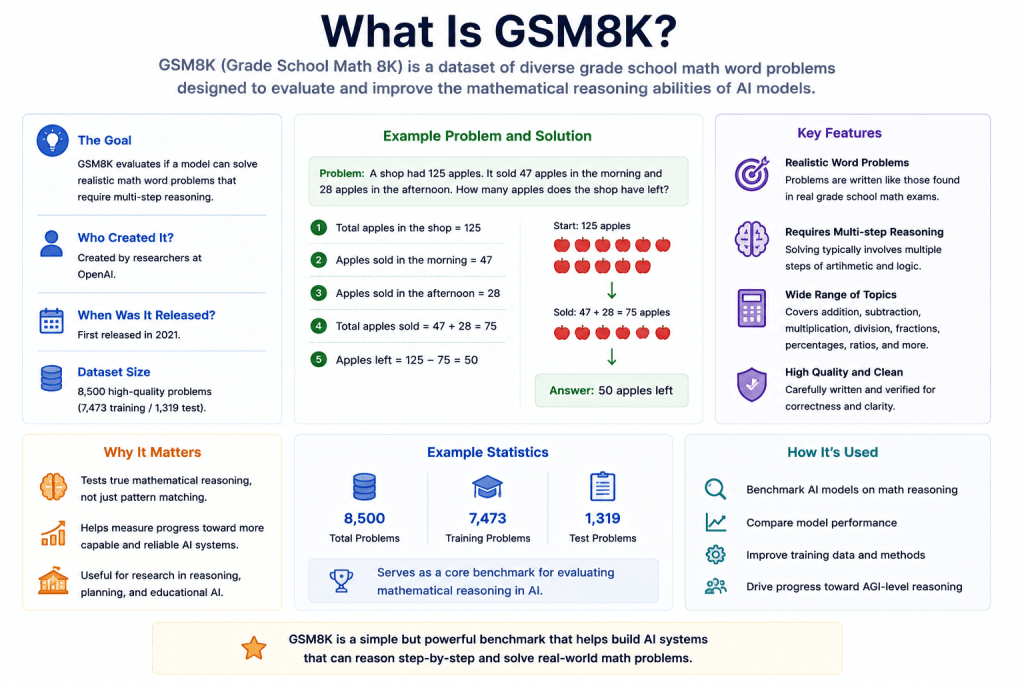
What Does GSM8K Mean?
GSM8K stands for:
Grade School Math 8K.
The benchmark contains approximately:
- 8,000 grade-school-level math word problems.
However, despite the “grade-school” label, the benchmark is surprisingly difficult for AI systems because it requires:
- multi-step reasoning,
- arithmetic planning,
- intermediate calculations,
- and logical decomposition.
The benchmark was created to evaluate:
whether AI systems can reason step-by-step through mathematical problems.
Why GSM8K Matters
Traditional language models often struggled with:
- arithmetic,
- logical reasoning,
- and multi-step problem solving.
Models frequently:
- skipped reasoning steps,
- hallucinated calculations,
- or produced inconsistent answers.
GSM8K became important because it strongly rewards:
- structured reasoning,
- intermediate logic,
- and deliberate problem decomposition.
The benchmark helped demonstrate that:
reasoning quality often improves dramatically when models reason step-by-step.
This became one of the major motivations behind:
- Chain-of-Thought reasoning,
- reflection systems,
- and deliberative inference architectures.
A Simple GSM8K-Style Example
A typical GSM8K problem may look like this:
“Sarah buys 3 packs of pencils with 4 pencils in each pack. She gives 5 pencils to a friend. How many pencils does she have left?”
The reasoning process involves:
- calculating total pencils,
- subtracting transferred pencils,
- and producing the final answer.
This requires:
- sequential reasoning,
- intermediate state tracking,
- and arithmetic consistency.
Why GSM8K Is Challenging for AI
Although humans often solve these problems easily, AI systems historically struggled because:
- language models were optimized primarily for text prediction,
- not structured reasoning.
GSM8K problems require:
- decomposition,
- logical consistency,
- arithmetic planning,
- and multi-step reasoning chains.
Small reasoning errors often:
- propagate through the solution,
- causing final-answer failure.
GSM8K and Chain-of-Thought Reasoning
GSM8K became one of the most important benchmarks demonstrating the power of:
Chain-of-Thought reasoning.
Researchers discovered that prompting models with:
“Let’s think step-by-step.”
often dramatically improved GSM8K performance.
Instead of:
guessing answers directly,
models began:
- generating intermediate calculations,
- reasoning sequentially,
- and improving accuracy significantly.
This became one of the foundational discoveries behind modern reasoning AI.
Related article:
GSM8K and Reasoning Traces
Reasoning traces are especially important in GSM8K tasks.
The system often generates:
- intermediate calculations,
- arithmetic reasoning,
- and step-by-step logic.
These traces help:
- improve interpretability,
- diagnose reasoning failures,
- and evaluate problem-solving quality.
Related article:
GSM8K and Self-Consistency Sampling
Self-Consistency Sampling often improves GSM8K performance significantly.
Instead of:
generating one reasoning path,
the system:
- generates multiple reasoning chains,
- compares answers,
- and selects the most consistent result.
This reduces:
- arithmetic instability,
- and reasoning drift.
Related article:
GSM8K and Reflection Systems
Reflection systems may:
- critique intermediate calculations,
- identify reasoning mistakes,
- revise arithmetic,
- and improve final answers iteratively.
This often improves:
- mathematical reliability,
- and reasoning robustness.
Related article:
GSM8K and Verifier Models
Verifier architectures are highly relevant for GSM8K-style tasks.
Verifier systems may:
- inspect calculations,
- validate intermediate reasoning,
- and identify arithmetic inconsistencies.
This improves:
- reasoning oversight,
- and mathematical correctness.
Related article:
GSM8K and Test-Time Compute
GSM8K performance often improves significantly when models allocate:
- more reasoning effort,
- more intermediate steps,
- or more deliberative inference during execution.
Instead of:
immediate prediction,
the system may:
- deliberate longer,
- compare alternatives,
- revise calculations,
- and improve reasoning reliability.
This strongly connects GSM8K with:
- test-time compute scaling.
Related article:
GSM8K and Deliberative Inference
Deliberative reasoning architectures perform especially well on:
- mathematical reasoning tasks,
- including GSM8K.
The system may:
- explore reasoning paths,
- verify intermediate calculations,
- and revise solutions iteratively.
This improves:
- arithmetic robustness,
- and structured reasoning quality.
Related article:
GSM8K and AI Agents
Mathematical reasoning is increasingly important for:
- autonomous agents,
- coding systems,
- workflow planning,
- and scientific AI.
Agents often require:
- structured reasoning,
- intermediate calculations,
- and planning consistency.
GSM8K therefore provides useful insights into:
- reasoning reliability in autonomous systems.
Related article:
GSM8K vs Memorization
One important reason GSM8K became influential is that it focuses less on:
- factual recall,
- and more on:
- procedural reasoning.
The benchmark emphasizes:
- solving problems dynamically,
- rather than retrieving memorized answers.
This makes GSM8K particularly important for:
- reasoning-oriented AI research.
Limitations of GSM8K
Although highly influential, GSM8K also has limitations.
Potential criticisms include:
- relatively narrow domain scope,
- arithmetic focus,
- benchmark saturation,
- or over-optimization by frontier models.
Additionally:
- strong GSM8K performance does not necessarily imply:
- general intelligence,
- or robust reasoning across all domains.
However, the benchmark remains extremely valuable for studying:
- multi-step reasoning,
- and structured inference behavior.
Emerging Trends Around GSM8K
Modern reasoning systems increasingly use:
- reflection,
- verifier models,
- search-based inference,
- and adaptive reasoning depth
to improve GSM8K performance.
Future systems may rely less on:
- static pattern prediction,
and more on:
- dynamic reasoning architectures.
Practical Importance of GSM8K
GSM8K is increasingly important for:
- reasoning model evaluation,
- AI benchmark comparison,
- Chain-of-Thought research,
- autonomous reasoning systems,
- and cognitive AI research.
Researchers frequently use GSM8K to evaluate:
- reasoning quality,
- inference depth,
- and arithmetic reliability.
This makes GSM8K one of the foundational benchmarks behind:
- modern reasoning AI systems.
Python Example: Simplified GSM8K Reasoning Workflow
Below is a simplified conceptual example.
problem = load_math_problem()reasoning_trace = generate_chain_of_thought(problem)answer = extract_final_answer(reasoning_trace)print(answer)
Real reasoning systems often involve:
- reflection loops,
- verifier systems,
- and self-consistency sampling.
GSM8K and the Future of AI
GSM8K helped reveal one of the most important discoveries in modern AI:
reasoning quality often improves dramatically when models reason step-by-step.
This insight strongly influenced:
- reasoning architectures,
- autonomous agents,
- test-time compute scaling,
- and deliberative inference systems.
GSM8K is increasingly viewed as:
one of the foundational reasoning benchmarks behind modern AI evaluation.
Related Concepts
- Chain-of-Thought Reasoning
- Reflection Systems
- Self-Consistency Sampling
- Verifier Models
- Deliberative Inference
- Test-Time Compute
- Reasoning Traces
- ARC-AGI
- Process Supervision
- Autonomous Agents
Continue Exploring
To continue exploring reasoning benchmarks and architectures, consider reading:
- What Is ARC-AGI?
- Reflection Loops in AI Systems
- Deliberative Inference Explained
- Test-Time Compute Explained
- What Are Verifier Models?
These concepts build directly on the reasoning foundations evaluated by GSM8K.
👉 You can experiment with a practical Python implementation of this concept in the official GitHub repository for the Reasoning Systems examples:
 Reasoning Systems