As AI systems become more autonomous, one capability is becoming increasingly essential:
memory.
Traditional language models are often:
- stateless,
- short-context,
- and session-limited.
They may:
- forget previous interactions,
- lose long-term objectives,
- repeat mistakes,
- or fail at extended workflows.
Autonomous AI agents require much more than short-term conversation history.
They increasingly depend on:
- persistent memory,
- contextual continuity,
- workflow state,
- and long-term knowledge retention.
These systems are known as:
memory architectures.
Memory architectures are becoming foundational to:
- AI agents,
- autonomous workflows,
- reasoning systems,
- enterprise AI,
- and cognitive AI architectures.
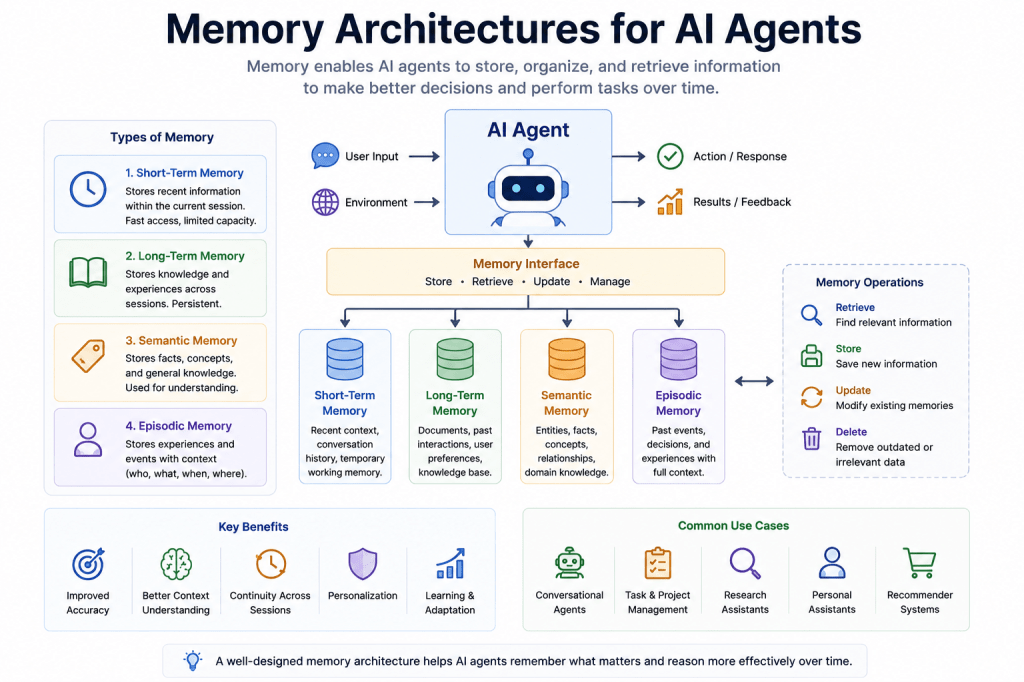
What Is a Memory Architecture?
A memory architecture is a system that allows AI agents to:
- store information,
- retrieve context,
- maintain continuity,
- and use past knowledge during reasoning and execution.
Instead of operating as:
isolated prompt-response systems,
agents with memory can:
- remember objectives,
- track workflows,
- store experiences,
- and adapt behavior over time.
Memory transforms AI systems from:
reactive generators
into:
persistent reasoning systems.
Why Memory Matters in AI Agents
Without memory, autonomous agents struggle with:
- long tasks,
- evolving workflows,
- persistent goals,
- and contextual consistency.
An agent may:
- forget previous steps,
- repeat failed actions,
- lose planning structure,
- or restart workflows unnecessarily.
Memory systems help agents:
- maintain state,
- coordinate actions,
- and operate across extended reasoning horizons.
As AI systems become more autonomous, memory becomes increasingly critical for:
- reliability,
- continuity,
- and intelligent adaptation.
A Simple Memory Example
Imagine an AI research agent working over several hours.
Without memory:
- the system may repeatedly search the same information,
- forget completed subtasks,
- or lose the overall objective.
With memory:
- the agent stores:
- completed research,
- workflow progress,
- retrieved documents,
- and planning state.
This allows:
- continuity,
- coordination,
- and adaptive reasoning.
Stateless Systems vs Memory-Enabled Systems
The distinction between these architectures is fundamental.
Stateless AI Systems
Traditional systems often:
- process prompts independently,
- and forget information after inference.
These systems work well for:
- short interactions,
- summarization,
- and isolated tasks.
However, they struggle with:
- persistent workflows,
- long-horizon planning,
- and adaptive coordination.
Memory-Enabled AI Systems
Memory-enabled systems instead:
- maintain context over time,
- retrieve historical information,
- and coordinate ongoing reasoning.
This creates:
- more persistent,
- more adaptive,
- and more autonomous AI behavior.
Types of AI Memory
Modern AI systems use multiple forms of memory.
Short-Term Memory
Short-term memory stores:
- recent interactions,
- immediate workflow state,
- and current conversational context.
This is often:
- temporary,
- session-based,
- and rapidly changing.
Long-Term Memory
Long-term memory stores:
- persistent information,
- historical knowledge,
- and accumulated experiences.
Examples:
- saved workflows,
- prior research,
- user preferences,
- and historical task execution.
Episodic Memory
Episodic memory stores:
- specific experiences,
- past events,
- and workflow histories.
This allows agents to:
- learn from previous actions,
- revisit prior reasoning,
- and improve future planning.
Semantic Memory
Semantic memory stores:
- structured knowledge,
- concepts,
- facts,
- and relationships.
Examples:
- documentation,
- internal knowledge bases,
- vector retrieval systems.
Working Memory
Working memory refers to:
- actively maintained information
- used during reasoning and planning.
This is especially important for:
- multi-step reasoning,
- coding workflows,
- and planning systems.
Vector Memory Systems
Many modern AI systems use:
vector databases
for memory retrieval.
Information is converted into:
- embeddings,
- semantic vectors,
- or latent representations.
This allows systems to:
- search memory semantically,
- retrieve related concepts,
- and maintain contextual relevance.
Vector memory is becoming foundational to:
- retrieval systems,
- RAG pipelines,
- and autonomous agents.
Related article:
Memory and AI Agents
Memory is one of the defining capabilities of autonomous agents.
Agents often require:
- persistent objectives,
- workflow continuity,
- contextual awareness,
- and adaptive execution.
Without memory, agents remain:
- reactive,
- fragile,
- and limited to short interactions.
Memory architectures allow agents to:
- coordinate long tasks,
- improve planning,
- and operate more autonomously.
Related article:
Memory and Planning Systems
Planning systems rely heavily on memory.
Agents may need to remember:
- completed tasks,
- workflow progress,
- previous failures,
- and strategic objectives.
Memory helps planning systems:
- maintain continuity,
- avoid redundant actions,
- and adapt dynamically.
Related article:
Memory and Reflection Systems
Reflection systems often depend on memory to:
- analyze previous reasoning,
- evaluate failures,
- and revise strategies.
Without memory, reflection becomes:
- shallow,
- repetitive,
- or disconnected.
Memory enables:
- iterative learning,
- and long-term reasoning improvement.
Related article:
Memory and Multi-Agent Systems
Collaborative AI systems often require:
- shared memory,
- distributed context,
- and synchronized workflow state.
Agents may:
- exchange information,
- update shared knowledge,
- and coordinate reasoning collaboratively.
Shared memory architectures improve:
- coordination,
- specialization,
- and workflow continuity.
Related article:
Memory and Tool Calling
Many memory systems rely on:
- retrieval tools,
- vector search,
- databases,
- and external storage systems.
Agents increasingly use tools to:
- retrieve memory dynamically,
- update context,
- and coordinate workflows.
Memory and tool use are becoming tightly interconnected.
Related article:
Memory and Retrieval-Augmented Generation (RAG)
Retrieval-Augmented Generation (RAG) systems combine:
- language models,
- retrieval systems,
- and memory architectures.
Instead of relying entirely on:
internal model weights,
RAG systems retrieve:
- relevant external context,
- documents,
- and historical information dynamically.
This dramatically improves:
- factual grounding,
- context awareness,
- and workflow continuity.
Memory in Coding Systems
Coding agents rely heavily on memory.
A coding system may need to remember:
- repository structure,
- previous code changes,
- failed tests,
- debugging history,
- and implementation plans.
Memory improves:
- software reliability,
- workflow coordination,
- and autonomous development capabilities.
Modern coding agents increasingly depend on:
- persistent contextual memory systems.
Challenges of AI Memory Systems
Although powerful, memory architectures introduce major challenges.
Memory systems may suffer from:
- retrieval failures,
- stale information,
- memory drift,
- context overload,
- inconsistent updates,
- or hallucinated memory references.
Additional challenges include:
- scalability,
- storage cost,
- synchronization,
- and memory management complexity.
This creates important engineering tradeoffs involving:
- persistence,
- efficiency,
- and reliability.
Memory and AI Safety
Persistent memory introduces important safety considerations.
Agents with memory may:
- accumulate sensitive information,
- retain incorrect assumptions,
- or develop problematic reasoning loops.
Future systems may require:
- memory governance,
- retrieval controls,
- expiration policies,
- and verification mechanisms.
Memory architectures are becoming increasingly important in:
- trustworthy AI,
- autonomous systems,
- and AI alignment research.
Emerging Trends in AI Memory
The field is evolving rapidly.
Modern systems increasingly explore:
- adaptive memory retrieval,
- episodic reasoning systems,
- memory-aware planning,
- hierarchical memory architectures,
- and long-term autonomous cognition.
Future AI systems may increasingly function as:
- persistent reasoning entities,
- capable of learning continuously across workflows and environments.
Practical Applications
Memory architectures are increasingly important for:
- autonomous agents,
- enterprise AI,
- coding systems,
- research workflows,
- customer support,
- robotics,
- and intelligent operations systems.
Applications requiring:
- continuity,
- long-horizon reasoning,
- or adaptive workflows
often depend heavily on memory systems.
Python Example: Simplified Memory Workflow
Below is a simplified conceptual example.
memory.store("Research completed on reasoning frameworks")context = memory.retrieve("reasoning frameworks")response = generate_response(context)print(response)
Real memory systems often involve:
- vector databases,
- embeddings,
- orchestration frameworks,
- and retrieval pipelines.
Memory Architectures and the Future of AI
Memory architectures represent one of the most important transitions in modern AI systems.
The industry is increasingly moving from:
stateless generation systems
toward:
persistent reasoning systems capable of continuity, adaptation, and long-term autonomous behavior.
This transition is influencing:
- reasoning architectures,
- autonomous agents,
- enterprise AI,
- robotics,
- and cognitive AI research.
Memory systems are increasingly viewed as:
one of the foundational mechanisms behind autonomous intelligence.
Related Concepts
- AI Agents
- Planning Systems
- Reflection Systems
- Tool Calling
- Retrieval-Augmented Generation
- Multi-Agent Systems
- Workflow Orchestration
- Deliberative Inference
- Vector Databases
- Cognitive Architectures
Continue Exploring
To continue exploring agent architectures, consider reading:
- Retrieval-Augmented Reasoning
- Planning Systems in Autonomous AI
- Tool Calling Explained
- Reflection Loops in AI Systems
- Multi-Agent Systems Explained
These concepts build directly on the foundations introduced by memory-enabled AI systems.
👉 You can experiment with a practical Python implementation of this concept in the official GitHub repository for the Reasoning Systems examples: https://github.com/BenardoKemp/reasoningsystems/tree/main/agent-systems/memory-architectures-for-ai-agents
 Reasoning Systems