One of the most important breakthroughs in modern artificial intelligence is the ability of AI systems to:
- automatically discover patterns,
- compress information,
- and build internal representations of the world.
This capability is known as:
representation learning.
Instead of relying entirely on:
- manually engineered features,
- predefined rules,
- or handcrafted abstractions,
modern AI systems increasingly learn:
- useful representations directly from data.
Representation learning has become foundational to:
- deep learning,
- reasoning systems,
- large language models,
- computer vision,
- speech recognition,
- autonomous agents,
- and modern AI architectures.
In many ways, representation learning is one of the core mechanisms behind:
how neural networks understand structure.
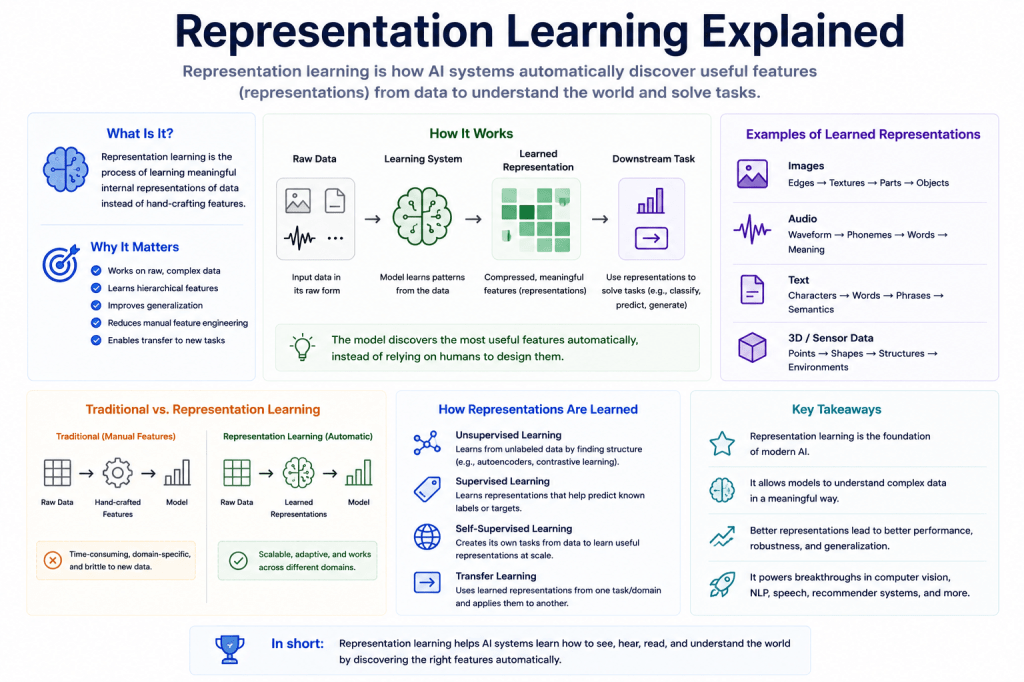
What Is Representation Learning?
Representation learning is the process by which AI systems automatically learn:
- meaningful internal representations,
- patterns,
- abstractions,
- and feature structures
from raw data.
Instead of manually defining:
- what features matter,
the model learns:
- which patterns are useful for prediction,
- reasoning,
- planning,
- or understanding.
These learned internal structures are called:
representations.
Why Representation Learning Matters
Traditional machine learning often relied heavily on:
- manual feature engineering.
Humans had to explicitly design:
- feature extractors,
- statistical descriptors,
- or rule-based transformations.
This created major limitations:
- poor scalability,
- domain dependence,
- and limited adaptability.
Representation learning changed this by enabling systems to:
- learn features automatically,
- discover hidden structure,
- and build layered abstractions from data.
This became one of the foundational advantages of:
- deep learning systems.
A Simple Example
Imagine training an image recognition system.
Traditional Approach
Engineers manually define features such as:
- edges,
- textures,
- shapes,
- or color patterns.
The model depends heavily on:
- human-designed representations.
Representation Learning Approach
A neural network instead learns:
- low-level patterns,
- intermediate structures,
- and high-level concepts automatically.
The system may internally learn:
- edges,
- object parts,
- faces,
- or semantic categories
without explicit programming.
What Is a Representation?
A representation is an internal encoding of information used by the model.
Representations may include:
- embeddings,
- latent vectors,
- hidden states,
- feature maps,
- or abstract conceptual structures.
These representations allow systems to:
- organize information,
- recognize relationships,
- and reason about patterns.
Representation Learning and Neural Networks
Neural networks are especially powerful because they naturally support:
hierarchical representation learning.
Lower layers often learn:
- simple patterns.
Middle layers learn:
- intermediate abstractions.
Higher layers learn:
- semantic concepts,
- reasoning structures,
- or task-relevant representations.
This layered abstraction is one of the defining strengths of:
- deep learning architectures.
Hierarchical Representations
Modern neural networks often build:
hierarchical representations.
Example in image systems:
Lower Layers
- edges,
- lines,
- textures.
Middle Layers
- shapes,
- object components,
- patterns.
Higher Layers
- faces,
- vehicles,
- semantic categories.
This hierarchy allows systems to:
- understand increasingly abstract concepts.
Representation Learning and Language Models
Large language models rely heavily on:
- learned representations of language.
Models learn:
- semantic relationships,
- syntax,
- concepts,
- context,
- and latent knowledge structures.
Words become encoded as:
- embeddings,
- vector representations,
- and contextual states.
This enables:
- reasoning,
- prediction,
- and language understanding.
Embeddings and Representation Learning
Embeddings are one of the most important forms of:
- learned representations.
An embedding converts information into:
- numerical vector space representations.
Similar concepts often become:
- geometrically close in latent space.
This allows systems to:
- measure similarity,
- organize meaning,
- and retrieve related information.
Related article:
- Embeddings Explained
Representation Learning and World Models
World models depend heavily on:
- internal representations of environments.
The system learns:
- latent structures,
- environmental dynamics,
- and predictive abstractions.
These representations enable:
- simulation,
- planning,
- and future-state prediction.
Related article:
Representation Learning and Reasoning Systems
Modern reasoning architectures increasingly rely on:
- abstract latent representations.
Instead of reasoning directly over:
- raw inputs,
systems reason over:
- compressed conceptual structures.
This improves:
- scalability,
- abstraction,
- and reasoning flexibility.
Representation learning therefore becomes foundational to:
- reasoning AI systems.
Representation Learning and Self-Supervised Learning
Representation learning became dramatically more powerful through:
self-supervised learning.
Instead of requiring:
- fully labeled datasets,
models learn representations by:
- predicting missing information,
- modeling context,
- or learning structural relationships from raw data.
This became one of the major breakthroughs behind:
- modern foundation models,
- and large language models.
Representation Learning and Latent Space
Many AI systems operate within:
latent spaces.
A latent space is a compressed internal representation space where:
- similar concepts cluster together,
- and meaningful structure emerges.
Latent representations allow systems to:
- interpolate,
- generalize,
- and reason abstractly.
Modern generative AI depends heavily on:
- latent representation learning.
Representation Learning and Generalization
Good representations improve:
- generalization ability.
Instead of memorizing:
- surface patterns,
the system learns:
- deeper structure,
- abstract relationships,
- and reusable concepts.
This helps AI systems:
- adapt to unfamiliar tasks,
- and reason more flexibly.
Representation Learning and AI Agents
Autonomous agents often require:
- compact representations of environments,
- workflows,
- and objectives.
Representation learning helps agents:
- organize information,
- maintain internal state,
- and reason strategically.
This becomes increasingly important for:
- long-horizon autonomous systems.
Related article:
Representation Learning and Reinforcement Learning
Reinforcement learning systems often learn:
- state representations,
- environmental abstractions,
- and policy-relevant latent structures.
Better representations dramatically improve:
- planning,
- exploration,
- and policy learning.
Representation quality often strongly influences:
- reinforcement learning performance.
Representation Learning and Multimodal AI
Modern multimodal systems learn:
- shared representations across:
- text,
- images,
- audio,
- video,
- and sensor data.
This allows systems to:
- connect concepts across modalities,
- and reason across different information types.
Multimodal representation learning is becoming increasingly important for:
- general-purpose AI systems.
Challenges of Representation Learning
Although powerful, representation learning introduces important challenges.
Potential problems include:
- biased representations,
- representation collapse,
- poor generalization,
- entangled latent spaces,
- or inefficient abstractions.
Some learned representations may become:
- brittle,
- difficult to interpret,
- or misaligned with human reasoning.
This creates major research challenges involving:
- interpretability,
- robustness,
- and alignment.
Representation Learning and AI Safety
Representation learning is increasingly important in:
- AI safety research.
Internal representations strongly influence:
- reasoning,
- planning,
- decision-making,
- and behavior.
Poorly aligned representations may contribute to:
- hallucinations,
- bias,
- or unsafe reasoning patterns.
Understanding internal representations is becoming increasingly important for:
- mechanistic interpretability,
- and alignment research.
Emerging Trends in Representation Learning
The field is evolving rapidly.
Modern systems increasingly explore:
- disentangled representations,
- multimodal latent spaces,
- predictive world representations,
- self-supervised learning,
- and reasoning-aware representation architectures.
Future AI systems may increasingly rely on:
- structured conceptual representation spaces,
- rather than shallow statistical pattern learning.
Practical Applications
Representation learning is increasingly important for:
- language models,
- computer vision,
- robotics,
- autonomous agents,
- recommendation systems,
- scientific AI,
- and reasoning architectures.
Applications requiring:
- abstraction,
- pattern discovery,
- or adaptive reasoning
often depend heavily on learned representations.
Python Example: Simplified Representation Learning Workflow
Below is a simplified conceptual example.
data = load_training_data()latent_representation = encoder(data)prediction = model(latent_representation)train(prediction)
Real systems often involve:
- transformers,
- autoencoders,
- embedding systems,
- and self-supervised learning architectures.
Representation Learning and the Future of AI
Representation learning represents one of the foundational breakthroughs behind modern artificial intelligence.
The industry is increasingly moving from:
manually engineered AI systems
toward:
systems capable of discovering internal abstractions and conceptual structures automatically from data.
This transition is influencing:
- reasoning architectures,
- language models,
- autonomous agents,
- robotics,
- and cognitive AI research.
Representation learning is increasingly viewed as:
one of the foundational mechanisms behind intelligent behavior in neural systems.
Related Concepts
- Embeddings
- Latent Space
- Self-Supervised Learning
- World Models
- Neural Networks
- Reasoning Systems
- AI Agents
- Multimodal AI
- Reinforcement Learning
- Mechanistic Interpretability
Continue Exploring
To continue exploring reasoning architectures and neural systems, consider reading:
- What Are World Models?
- Embeddings Explained
- Self-Supervised Learning Explained
- Mechanistic Interpretability Explained
- What Are AI Agents?
These concepts build directly on the foundations introduced by representation learning systems.
👉 You can experiment with a practical Python implementation of this concept in the official GitHub repository for the Reasoning Systems examples:
 Reasoning Systems