As AI systems become increasingly autonomous, one capability is becoming critically important:
breaking large problems into manageable pieces.
Modern AI agents are expected to:
- solve complex workflows,
- coordinate tools,
- execute long tasks,
- manage research processes,
- and operate across dynamic environments.
However, many large objectives are simply too complex to solve in:
one reasoning step.
This is where task decomposition becomes essential.
Task decomposition allows AI systems to:
- divide goals into subtasks,
- organize workflows,
- structure execution,
- and improve reasoning quality.
It is becoming one of the foundational mechanisms behind:
- planning systems,
- autonomous agents,
- coding systems,
- enterprise AI workflows,
- and deliberative reasoning architectures.
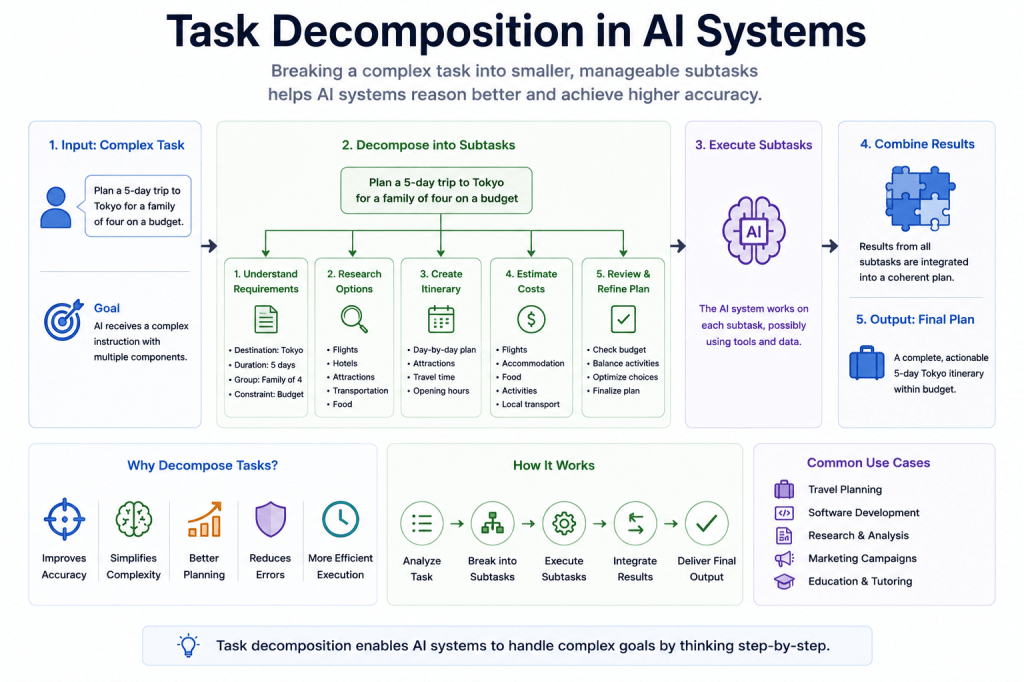
What Is Task Decomposition?
Task decomposition is the process of breaking a complex objective into:
- smaller subtasks,
- intermediate goals,
- or structured execution steps.
Instead of attempting to solve:
one massive problem directly,
the AI system divides the objective into:
- manageable reasoning units.
This allows systems to:
- reason incrementally,
- coordinate workflows,
- and execute tasks more reliably.
Task decomposition is closely related to:
- planning,
- reasoning,
- and hierarchical execution.
Why Task Decomposition Matters
Large tasks often overwhelm:
- short-context reasoning,
- planning systems,
- and reactive AI architectures.
Without decomposition, AI systems may:
- lose objectives,
- skip important steps,
- hallucinate workflows,
- or fail at long-horizon execution.
Task decomposition helps systems:
- organize reasoning,
- maintain structure,
- and improve execution reliability.
This becomes increasingly important for:
- autonomous agents,
- coding workflows,
- research systems,
- and enterprise orchestration.
A Simple Example
Imagine asking an AI system:
“Create a complete website about reasoning AI.”
Without decomposition:
- the task may be too broad and unstructured.
With decomposition, the system may create subtasks such as:
- Define website categories
- Create pillar pages
- Generate article topics
- Write foundational articles
- Create internal linking structure
- Design navigation
- Generate code examples
- Optimize SEO structure
This transforms:
one overwhelming objective
into:
structured executable tasks.
Reactive Execution vs Decomposed Execution
The distinction between these approaches is fundamental.
Reactive Systems
Reactive systems often:
- attempt immediate execution,
- without structured planning.
These systems may:
- skip steps,
- lose context,
- or behave inconsistently.
Decomposition-Based Systems
Decomposition systems instead:
- organize tasks hierarchically,
- structure workflows,
- and sequence execution logically.
This creates:
- more reliable,
- more scalable,
- and more autonomous reasoning systems.
Task Decomposition and Planning Systems
Task decomposition is one of the foundational mechanisms behind:
planning systems.
Planning architectures often:
- analyze objectives,
- divide goals into subtasks,
- prioritize actions,
- sequence execution,
- and revise workflows dynamically.
Without decomposition, planning systems struggle with:
- large objectives,
- adaptive coordination,
- and long workflows.
Related article:
Task Decomposition and Chain-of-Thought
Chain-of-Thought reasoning introduced:
- step-by-step reasoning.
Task decomposition extends this idea toward:
- workflow-level organization,
- hierarchical execution,
- and structured problem solving.
Instead of:
one reasoning chain,
the system creates:
coordinated reasoning modules.
Related article:
Task Decomposition and Tree-of-Thoughts
Tree-of-Thoughts architectures naturally support decomposition.
The system may:
- branch into subtasks,
- explore alternative plans,
- evaluate workflows,
- and organize execution hierarchically.
This improves:
- exploration,
- planning quality,
- and reasoning flexibility.
Related article:
Hierarchical Task Decomposition
Some systems use:
hierarchical decomposition.
This involves:
- high-level goals,
- intermediate subtasks,
- and low-level execution steps.
Example:
High-Level Goal
Build an AI research assistant
Mid-Level Tasks
- retrieval system
- planning system
- memory architecture
Low-Level Tasks
- database setup
- embedding generation
- API integration
Hierarchical decomposition improves:
- scalability,
- coordination,
- and workflow organization.
Dynamic Task Decomposition
Modern environments are often:
- uncertain,
- evolving,
- or unpredictable.
Static decomposition may fail when conditions change.
Dynamic decomposition systems instead:
- revise tasks continuously,
- adapt workflows,
- and restructure execution dynamically.
This creates:
- adaptive autonomous systems.
Task Decomposition and AI Agents
Task decomposition is one of the defining capabilities of modern AI agents.
Agents often need to:
- organize goals,
- coordinate subtasks,
- manage workflows,
- and execute long-horizon objectives.
Without decomposition, agents may:
- lose structure,
- repeat work,
- or fail at coordination.
Task decomposition helps agents:
- maintain focus,
- improve planning,
- and execute workflows reliably.
Related article:
Task Decomposition and Tool Calling
Decomposition often determines:
- which tools should be used,
- when to invoke them,
- and how workflows should be coordinated.
An agent may decompose a workflow into:
- retrieval tasks,
- coding tasks,
- verification tasks,
- and execution tasks.
Each subtask may involve:
- different tools,
- APIs,
- or reasoning systems.
Related article:
Task Decomposition and Multi-Agent Systems
Multi-agent systems frequently distribute subtasks across:
- specialized agents.
Examples:
- planner agents,
- coding agents,
- verifier agents,
- retrieval agents.
Task decomposition enables:
- specialization,
- parallelism,
- and collaborative reasoning.
Related article:
Task Decomposition and Reflection Systems
Reflection systems often analyze:
- failed subtasks,
- incomplete execution,
- or reasoning breakdowns.
Agents may:
- revise decomposition strategies,
- reorganize workflows,
- and improve planning dynamically.
This creates:
- adaptive task management systems.
Related article:
Task Decomposition and Memory Systems
Memory architectures help systems:
- track subtasks,
- maintain workflow state,
- and preserve execution continuity.
Without memory:
- decomposition structures may collapse during long workflows.
Memory improves:
- coordination,
- continuity,
- and long-horizon execution.
Related article:
Why Task Decomposition Improves Reliability
Decomposition reduces:
- cognitive overload,
- reasoning complexity,
- and execution instability.
Smaller subtasks are often:
- easier to verify,
- easier to reason about,
- and easier to coordinate.
This improves:
- planning quality,
- execution consistency,
- and autonomous reliability.
Challenges of Task Decomposition
Although powerful, decomposition introduces important challenges.
Potential problems include:
- incorrect decomposition,
- missing subtasks,
- workflow fragmentation,
- excessive orchestration,
- or coordination failures.
Over-decomposition may also create:
- unnecessary complexity,
- excessive tool calls,
- and increased latency.
This creates important engineering tradeoffs between:
- structure,
- flexibility,
- and efficiency.
Task Decomposition and Test-Time Compute
Decomposition often increases:
- inference steps,
- planning overhead,
- and orchestration complexity.
Instead of:
one reasoning pass,
the system may:
- analyze goals,
- generate subtasks,
- coordinate execution,
- and revise workflows dynamically.
This increases:
- computational cost,
- but often dramatically improves reliability.
Related article:
Emerging Trends in Task Decomposition
The field is evolving rapidly.
Modern systems increasingly explore:
- adaptive decomposition,
- recursive task planning,
- reasoning-aware workflows,
- multi-agent decomposition,
- and autonomous orchestration architectures.
Future AI systems may dynamically:
- restructure tasks,
- optimize workflows,
- and adapt execution hierarchies continuously.
Practical Applications
Task decomposition is increasingly important for:
- autonomous agents,
- coding systems,
- enterprise automation,
- scientific research,
- workflow orchestration,
- robotics,
- and intelligent operations systems.
Applications requiring:
- long-horizon execution,
- structured workflows,
- or adaptive planning
often depend heavily on decomposition systems.
Python Example: Simplified Task Decomposition Workflow
Below is a simplified conceptual example.
goal = "Build reasoning AI website"subtasks = decompose(goal)for task in subtasks: execute(task)review_results()
Real systems may involve:
- planning architectures,
- orchestration frameworks,
- memory systems,
- and multi-agent coordination layers.
Task Decomposition and the Future of AI
Task decomposition represents one of the foundational mechanisms behind autonomous reasoning systems.
The industry is increasingly moving from:
reactive prompt-response systems
toward:
structured AI systems capable of organizing, sequencing, and coordinating complex workflows autonomously.
This transition is influencing:
- reasoning architectures,
- enterprise AI,
- coding systems,
- robotics,
- and cognitive AI research.
Task decomposition is increasingly viewed as:
one of the foundational mechanisms behind scalable autonomous intelligence.
Related Concepts
- Planning Systems
- AI Agents
- Chain-of-Thought Reasoning
- Tree-of-Thoughts
- Reflection Systems
- Tool Calling
- Multi-Agent Systems
- Workflow Orchestration
- Deliberative Inference
- Memory Architectures
Continue Exploring
To continue exploring reasoning architectures, consider reading:
- Planning Systems in Autonomous AI
- What Are AI Agents?
- Tool Calling Explained
- Reflection Loops in AI Systems
- Multi-Agent Systems Explained
These concepts build directly on the foundations introduced by task decomposition systems.
👉 You can experiment with a practical Python implementation of this concept in the official GitHub repository for the Reasoning Systems examples: https://github.com/BenardoKemp/reasoningsystems/tree/main/agent-systems/task-decomposition-in-ai-systems
 Reasoning Systems