A Full Sequence-Based Reasoning Example with Code Breakdown
Neural networks become far more interesting when they process information as sequences instead of fixed numerical inputs.
In the previous example (“Teaching a Neural Network to Add Two Numbers with PyTorch (Full Working Example)“), we trained a model like this:
[10, 15] → 25
and generate another sequence:
"25"
In this article, we will build a complete PyTorch sequence model that learns addition character-by-character.
The model will:
- Read arithmetic expressions as text
- Encode the sequence internally
- Generate answers token-by-token
- Learn from examples using gradient descent
- Generalize to new arithmetic expressions
This introduces important concepts used in:
- Sequence models
- Encoder-decoder architectures
- GRUs and LSTMs
- Language models
- Chain-of-thought systems
- Neural reasoning architectures
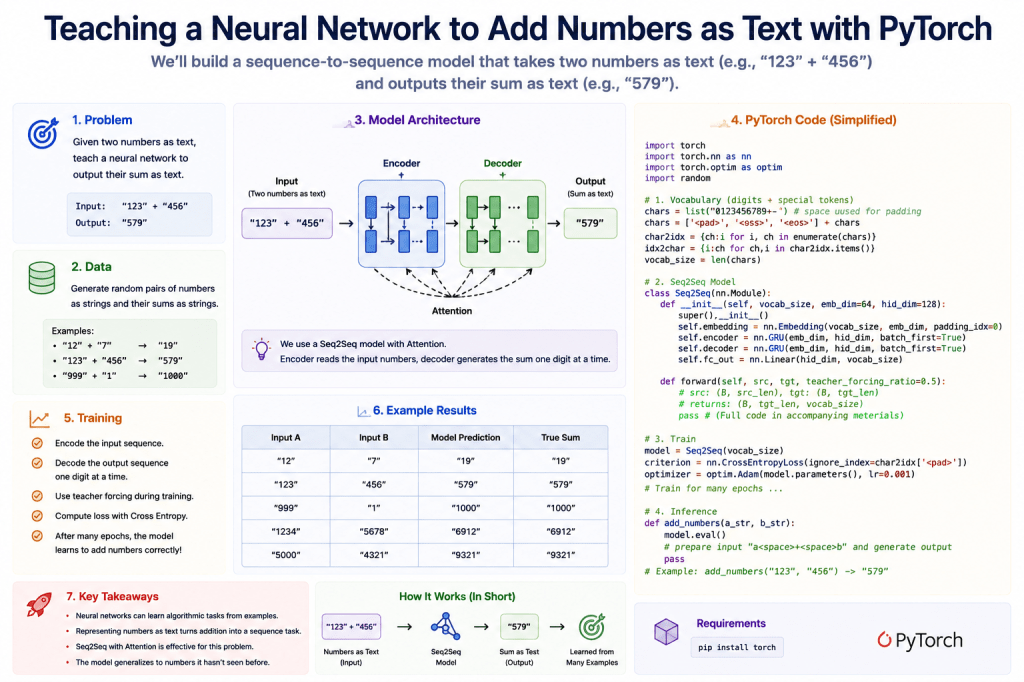
What We Are Building
We want the neural network to learn this transformation:
"12+7=" → "19"
Instead of directly supplying two numerical variables, we provide a sequence of characters.
The network must:
- Read the digits
- Understand the plus operator
- Maintain internal memory
- Generate the answer sequence
This is much closer to real-world AI reasoning systems.
Overall Architecture
The model follows a simple encoder-decoder structure:
Input Sequence ↓Character Embeddings ↓Encoder GRU ↓Hidden Representation ↓Decoder GRU ↓Generated Output Sequence
The encoder compresses the input expression into an internal representation.
The decoder then generates the answer one token at a time.
Mathematical View
The model learns a sequence transformation function:
where:
- = input tokens
- = output tokens
The hidden state evolves through time:
This hidden state acts as the model’s working memory.
Full Working Code
Save this as:
sequence_addition_reasoning.py
👉 You can experiment with a practical Python implementation of this concept in the official GitHub repository for the Reasoning Systems examples: https://github.com/BenardoKemp/reasoningsystems/tree/main/practical-python/sequence_addition_reasoning
Step-by-Step Code Breakdown
1. Creating the Vocabulary
The model cannot process raw text directly.
We must convert characters into token IDs.
tokens = [ "<PAD>", "<SOS>", "<EOS>", "0", "1", "2", ...]
Special tokens:
| Token | Purpose |
|---|---|
<PAD> | Padding shorter sequences |
<SOS> | Start of output sequence |
<EOS> | End of output sequence |
The mappings:
stoi
and
itos
convert between characters and integers.
2. Generating Training Examples
We randomly create arithmetic problems:
a = random.randint(0, MAX_NUMBER)b = random.randint(0, MAX_NUMBER)
Then convert them into text:
input_text = f"{a}+{b}="
Example:
"27+8="
The target becomes:
"35"
3. Encoding Sequences
Neural networks require numerical tensors.
Input text:
"27+8="
becomes something like:
[5, 10, 13, 11, 14]
The encoder transforms characters into integers.
4. Embedding Layer
The embedding layer converts token IDs into dense vectors.
self.embedding = nn.Embedding(...)
Instead of representing characters as simple integers, embeddings learn semantic representations.
This is the same principle used in language models.
5. GRU Encoder
The encoder reads the sequence one token at a time.
self.gru = nn.GRU(...)
The hidden state updates at every step:
The final hidden state summarizes the entire arithmetic expression.
6. Decoder
The decoder generates the answer token-by-token.
Example generation:
<SOS> → "1" → "9" → <EOS>
The decoder uses:
- previous generated token
- hidden memory state
to predict the next token.
7. Teacher Forcing
During training, we feed the correct previous token into the decoder.
decoder_input = target[:, t].unsqueeze(1)
This stabilizes learning.
Without teacher forcing, training becomes harder and less stable.
8. Cross Entropy Loss
The model predicts probability distributions over vocabulary tokens.
We optimize using:
nn.CrossEntropyLoss()
The objective:
Lower loss means better token predictions.
9. Backpropagation
The core learning step:
loss.backward()
PyTorch automatically computes gradients through time.
This process is called:
- Backpropagation Through Time (BPTT)
for recurrent sequence models.
10. Inference
After training, we test on unseen expressions.
Example:
predict("45+32=")
Possible output:
77
The decoder generates one character at a time until:
<EOS>
is produced.
Example Output
You may see results like:
Epoch 1/30, Loss: 1.9213Epoch 10/30, Loss: 0.1421Epoch 20/30, Loss: 0.0329Epoch 30/30, Loss: 0.0114Test Results--------------------3+4= predicted: 7 | actual: 710+15= predicted: 25 | actual: 2527+8= predicted: 35 | actual: 3545+32= predicted: 77 | actual: 7799+99= predicted: 198 | actual: 198
Why This Matters for AI Reasoning
This example introduces several foundational ideas behind reasoning systems.
The model:
- Maintains sequential memory
- Processes symbolic structures
- Generates outputs autoregressively
- Learns internal representations
- Handles variable-length inputs
These concepts directly relate to:
- Language models
- Transformers
- Neural reasoning systems
- Chain-of-thought prompting
- Agent architectures
Limitations of This Model
This is still a very small neural system.
It does not truly “understand” arithmetic symbolically.
Limitations include:
- Small training range
- Limited generalization
- Character-level processing only
- No attention mechanism
- No transformer architecture
However, it demonstrates the core mechanics clearly.
Possible Extensions
You can extend this project into:
More Operations
- subtraction
- multiplication
- division
Longer Numbers
Train on 5-digit or 10-digit arithmetic.
Transformer Architecture
Replace GRUs with transformers.
Chain-of-Thought Outputs
Generate intermediate reasoning steps:
12+7=12 plus 719
Token-Based Arithmetic
Move from characters to tokenizer-based inputs.
Final Thoughts
Sequence-based reasoning is one of the most important ideas in modern AI.
Even advanced reasoning models ultimately process information as ordered sequences.
This small PyTorch project demonstrates:
- sequence encoding
- recurrent memory
- autoregressive generation
- neural reasoning foundations
Understanding these mechanics makes larger AI systems far easier to understand.
 Reasoning Systems